



Non-Custodial Stationhouse Interrogations
Because warnings are only required prior to custodial interrogation, one way to minimize the adverse impact of Miranda on investigations is to try to conduct interrogations whenever possible in non-custodial settings.

As the Supreme Court has acknowledged, "Miranda warnings may inhibit persons from giving information." (Oregon v. Elstad) Every law enforcement officer has had the experience of losing an opportunity to obtain a possible confession because a suspect reacted to a Miranda warning by invoking his rights.
FBI statistics show that the national clearance rate for violent crimes plunged 28 percent after the Miranda decision, and it has never recovered. These facts mean that officers are not well-advised to give unnecessary Miranda warnings, risking the needless loss of a potential confession.
Because warnings are only required prior to custodial interrogation, one way to minimize the adverse impact of Miranda on investigations is to try to conduct interrogations whenever possible in non-custodial settings (such as at the suspect's home or on the street, without arrest-like restraints). A series of five Supreme Court rulings establishes that it is also possible to interrogate an un-arrested suspect at the police station without warnings, if the situation is handled properly.
Oregon v. Mathiason
Carl Ray Mathiason burglarized a residence. Some 25 days after the crime, the state patrol telephoned Mathiason and asked him to come to the patrol office to talk. Mathiason agreed and came to the station, where he was interrogated for an hour and a half. He was told that he was not under arrest, and no Miranda warnings were given. Mathiason made incriminating statements, after which he was allowed to leave. He was subsequently arrested and convicted. The Oregon Supreme Court reversed the conviction, ruling that Miranda warnings should have been given. The U.S. Supreme Court reversed this ruling and held that Mathiason had not been in custody during his voluntary stationhouse interview. The court explained its rationale as follows:
"Police officers are not required to give Miranda warnings to everyone whom they question. Nor is the requirement of warnings to be imposed simply because the questioning takes place in the stationhouse, or because the questioned person is one whom the police suspect. Miranda warnings are required only where there has been such a restriction on a person's freedom as to render him 'in custody.'" (Oregon v. Mathiason)
California v. Beheler
Jerry Lain Beheler helped his step-brother kill a woman over a drug deal. Later that evening, Beheler agreed to accompany police to the station for questioning about the crime. Officers told Beheler he was not under arrest and questioned him for about 30 minutes, without Miranda warnings. He made incriminating statements and was then allowed to go home. Five days later, he was arrested.
The California Court of Appeal reversed Beheler's murder conviction, holding that he was in custody during the stationhouse interrogation and should have been Mirandized. The state appealed to the U.S. Supreme Court.
Noting that the facts in Beheler were "remarkably similar" to those in Mathiason, the Supreme Court reversed the appellate decision and reinstated Beheler's conviction. The court said that no reasonable person in Beheler's position would have felt himself to be under arrest when he had been expressly advised that he was not, and when he came and went voluntarily without police restraints on his freedom.
As a result of the rulings in Mathiason and Beheler, it became a standard police practice in cases where the suspect was not a flight or safety risk to try to get the suspect to come to the station to be interviewed voluntarily, without arrest. Instead of a Miranda warning, the suspect would be given a "Beheler admonition," such as the following: "You're not under arrest. You're free to leave anytime you want. OK?" As long as the suspect was not subjected to any physical restraint or detained in the station, no Miranda warnings would be given, and statements would often result.
Some lower courts continued to resist the holdings in Mathiason and Beheler, and had to be corrected by the Supreme Court.
[PAGEBREAK]
Stansbury v. California
After a 10-year-old girl was kidnapped, raped, and murdered, sheriff's homicide investigators contacted Robert Edward Stansbury as a possible witness to her disappearance. Stansbury agreed to come in and he accepted a ride to the station in a patrol car. He was not given Miranda warnings before he gave answers that indicated he was the likely perpetrator, after which he was arrested.
Although the California Supreme Court believed Stansbury was in custody as soon as suspicion focused on him, the U.S. Supreme Court unanimously rejected this erroneous standard for determining custody. The court ruled that Stansbury's interrogation was not custodial, and Miranda did not apply to his stationhouse questioning prior to arrest.
Thompson v. Keohane
Alaskan hunters discovered the body of Dixie Thompson. ,Her husband Carl was asked by state troopers to come to the station, ostensibly to identify her things. In fact, the troopers already suspected Thompson of murder. He drove to the station, where troopers assured him he was not under arrest and then questioned him without warnings for two hours. Thompson admitted killing Dixie, but the troopers allowed him to leave the station. Two hours later, they arrested him.
Thompson was convicted of murder, and appeals took him to the U.S. Supreme Court. On a procedural issue, the court sent his case back to the Ninth Circuit Court of Appeals to decide the custody issue in light of the rulings in Mathiason, Beheler, and Stansbury. The lower courts then ruled that Thompson had not been in custody when he admitted the killing and did not need to have been Mirandized.
[PAGEBREAK]
Yarborough v. Alvarado
Seventeen-year-old Michael Alvarado helped Paul Soto carjack a truck. Soto shot and killed the driver, and Alvarado helped hide the gun. Once the investigation indicated Alvarado's involvement, a sheriff's homicide detective asked Alvarado to come to the station to be questioned. Alvarado's parents brought him in and waited in the lobby while a detective took him to an interview room. No Miranda warnings were given, but the detective repeatedly offered to take a break and she allowed Alvarado to leave with his parents after a two-hour interrogation, during which Alvarado made incriminating statements. He was arrested a few months later.
The Ninth Circuit Court of Appeals ordered Alvarado released from custody on writ of habeas corpus. That court ruled that a minor should be deemed to be in custody and entitled to Miranda warnings even at a voluntary stationhouse interrogation. The U.S. Supreme Court reversed that ruling and reinstated Alvarado's murder conviction. The court repeated that unless the suspect is formally arrested or restrained to a comparable degree, there is no Miranda custody, even in a police station.
Avoiding Custody
As these cases show, a suspect can be questioned in a police setting without Miranda warnings where several of the following factors indicate a lack of arrest or restraint (a case with all of them would be even stronger):
The suspect agrees to talk and brings himself in.
A "Beheler admonition" is given.
No restraints or threats of detention or arrest are used.
The suspect is questioned for an hour or two, with breaks offered.
The suspect is allowed to leave and is arrested sometime later.
Devallis Rutledge is a former police officer and veteran prosecutor who currently serves as Special Counsel to the Los Angeles County District Attorney. He is the author of 11 books, including "Courtroom Survival, The Officer's Guide to Better Testimony."
More Patrol

Adept Armor Introduces Two New Rifle Plates
Adept Armor has launched two new Level IV ballistic plates, the Emperor and the Archon Mark 2, which brings Adept Armor’s new Quatroid ceramic to the high-threat, performance-value center of the range at 5.2 pounds.
Read More →
POLICE Product Test: Benchmade Bailout
The Benchmade Bailout is a slim, lightweight carry knife with a deep-ride pocket clip and comes in a variety of blade steels and scales. Here is a detailed review of the Taiga Green Bailout, released earlier this year.
Read More →
NLEOMF Announces July 2026 Officer of the Month
NLEOMF honored a Michigan deputy sheriff as the July 2026 Officer of the Month for rescuing a trapped driver from a burning vehicle following a Fourth of July crash.
Read More →
Streamlight to Showcase Newest Lighting Products at National Safety Council’s Safety Congress & Expo 2026
Streamlight will showcase its latest lights, including the Portable Scene Light III and the LiteBox 1Million, at the 2026 National Safety Council (NSC) Safety Congress & Expo.
Read More →
The 2027 World Police & Fire Games Set for Perth, Australia
The 2027 World Police & Fire Games (WPFG) will take place in Perth, Western Australia, from Friday, March 12 through Sunday, March 21, 2027.
Read More →
5.11 Partners with National Fallen Firefighters Foundation to Support #ForThe343
5.11 has joined the nationwide movement honoring the 343 New York City Fire Department firefighters lost on Sept. 11, 2001.
Read More →
Team Wendy Announces Title Sponsorship of the Jorge Pastore Foundation
Team Wendy’s 3-year partnership with the Jorge Pastore Foundation expands access to programs that strengthen those who serve.
Read More →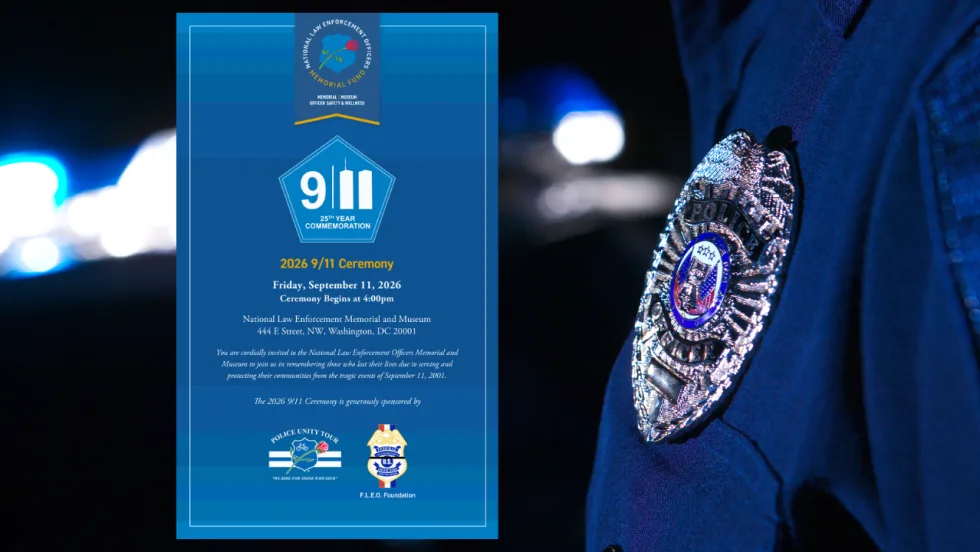
National Law Enforcement Memorial and Museum Hosting 9/11 25th-Year Commemoration Ceremony
The National Law Enforcement Memorial and Museum is hosting a 9/11 25th Year Commemoration Ceremony on Sept. 11 at 4 p.m.
Read More →
National Law Enforcement Officers Memorial Fund Announces June 2026 Officers of the Month
The National Law Enforcement Officers Memorial Fund (NLEOMF) named 15 officers of the Chico Police Department (California) as the Officers of the Month for June 2026 for their roles in responding to an active-shooter incident at a public library.
Read More →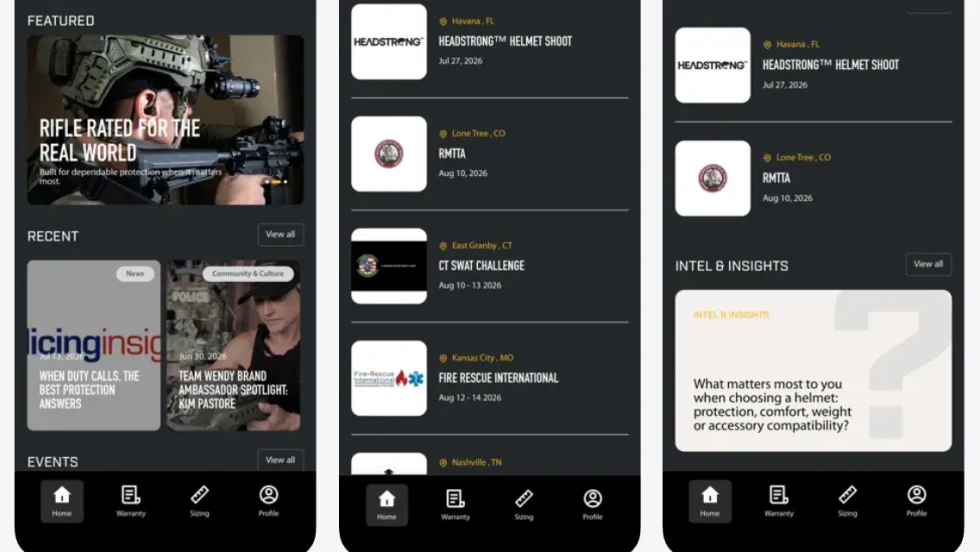
Team Wendy App Creates New Digital Hub for Helmet Owners
The Team Wendy Community App provides one location for warranty registration, size-fit tools, product updates, and community connection. For helmet owners, the new app creates a simpler path to the information and tools that matter most.
Read More →