



My Technology Can...Give You Real-Time Aerial Visibility
Cape's Aerial Telepresence platform allows agencies to send drones to calls to gain valuable intelligence before officers arrive on scene.

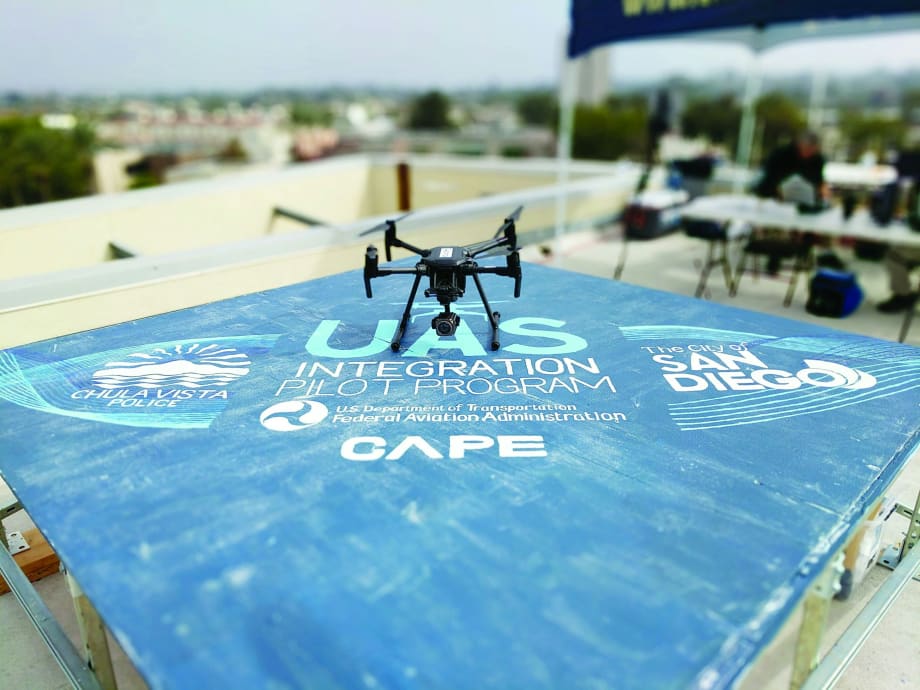
Cape's pilot program with the Chula Vista (CA) Police Department involves using drones not in the pilot's line of sight.
Photo: Cape
Drones are transforming the way public safety agencies operate and make decisions, providing increased situational awareness and real-time intelligence. As the world's first cloud software for full drone telepresence and data management, Cape (www.cape.com) enables complete remote aerial visibility, giving organizations including public safety agencies the real-time information needed to make quick and accurate decisions, and improve the safety of their officers and the communities they serve.
The Problem
In a recent study we conducted at Cape, we found that Americans have increasingly high standards when it comes to public safety agencies keeping them safe and responding to their needs. A total of 93% expect law enforcement to be present and highly visible in their communities, and 89% expect law enforcement and first responders to reach them quickly when they call for help.
Because of such increasing expectations from civilians, there is a critical need to invest in tools and technology that meet rising demands when it comes to keeping the public safe. In fact, 84% of Americans expect their local law enforcement and first responders to leverage the best technology for ensuring public safety.
However, real-time visibility has been difficult to achieve because of a variety of resource constraints. Physical limitations such as distance and terrain can make operations difficult. Additionally, agencies often lack the needed resources and internal experts vital to maintaining constant visuals on situations and are forced to do more with less, potentially compromising safety and valuable time. With limitations on the time and money required to quickly and effectively cover needed ground, including bringing in outside resources and equipment such as helicopters for overhead visibility, there have been several challenges that put agencies in a tight spot when the right resources and support are needed most.
Beyond physical and resource constraints, a lack of aerial visibility puts first responders at risk in potentially dangerous situations. Emergency calls are made during traumatic situations, meaning callers provide limited detail and insight into what's happening at the scene. With such little insight, it's difficult to determine which situations require additional response, or the best resources to deploy until it's too late. Without real-time visibility, first responders are left walking into unknown situations without a clear picture of present dangers or how to best approach the situation.
Additionally, while community concerns have presented challenges in the past, our research shows Americans are ready to embrace drones as a tool for public safety. Over 70% of consumers support the use of drones by law enforcement in their community and 62% explicitly say they would feel safer if local first responders used drones to protect their communities.
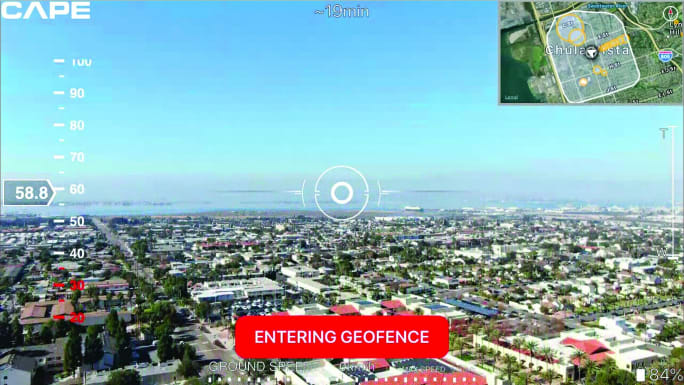
Law enforcement agencies can use Cape's cloud platform to transmit aerial views of a scene from the drone to officers at other locations.
Photo: Cape
The Solution
Cape is the leading cloud platform for drone telepresence and data management. The Cape Aerial Telepresence platform gives agencies a safe, easy, and secure tool for enabling aerial visibility and intelligence. Using Cape-enabled drones, not only is full aerial visibility possible, but deployment is fast, easy, and safe. The Cape Aerial Telepresence software easily integrates with off-the-shelf drone hardware and comes equipped with safeguards such as user-defined automation and geofencing built into the platform to ensure easy and safe operations.
Once the drone is in flight, users can log into the platform on any connected device such as smartphones and tablets and take full control of the drone to capture high-resolution video and 4K quality images. Additionally, users can also remotely and simultaneously view the live stream in real time with up to 50 authorized users using industry-best low latency.
Through the Cape Cloud, the Cape Aerial Telepresence platform easily integrates with both existing applications like CAD systems and additional drone hardware to give agencies 360-degree visibility and intelligence, which enables faster and more data-driven decisions. Data such as flight history and paths flown, drone IDs for maintenance records, and collected images and video are easily and securely stored on private portals through the Cape Cloud, giving officers the ability to save and review data to collect additional insights and learnings. The Cape Cloud offers the same level of security protocols used for activities like online banking and the portals are never exposed to external networks, ensuring all data collected is easy to access by authorized users while also remaining private and secure.
Using Cape-enabled drones, agencies can quickly get eyes on situations, better respond with the right resources, and reduce response times. Through aerial intelligence, internal experts can easily access the platform and, in real time, see the situation at hand, share tactical and situational awareness with responding officers, and make quick and accurate decisions regardless of whether they're in the field or not. Additionally, with constant eyes on situations, agencies can accurately and efficiently deploy the right resources when responding and can even help clear calls for service and keep ground units free for higher priority calls. For assisting officers and first responders, aerial visualization and real-time data can significantly improve situational awareness, helping better address situations, improve outcomes, identify criminals, support victims, and ultimately save lives.
Case Study
In October 2018 as part of the San Diego Unmanned Aircraft Systems (UAS) Integration Pilot Program (IPP), the Chula Vista Police Department and Cape launched the nation's first Drone as a First Responder program, integrating drones equipped with Cape Aerial Telepresence technology into daily emergency response operations.
Traditionally, teams leveraged drones in much more limited and one-off situations—where designated drone officers drive a car to the location, launch and navigate a single drone relaying information via phone or radio to the responding teams or commanding officers. Today, the Chula Vista PD and Cape are pioneering a totally new approach and unlocking the full potential of drones for public safety agencies with their Drone as a First Responder program proactively leveraging Cape-enabled drones as true first responders for emergency situations.
Since the debut of the Drone as a First Responder program (DFR), drones equipped with the Cape Aerial Telepresence platform have been dispatched to high-priority calls in close proximity to the CVPD's headquarters, which is one of the heaviest call zones in the city. After launching the drone from the roof of police headquarters to the scene, the designated pilot in the command center can control and manipulate the drone in order to gain the exact visibility needed. With the drone typically arriving on the scene well before responding officers, the command center can better identify and dispatch needed resources to the scene. Responding officers can also view the live stream en route to the scene, giving them full visibility of the situation they are walking into.
For CVPD, the drones have been critical to increasing situational awareness, the safety of officers, and the safety of the surrounding community. In just five months of active drone deployment, CVPD has integrated the drones into daily emergency response operations, and has flown 322 flights to date. The drone has contributed to 44 arrests.
As a testament to Cape's and CVPD's success with the DFR program, the Federal Aviation Administration (FAA) has granted the first public safety Certificate of Authorization (COA) with Beyond Visual Line of Sight (BVLOS) provision for an Integrated Pilot Program that will allow for proactive emergency response. The provision promises to drastically increase the level of success in Chula Vista, and lay the groundwork for future drone integration into public safety operation.
For more information about Cape, visit www.cape.com.
Chris Rittler is CEO of Cape.
More Technology

A police agency's guide to data-driven fleet management
Costs are rising and the public expects more transparency into how their tax dollars are spent. This e-book shows how police agencies can use fleet data to take control of fleet expenses while improving officer safety and demonstrating fiscal responsibility to the communities they serve.
Read More →
AI and analytics for law enforcement: Turning data into insights
Law enforcement agencies are managing more video, sensor data and digital evidence than ever before. Discover how AI and analytics can help turn that data into actionable insights that strengthen situational awareness, accelerate investigations and support more informed decisions.
Read More →
Vasco Electronics Adds Automatic Language Detection to Vasco Translator Q1
Vasco Electronics’ software update introduces hands-free language switching and expanded offline translation across 45 language pairs, empowering law enforcement, healthcare, and front-office enterprise teams
Read More →
North Miami Police Department Deploys Mark43
The North Miami Police Department has deployed Mark43 as part of its Five-Year Strategic Plan that represents its collective vision and goals for a more proactive police department, anchored by a core commitment to leveraging modern technology to enhance efficiency and public safety.
Read More →
Cellebrite Genesis for Enterprise Now Generally Available
Made available to the public sector in June, Cellebrite Genesis is serving a growing mix of national, regional, and local agencies worldwide, including some of the largest regional and metropolitan police departments. It is now available for enterprise organizations.
Read More →
2026 Vision FirstNet Users Summit to Host Emerging Leaders Training on Grassroots Advocacy for Public Safety
“Emerging Leaders Training: Understanding the Importance of Grassroots Advocacy for Public Safety," a session during the 2026 Vision FirstNet Users Summit, will offer a roadmap for unified advocacy at the federal level.
Read More →
Motorola Solutions Completes Acquisition of D-Fend Solutions
Motorola Solutions has acquired D-Fend Solutions, an industry leader in counter-drone technology. This deal provides public safety and enterprise customers with access to advanced counter-unmanned aerial systems.
Read More →
ZeroEyes, Advantech & Camden Police Partner to Bring AI Gun Detection Technology to Delaware School District
ZeroEyes has partnered with Advantech and the Camden Police Department to deploy ZeroEyes’ AI gun detection and intelligent situational awareness platform at Delaware’s Caesar Rodney School District (CRSD).
Read More →
Leonardo U.S. Cyber & Security Solutions Introduces SignalTrace, the Next Evolution in Electronic Signature Detection Technology
SignalTrace reflects years of product refinement and a clearer expression of the technology’s purpose of recognizing and correlating electronic signatures in publicly broadcast wireless signals to reveal patterns, relationships, and trends that might otherwise go undetected.
Read More →
Pimloc Launches Secure File Sharing to Streamline Release of Redacted Video
Pimloc’s Secure File Sharing lets organizations deliver redacted video, audio, and documents through expiring, passcode-protected links, accelerating delivery while reducing security, compliance, and chain-of-custody risks.
Read More →