



My Technology Can…Automate Body-Worn Camera Reviews
Truleo’s body camera data review solution can help agencies learn more about officer performance, both good and bad.

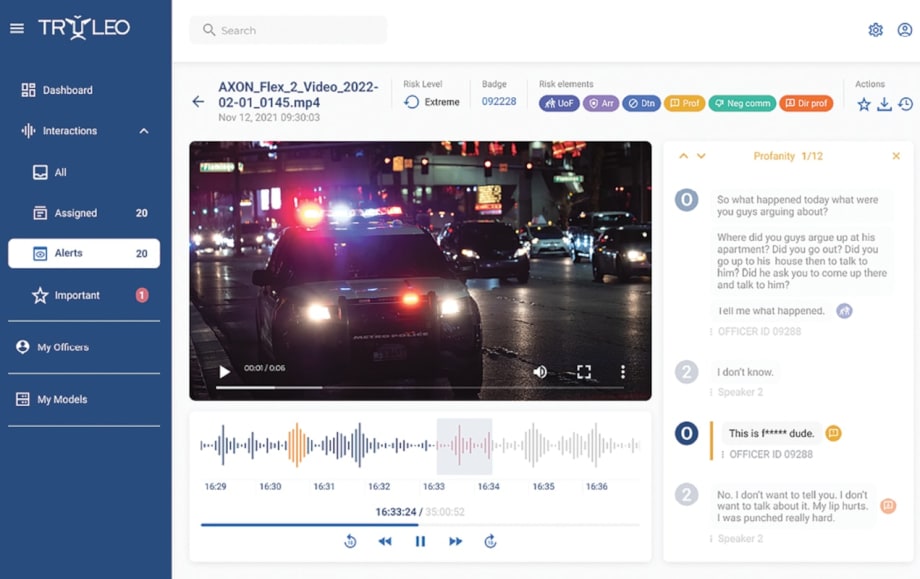
Truleo is an automated body-worn camera review and analysic platform. Using Natural Language Processing (NLP), Truleo can process 100% of a law enforcement agency’s body camera files in near real time and provide insights into how the agency’s officers are performing, both good and bad, when interacting with the community.
Not long ago body-worn cameras (BWC) were considered groundbreaking, and agencies that first implemented them were seen as leading-edge “early adopters.” Now, they have become so ubiquitous that agencies without them are looked at as being behind the times. Several states now mandate that all law enforcement agencies deploy BWCs on their officers.
Early on, body cams were only deployed with officers working in field assignments, but we are now seeing them become more commonplace in correctional facilities as well. There’s no doubt BWCs in law enforcement are here to stay. And while they have enhanced the profession in many ways, they have also created some challenges for the agencies that implement them.
The Problem
Body-worn cameras have been beneficial for law enforcement in many ways. They have helped dispel false complaints of police misconduct, improved administrative investigations, provided key evidentiary support in criminal investigations, and given a measure of transparency with the community.
But they have also placed an administrative burden on agencies. As with any department-wide program, effective management and maintenance is key. Depending on the size of the agency, this could involve a team of sworn and/or non-sworn staff members or, at minimum, a collateral assignment for an officer. Agencies must consider these staffing hours as an additional cost to their body cam program.
Another cost that sometimes isn’t considered or discussed is data storage. Body-worn cameras generate huge amounts of data that needs to be preserved somewhere—either on premises or in the cloud. Often, it’s not the cameras that are expensive. The big cost is the data storage that is needed to maintain the evidence.
Agencies are paying to store all this BWC data, and yet they do very little with it. While it is true that these videos can help with criminal and administrative investigations, the reality is that less than 1% of the videos are ever reviewed by the agency, which is a missed opportunity for leadership to gain insight into the performance of their officers.
Although we often see poor performance by officers captured on BWCs and subsequently publicized, conversely, and much more frequently, there are some fantastic interactions between officers and the community that go unrecognized. There are thousands of professional, courteous, and empathetic encounters exemplifying the best of the law enforcement profession that are captured on body-worn cameras and are never seen by the public.
So how do agencies discover good officer performance and bad officer performance captured on body camera video? Industry best practice is to conduct audits of videos as part of a BWC program and early identification system, but this presents a challenge for many agencies. Amid severe recruiting and retention difficulties, as well as rising crime rates, department leadership is faced with the choice of diverting valuable human resources to conducting reviews—either full-time or as a collateral duty—or doing fewer (if any) reviews.
The Solution
My company’s product, Truleo, is an automated body-worn camera review and analysis platform. By leveraging Natural Language Processing (NLP), our technology can process 100% of an agency’s BWC videos in near real-time and provide insights into police-community interactions.
The process works like this:
1. Officers upload their cameras to the agency’s digital evidence management system just as they normally would. No extra steps are needed.
2. Truleo streams the data via an API to our GovCloud-hosted service.
3. The audio is extracted, translated to a written transcript, and analyzed by our proprietary NLP models, which are built by police for police—all within a CJIS compliant environment
4. All data (audio, video, transcripts) and analyses are presented back to the user within the Truleo Scope application.
Through the Scope application, agencies can see the videos that represent the highest risk to the officers and the organization. By identifying elements in the interactions related to detentions, arrests, uses of force, pursuits, and profanity, we assign a risk score to each file. Those files that are highest risk are then surfaced for review by the agency.
The automation of BWC reviews solves several problems for law enforcement agencies. It frees up staff who are conducting these reviews manually to address higher priority assignments, and ensures their valuable time is used only for incidents that need human review.
Our review process also helps identify problems much earlier than traditional early warning systems and solutions. Problematic encounters can be addressed with the officer the very next shift so that timely training and coaching can be administered, helping officers improve and have longer, healthier careers.
Additionally, there is some level of expectation from the community that agencies with a BWC program are reviewing videos. The magnitude of data that is produced, however, makes that near impossible. By automating the process, agencies can confidently tell their community stakeholders that they are reviewing all the interactions between their officers and the community they serve.
Although it’s important to surface risk and address substandard performance, it is just as important to recognize exemplary conduct and measure professionalism. Our model for professionalism allows agencies to see which officers are exhibiting empathy, gratitude, formality (sir, ma’am, Mr., Ms.), asking questions, and providing explanations.
The insights provided by Truleo Scope give agencies the data to show what those of us who are, or have been, in the profession instinctively know: Most interactions between the police and community are neutral/positive and professional, and very few are problematic.
Case Study
The Seattle Police Department is an early customer of Truleo body-worn camera review solution.
“Truleo has allowed us to reshape how we evaluate quality assurance and risk management, and we’re eager to continue our relationship with them,” said Loren Atherley, director of performance, analytics and research for Seattle PD. “As new technologies emerge to help agencies realize the promise of body worn video data, we have been very pleased with early results.”
Chris Sansone is the director of strategic partnerships at Truleo and a former lieutenant with the Oakland Police Department, where he served for 23 years.
More Technology

A police agency's guide to data-driven fleet management
Costs are rising and the public expects more transparency into how their tax dollars are spent. This e-book shows how police agencies can use fleet data to take control of fleet expenses while improving officer safety and demonstrating fiscal responsibility to the communities they serve.
Read More →
AI and analytics for law enforcement: Turning data into insights
Law enforcement agencies are managing more video, sensor data and digital evidence than ever before. Discover how AI and analytics can help turn that data into actionable insights that strengthen situational awareness, accelerate investigations and support more informed decisions.
Read More →
Vasco Electronics Adds Automatic Language Detection to Vasco Translator Q1
Vasco Electronics’ software update introduces hands-free language switching and expanded offline translation across 45 language pairs, empowering law enforcement, healthcare, and front-office enterprise teams
Read More →

North Miami Police Department Deploys Mark43
The North Miami Police Department has deployed Mark43 as part of its Five-Year Strategic Plan that represents its collective vision and goals for a more proactive police department, anchored by a core commitment to leveraging modern technology to enhance efficiency and public safety.
Read More →
Cellebrite Genesis for Enterprise Now Generally Available
Made available to the public sector in June, Cellebrite Genesis is serving a growing mix of national, regional, and local agencies worldwide, including some of the largest regional and metropolitan police departments. It is now available for enterprise organizations.
Read More →
2026 Vision FirstNet Users Summit to Host Emerging Leaders Training on Grassroots Advocacy for Public Safety
“Emerging Leaders Training: Understanding the Importance of Grassroots Advocacy for Public Safety," a session during the 2026 Vision FirstNet Users Summit, will offer a roadmap for unified advocacy at the federal level.
Read More →
Motorola Solutions Completes Acquisition of D-Fend Solutions
Motorola Solutions has acquired D-Fend Solutions, an industry leader in counter-drone technology. This deal provides public safety and enterprise customers with access to advanced counter-unmanned aerial systems.
Read More →
ZeroEyes, Advantech & Camden Police Partner to Bring AI Gun Detection Technology to Delaware School District
ZeroEyes has partnered with Advantech and the Camden Police Department to deploy ZeroEyes’ AI gun detection and intelligent situational awareness platform at Delaware’s Caesar Rodney School District (CRSD).
Read More →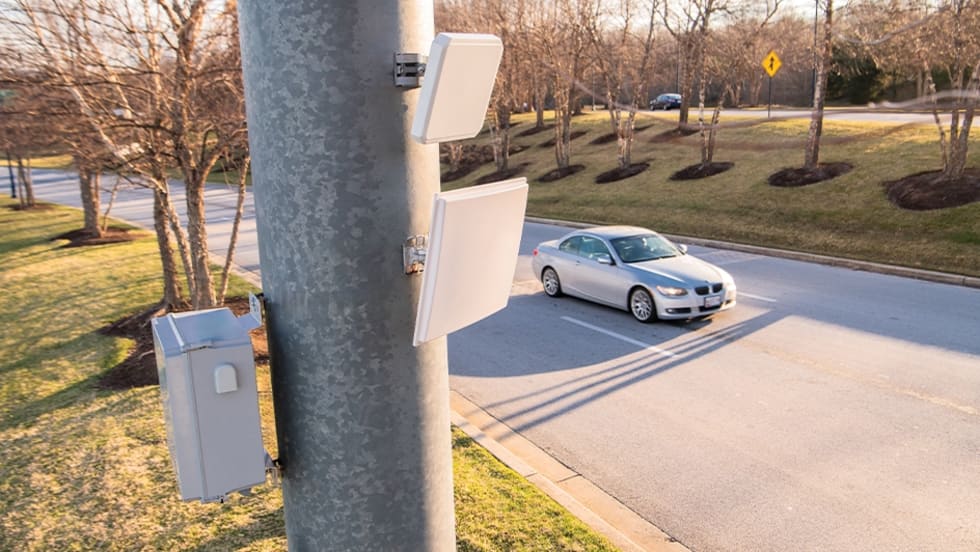
Leonardo U.S. Cyber & Security Solutions Introduces SignalTrace, the Next Evolution in Electronic Signature Detection Technology
SignalTrace reflects years of product refinement and a clearer expression of the technology’s purpose of recognizing and correlating electronic signatures in publicly broadcast wireless signals to reveal patterns, relationships, and trends that might otherwise go undetected.
Read More →
Pimloc Launches Secure File Sharing to Streamline Release of Redacted Video
Pimloc’s Secure File Sharing lets organizations deliver redacted video, audio, and documents through expiring, passcode-protected links, accelerating delivery while reducing security, compliance, and chain-of-custody risks.
Read More →