



Mobile Print ID
Though mobile fingerprint technology has been in use in law enforcement for nearly a decade, continued enhancements are making the technology viable for agencies of all sizes.

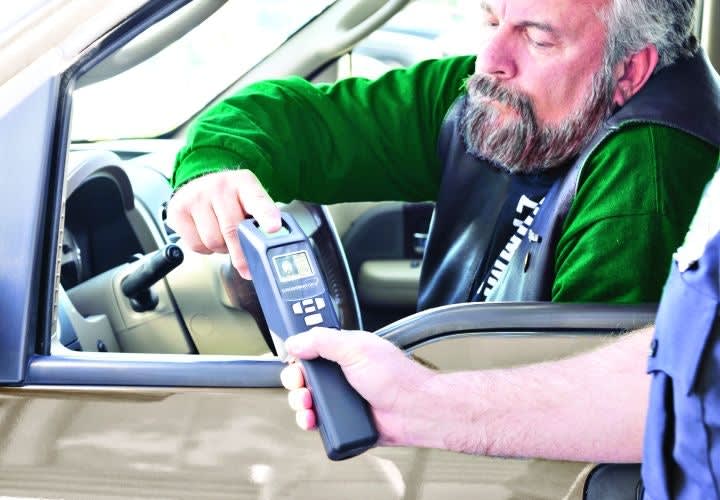
Photo: Crossmatch
As a state trooper approached a vehicle during a routine traffic stop, he likely imagined things would follow a typical course. Driving with his headlights off would have earned the driver a citation—or perhaps just a warning—and a "be more careful and have a nice night." But as the driver handed the trooper a South Carolina driver's license, the alert trooper noticed the driver also possessed a bank card bearing a different name.
Using a Mobile ID system, the trooper collected a fingerprint sample from the driver and submitted the print to the state's database, which also forwarded a query to the FBI's Repository for Individuals of Special Concern (RISC) database to check for a match. Within seconds, the trooper received a "red" response—a highly probably match with an active warrant. The driver was wanted in Georgia in connection with a murder and aggravated assault—a warrant that had been outstanding for more than eight years.
The trooper, now taking proper precautions in dealing with a possibly dangerous suspect, was able to safely take the driver into custody. Thanks to Mobile ID technology, this state trooper was able to turn a routine traffic stop into the successful apprehension of a possible murderer and removal of a potentially violent public safety threat.
Stories like this one are becoming more and more common, though no less powerful, as the deployment of Mobile ID technology virtually explodes across law enforcement agencies in the U.S.
Enhanced Functionality
Though mobile fingerprint technology has been in use in law enforcement for nearly a decade, continued enhancements are making the technology viable for agencies of all sizes. The devices themselves are now more compact and lighter, often weighing slightly over a pound, making them very convenient for in-the-field use. The technology driving the devices has also continued to improve, including wireless connectivity, extended battery life, and expanded memory capacity. All of this adds up to more precise scanning, faster searching, and more reliable match results. Finally, the cost of these new solutions now makes the technology accessible for both large-scale deployment and small law enforcement agencies.
Behind the scenes, the databases these devices search have expanded. In 2011, the FBI launched its Repository for Individuals of Special Concern (RISC) database. The RISC database is a subset of the criminal fingerprint records in the FBI AFIS database—a type of "most wanted" list, containing fingerprint records of terrorists, violent criminals, child molesters, and other criminals designated as Individuals of Special Concern. One of the chief reasons for the development of this list was to create an optimized, quickly searchable list of the nation's most dangerous and concerning criminals for in-the-field agents using Mobile ID systems. Today, the RISC database can return results in just 10 seconds.
Recognizing the value of the FBI RISC database, the model has been copied by many states. Some have honed their targeted lists even further, often including just the index and middle finger (those most likely to yield prints in the field) to further enhance the speed of match searching in the field.
Game-changing Technology
Today's widespread use of these enhanced Mobile ID devices is truly changing the game for law enforcement in a number of critical ways. Perhaps the most common use case involves an officer making contact with an individual who lacks proper identification. Rather than bringing the individual into the station to fingerprint—a process that can take the officer off the street for several hours—the Mobile ID system allows prints to be collected on the spot.
The prints are then relayed from the fingerprint-scanning device to the officer's Android mobile device or an in-car mobile data terminal, and passed on to both the state criminal database and the FBI RISC database to search for a match. Thanks to the combination of faster technology and targeted databases, officers can count on a response in less than two minutes, at which point they can reliably ascertain if the individual has an active warrant.
Mobile ID systems are also becoming popular in identifying bodies in death investigations. Previously, unidentified bodies were fingerprinted at the morgue—with law enforcement officials often waiting up to 48 hours to get match results and begin their death investigation in full. Mobile ID systems allow unidentified bodies to be fingerprinted and run against existing databases right at the scene, enabling the investigation to begin immediately. In suspicious deaths, this "head-start" on the investigation can be a tremendous advantage.
Among the many other use cases, law enforcement officials are using Mobile ID systems to ensure that warrants are served to the correct individuals. The importance of this is largely self-evident, but law enforcement agencies note that this also protects them from legal liabilities and litigation stemming from wrongful arrest.
Key Benefits of Mobile ID
Between 2000 and 2009, 584 officers were killed by known offenders, according to the DOJ's 2009 LEOKA. Mobile ID systems promote officer safety. They enable officers to identify dangerous individuals immediately in the field and to take proper safety precautions in their interactions with these individuals.
As previously mentioned, in the event of contact with an individual lacking proper identification, Mobile ID systems improve productivity by enabling officers to quickly collect fingerprints and check the prints against state and federal databases. And all of this can be done from the field, with match results returned in less than two minutes.
This maximized officer productivity ensures that officers can remain on the street, protecting their communities. The simplicity of identifying individuals without proper identification means that officers are much more likely to obtain and search prints for these individuals. This significantly decreases the likelihood that wanted and/or dangerous individuals will be unknowingly let go.
Key Considerations for Agencies
As more and more law enforcement agencies look to deploy Mobile ID systems, there are two key considerations to ensure maximal benefit: fingerprint capture quality and ease of use.
The fingerprint scanners on Mobile ID devices vary greatly in terms of the print area scanned and the quality of the image captured. Reduced fingerprint capture area and the resulting loss of minutia reference points can lead to poor matching and false returns. In practice, this means that a wanted and/or dangerous individual could fail to be identified by poor prints, putting the officer and the public at risk. The scan area is defined as the device's Fingerprint Acquisition Profile (FAP). Not surprisingly, better sensors with higher FAP levels produce more accurate search results. In fact, a 2014 study by the National Institute of Standards and Technology (NIST) showed that a FAP10 sensor failed to identify its target approximately twice as often as a FAP20 or FAP30 sensor. For this reason, industry experts favor FAP30, or the capture of multiple fingers with FAP10, for more reliable accuracy.
Mobile ID systems are designed for in-the-field use, but the simplicity of operation can vary greatly. Devices that allow singlehanded operation enable an officer to retain a free hand; simple-to-use user interfaces mean faster print collection. These ease-of-use characteristics clearly enhance officer productivity, but they also play a critical role in ensuring officer safety. Instead of being physically and mentally tied up by a complicated device, a simple interface allowing singlehanded operation allows an officer to retain both a free hand and maintain situational awareness.
Functionality Continues to Evolve
Mobile ID technology is on its way to becoming the standard for in-the-field law enforcement officials, but the technology driving these devices continues to evolve. New all-in-one devices with 3G/4G LTE "smart" connectivity remove tethering dependencies to patrol cars, thereby maximizing device use flexibility. Developments such as this promise to lead not only to better functionality across existing use cases, but to create new applications for the technology—and to further support the safety of officers and the communities they serve.
Frank Fernandez is the market manager for law enforcement products at Crossmatch.
More Technology
A police agency's guide to data-driven fleet management
Costs are rising and the public expects more transparency into how their tax dollars are spent. This e-book shows how police agencies can use fleet data to take control of fleet expenses while improving officer safety and demonstrating fiscal responsibility to the communities they serve.
Read More →
AI and analytics for law enforcement: Turning data into insights
Law enforcement agencies are managing more video, sensor data and digital evidence than ever before. Discover how AI and analytics can help turn that data into actionable insights that strengthen situational awareness, accelerate investigations and support more informed decisions.
Read More →
Vasco Electronics Adds Automatic Language Detection to Vasco Translator Q1
Vasco Electronics’ software update introduces hands-free language switching and expanded offline translation across 45 language pairs, empowering law enforcement, healthcare, and front-office enterprise teams
Read More →

North Miami Police Department Deploys Mark43
The North Miami Police Department has deployed Mark43 as part of its Five-Year Strategic Plan that represents its collective vision and goals for a more proactive police department, anchored by a core commitment to leveraging modern technology to enhance efficiency and public safety.
Read More →
Cellebrite Genesis for Enterprise Now Generally Available
Made available to the public sector in June, Cellebrite Genesis is serving a growing mix of national, regional, and local agencies worldwide, including some of the largest regional and metropolitan police departments. It is now available for enterprise organizations.
Read More →
2026 Vision FirstNet Users Summit to Host Emerging Leaders Training on Grassroots Advocacy for Public Safety
“Emerging Leaders Training: Understanding the Importance of Grassroots Advocacy for Public Safety," a session during the 2026 Vision FirstNet Users Summit, will offer a roadmap for unified advocacy at the federal level.
Read More →
Motorola Solutions Completes Acquisition of D-Fend Solutions
Motorola Solutions has acquired D-Fend Solutions, an industry leader in counter-drone technology. This deal provides public safety and enterprise customers with access to advanced counter-unmanned aerial systems.
Read More →
ZeroEyes, Advantech & Camden Police Partner to Bring AI Gun Detection Technology to Delaware School District
ZeroEyes has partnered with Advantech and the Camden Police Department to deploy ZeroEyes’ AI gun detection and intelligent situational awareness platform at Delaware’s Caesar Rodney School District (CRSD).
Read More →
Leonardo U.S. Cyber & Security Solutions Introduces SignalTrace, the Next Evolution in Electronic Signature Detection Technology
SignalTrace reflects years of product refinement and a clearer expression of the technology’s purpose of recognizing and correlating electronic signatures in publicly broadcast wireless signals to reveal patterns, relationships, and trends that might otherwise go undetected.
Read More →
Pimloc Launches Secure File Sharing to Streamline Release of Redacted Video
Pimloc’s Secure File Sharing lets organizations deliver redacted video, audio, and documents through expiring, passcode-protected links, accelerating delivery while reducing security, compliance, and chain-of-custody risks.
Read More →