



Making More Comfortable Body Armor
The latest ballistic materials for bullet-resistant vests and plates offer wearers the same or better protection with lighter weight and improved flexibility.

There was a time when it was not uncommon for people to refer to all soft body armor as Kevlar. Maybe some veteran cops in your agency still do. The reason for this is that DuPont’s Kevlar was the first truly effective bullet-resistant fabric.
Today, there are many bullet-resistant woven and non-woven materials that are used in soft body armor. These include materials from DuPont, Dyneema, Honeywell, Teijin Twaron, and other companies. Often your vest uses multiple materials to protect you. For example, one material might excel at stopping the bullet, and the other material might help dissipate its energy to reduce the trauma you experience from the impact.
Last year two of the leading makers of bullet resistant fabrics, Avient (Dyneema) and DuPont, introduced new materials designed to be more comfortable to wear while providing as much or more protection than their predecessors.

Dyneema's new SB301 can be used to make ballistic armor that is lighter and offers the same or better protection than the company's previous unidirectional material.
Avient/Dyneema
Dyneema
SB301
In recent years, Dyneema’s Force Multiplier Technology material has been one of the most popular bullet-resistant fabrics for body armor. Force Multiplier was the second generation of the company’s unidirectional protection material. The third generation—SB301—was introduced in October.
SB301 is 10% to 20% lighter in NIJ Level IIIA armor and offers the same or better protection as previous Dyneema unidirectional materials, the company says.
Dyneema’s third-generation bullet-resistant material is made of ultra high molecular weight polyethylene fibers that are parallel to each other and sealed with resin. To create the fabric, each layer is set in the opposite direction (0 to 90 degrees) in the same plane, according to Marcelo van de Kamp, global business director for personal protection at Avient. There are up to four layers in the material.
Van de Kamp says the construction of SB301 not only gives the material its strength and its relative lightweight but also improves wearability. “When [the bullet-resistant material in armor] gets thinner it often gets stiffer,” he says. “I think with SB301 we can actually promote lightness but maintain flexibility and comfort.”
SB301 is designed for soft armor, but It can also be used in rifle plates. Van de Kamp believes it can be used to reduce the weight in hard armor. “We’re developing hard armor solutions with the same fiber,” he says, adding that the solution could lead to lighter, easier-to-wear plates.
Body armor featuring SB301 should be on the market by early 2025, according to van de Kamp.

DuPont's Kevlar Exo reportedly offers greatest flexibility and contours to the body better than previous Kevlar. Point Blank is planning to use the new material in its next vest models.
Point Blank Enterprises
DuPont
Kevlar Exo
Announced in April, Kevlar Exo is a new version of DuPont’s woven aramid fiber. It is reportedly 30% lighter than conventional Kevlar.
Joseph Hovanec, a global technology manager at DuPont, told PopSci.com that Kevlar Exo has three monomers (molecules) in its polymer chain rather than the two monomers in regular Kevlar, which gives it “additional strength.”
Not only is Kevlar Exo lighter than Kevlar it is also more flexible. DuPont claims the material contours to the bodies of the wearers.
Michael Haynes, director of product and brand development for armor giant Point Blank Enterprises, says comparing the flexibility of body armor is complicated. “We are working with DuPont on how to better measure and characterize the flexibility of soft armor in both a predictive and quantitative way. As we launch our new soft armor designs, we will be able to provide more data.”
Haynes says Point Blank has a multi-year exclusivity arrangement for using Kevlar Exo for body armor in North America. He adds that the company expects to have new products featuring Kevlar Exo this year.
More Patrol

Adept Armor Introduces Two New Rifle Plates
Adept Armor has launched two new Level IV ballistic plates, the Emperor and the Archon Mark 2, which brings Adept Armor’s new Quatroid ceramic to the high-threat, performance-value center of the range at 5.2 pounds.
Read More →
POLICE Product Test: Benchmade Bailout
The Benchmade Bailout is a slim, lightweight carry knife with a deep-ride pocket clip and comes in a variety of blade steels and scales. Here is a detailed review of the Taiga Green Bailout, released earlier this year.
Read More →
NLEOMF Announces July 2026 Officer of the Month
NLEOMF honored a Michigan deputy sheriff as the July 2026 Officer of the Month for rescuing a trapped driver from a burning vehicle following a Fourth of July crash.
Read More →
Streamlight to Showcase Newest Lighting Products at National Safety Council’s Safety Congress & Expo 2026
Streamlight will showcase its latest lights, including the Portable Scene Light III and the LiteBox 1Million, at the 2026 National Safety Council (NSC) Safety Congress & Expo.
Read More →
The 2027 World Police & Fire Games Set for Perth, Australia
The 2027 World Police & Fire Games (WPFG) will take place in Perth, Western Australia, from Friday, March 12 through Sunday, March 21, 2027.
Read More →
5.11 Partners with National Fallen Firefighters Foundation to Support #ForThe343
5.11 has joined the nationwide movement honoring the 343 New York City Fire Department firefighters lost on Sept. 11, 2001.
Read More →
Team Wendy Announces Title Sponsorship of the Jorge Pastore Foundation
Team Wendy’s 3-year partnership with the Jorge Pastore Foundation expands access to programs that strengthen those who serve.
Read More →
National Law Enforcement Memorial and Museum Hosting 9/11 25th-Year Commemoration Ceremony
The National Law Enforcement Memorial and Museum is hosting a 9/11 25th Year Commemoration Ceremony on Sept. 11 at 4 p.m.
Read More →
National Law Enforcement Officers Memorial Fund Announces June 2026 Officers of the Month
The National Law Enforcement Officers Memorial Fund (NLEOMF) named 15 officers of the Chico Police Department (California) as the Officers of the Month for June 2026 for their roles in responding to an active-shooter incident at a public library.
Read More →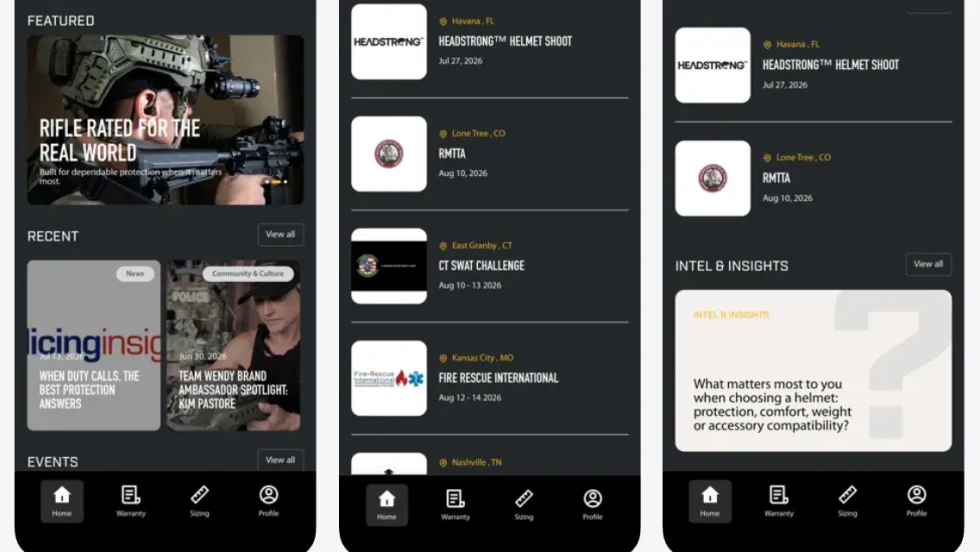
Team Wendy App Creates New Digital Hub for Helmet Owners
The Team Wendy Community App provides one location for warranty registration, size-fit tools, product updates, and community connection. For helmet owners, the new app creates a simpler path to the information and tools that matter most.
Read More →