



Learning the Finer Points of Attack Response
John P. Kary's training program, part of American Combatives Inc., differs from more traditional instruction in that its focus is offensive rather than defensive. This offensive approach prevents a grappling situation over a weapon and instead diverts the attacker's attention to his own survival.

Defend yourself against knife threats using an offensive approach.
You respond to a domestic violence call and you and your partner find yourselves in the living room of a small two-story house. The residence is located in a typical middle-class neighborhood. By the toys and other objects around the floor of the room, you know there are children living in the house. Although they are not visible, it is possible they are in an upstairs bedroom asleep. Your partner takes the woman into the kitchen, and you begin talking to the husband, who appears calm. Suddenly, he produces a knife and holds the point under your chin. He grabs your uniform shirt with his other hand and screams, "Move and I'll kill you."
This is one of several scenarios presented by John P. Kary of American Combatives Inc. to prepare for a demonstration of responses to high-level threats. The demonstration was organized for the newly formed West Virginia State Police tactical team to offer alternative responses to high-level threats (lethal or potentially lethal) that average officers might encounter in the day-to-day performance of their duties.
The solution to the above scenario, as presented by Kary, demonstrates the principals of World War II era combatives as opposed to traditional martial arts. Kary 's basic techniques are the same as those developed by Capt W. E. Fairbairn and Capt E. A. Sykes during their tenure with the Shanghai Municipal Police Force in the 1920s and '30s. The system is based on gross body movements,enabling someone who is attacked to perform under stress.
Kary enhanced the system by organizing Fairbairn's strikes, as well as adding a few techniques of his own.
A former Marine and Vietnam War veteran, Kary served in Southeast Asia where he received the Vietnamese Cross of Gallantry for his actions in close-quarter battle. He is currently National Director of the Gung Ho Chuan Association, which is an organization of Marines and former Marines dedicated to World War II era close quarter combat training.
His training program differs from more traditional instruction in that its focus is offensive rather than defensive. For example, when a weapon is involved, the goal is to get beyond the muzzle of the firearm or the blade of the knife and attack the attacker. This offensive approach prevents a grappling situation over a weapon and instead diverts the attacker's attention to his own survival.
The Offensive Approach
The following technique will help you disarm an assailant who threatens you from the front with a knife under your chin.
Photo 1: Bring both hands up in between the assailant's arms. no higher than chest level.
Photo 2: Force the blade sideways by moving your arms outward. trapping the assailant's arm at the wrist or forearm area. Simultaneously jerk your head back, bend your knees and arch your back to avoid the blade's tip.
Photo 3: Push off with your left foot on the same side as your trapping, or left hand. As you grab the suspect's wrist with your left hand, push down while stepping forward in between the assailant's legs, smashing his face with your free hand. (A face smash is an open-handed strike that uses the open hand in a position very similar to holding a shot put. The action of the strike is performed by snapping the hand forward into the face. It is not a pushing motion, but snaps from the elbow.)
Photo 4: After executing several face smashes, apply vertical "ax" strikes with your hands alternating to the assailant's biceps and neck, causing him to release the knife. (An ax strike is a chopping motion perfOll1led with a snap. Hold your fingers fully extended and together, but not too rigidly. The thumb is held away from the hand in a semi-relaxed position.) The power of the ax strike comes from its speed and the body weight behind it.
Photo 5: After the assailant drops the knife, use your free hand to reach across and grip his trapped arm at the elbow joint.
Photo 6: Pull the assailant's elbow toward your chest, pushing your hand up the assailant's back as you spin him around into a handcuffing position.
Photo 7: Force the assailant's face down to the ground by placing your foot on the back of his knee and applying pressure forward and down. (Be careful with your partner's knee during training.)
Student Success
The real proof of a self-defense technique's effectiveness is not how well the instructor performs the technique, but how easily the technique is taught to and retained by the average student.
As with any training method, competency lies in the application and retention of the technique. Your movements must be both fluid and quick. When practicing, begin slow, concentrating on hand placement and facial strikes.
Kary's method was tested during recent tactical training at the West Virginia State Police Academy by a class of city and county officers. It was also tested on a 17-year-old judo student. On both occasions, people of average ability learned the technique in less then 3 minutes.
Perhaps the best person to testify to the program's effectiveness, however, is Staff Sgt. Tom Smith, a former Marine who was assigned to the Scout/Sniper Marine Corps Reserve Unit located on Long Island. Smith trained at American Combatives for six months, attending classes twice a week. An inter-service transfer to the Navy caused him to discontinue training. A few years passed, and Smith found himself in SEAL training in California. During hand-to-hand combat training, the instructor asked Smith if he had any prior training, to which he responded, "a little." The instructor then demonstrated a roundhouse punch that was to be countered. Smith immediately reverted to the cover-up technique he had learned at American Combatives. He protected himself with face smashes and knee strikes to the instructor's groin, culminating in a face smash takedown. The instructor got up and said, "Thought you said you only had a little training!" Smith did not hesitate in responding to the attack.
Obviously, the techniques in this system are only appropriate for high level threat scenarios, and are certainly not to be used for low to mid-level resistance. They will however, see you through life-and-death situations.
First Sgt. Kenneth Burner is a certified defensive tactics instructor for the stale of West Virginia.
For additional information, contact American Combatives Inc. at:
Two Taft Place,
Albertson, NY 11507 Telephone: (516) 877-7878
This article is for supplemental information purposes only and is not intended to be a substitute for professional training under a qualified instructor. The author, POLICE and/or American Combatives Inc. accept no liability whatsoever for injuries to persons or property resulting from the information presented or implied in this article.
More Patrol

Adept Armor Introduces Two New Rifle Plates
Adept Armor has launched two new Level IV ballistic plates, the Emperor and the Archon Mark 2, which brings Adept Armor’s new Quatroid ceramic to the high-threat, performance-value center of the range at 5.2 pounds.
Read More →
POLICE Product Test: Benchmade Bailout
The Benchmade Bailout is a slim, lightweight carry knife with a deep-ride pocket clip and comes in a variety of blade steels and scales. Here is a detailed review of the Taiga Green Bailout, released earlier this year.
Read More →
NLEOMF Announces July 2026 Officer of the Month
NLEOMF honored a Michigan deputy sheriff as the July 2026 Officer of the Month for rescuing a trapped driver from a burning vehicle following a Fourth of July crash.
Read More →
Streamlight to Showcase Newest Lighting Products at National Safety Council’s Safety Congress & Expo 2026
Streamlight will showcase its latest lights, including the Portable Scene Light III and the LiteBox 1Million, at the 2026 National Safety Council (NSC) Safety Congress & Expo.
Read More →
The 2027 World Police & Fire Games Set for Perth, Australia
The 2027 World Police & Fire Games (WPFG) will take place in Perth, Western Australia, from Friday, March 12 through Sunday, March 21, 2027.
Read More →
5.11 Partners with National Fallen Firefighters Foundation to Support #ForThe343
5.11 has joined the nationwide movement honoring the 343 New York City Fire Department firefighters lost on Sept. 11, 2001.
Read More →
Team Wendy Announces Title Sponsorship of the Jorge Pastore Foundation
Team Wendy’s 3-year partnership with the Jorge Pastore Foundation expands access to programs that strengthen those who serve.
Read More →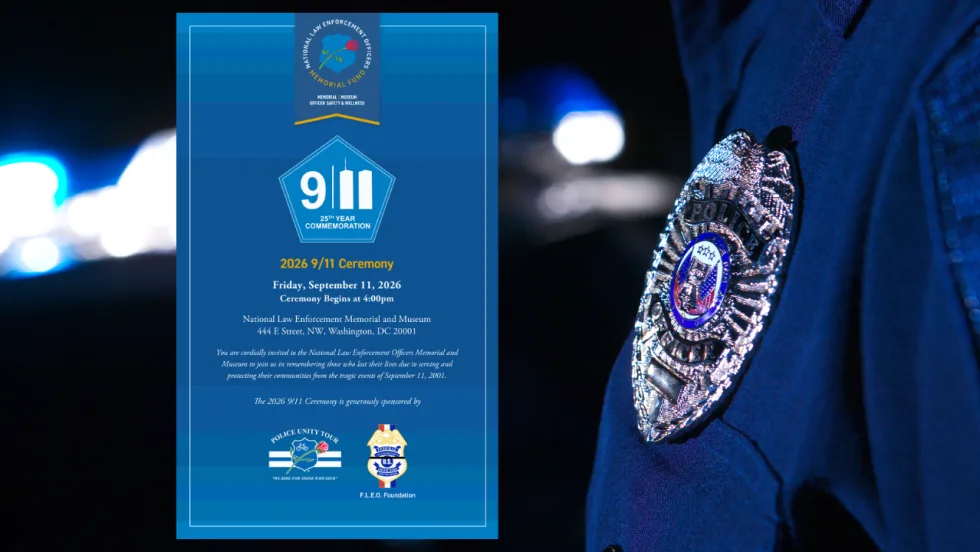
National Law Enforcement Memorial and Museum Hosting 9/11 25th-Year Commemoration Ceremony
The National Law Enforcement Memorial and Museum is hosting a 9/11 25th Year Commemoration Ceremony on Sept. 11 at 4 p.m.
Read More →
National Law Enforcement Officers Memorial Fund Announces June 2026 Officers of the Month
The National Law Enforcement Officers Memorial Fund (NLEOMF) named 15 officers of the Chico Police Department (California) as the Officers of the Month for June 2026 for their roles in responding to an active-shooter incident at a public library.
Read More →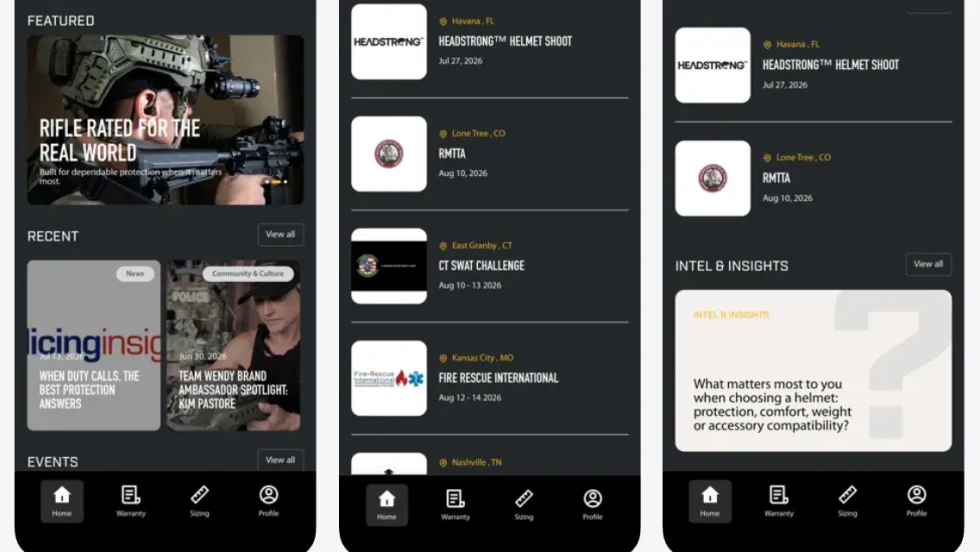
Team Wendy App Creates New Digital Hub for Helmet Owners
The Team Wendy Community App provides one location for warranty registration, size-fit tools, product updates, and community connection. For helmet owners, the new app creates a simpler path to the information and tools that matter most.
Read More →