



How to Tell When You Need a Search Warrant
The general rule-of-thumb is to try to get a warrant whenever possible. On the other hand, if you can seize evidence without engaging in a search, you don't need either a warrant or any exception.

You have to reign in your natural hunter's instinct and take the time to get a search warrant. There's the affidavit of probable cause to compose, the warrant form to fill out, maybe a review by the local prosecutor, and then finding a magistrate to submit the package to for approval. It's a hassle.
But it's a hassle the Constitution imposes, if your investigation has led you to a residence, garage, barn, outbuilding, warehouse, office, storage locker, package, vehicle, boat, or other place protected by the Fourth Amendment. The constitutional protection "against unreasonable searches and seizures" has been interpreted by the U.S. Supreme Court to mean that a search warrant is necessary to make searches and seizures "reasonable" unless the circumstances justify application of one or more of the recognized exceptions. (Katz v. U.S.)
Because warrantless searches and seizures are presumed to be unreasonable, the general rule-of-thumb is to try to get a warrant whenever possible. On the other hand, if you can seize evidence without engaging in a search, you don't need either a warrant or any exception. Therefore, the initial inquiry in determining whether you need a search warrant is whether you can seize the evidence without making a "search."
Is There a Search?
Not every acquisition of evidence involves a "search" as the Supreme Court has defined the term. The court has said that a Fourth Amendment "search" is a governmental infringement of a legitimate expectation of privacy. (U.S. v. Jacobsen) In situations where it would be unreasonable for a person to expect privacy, there is no "search" to justify, so no warrant is needed. The primary examples of search-less seizures are these:
Plain View. If you're in a place where you have a right to be, you can seize recognizable contraband or evidence in plain sight, without a warrant. (Horton v. California) However, even if displayed in plain view, materials protected by the First Amendment (books, magazines, tapes, movies, etc.) should not be seized until a judicial officer has made a determination that they are seizable. (Fort Wayne Books v. Indiana)
Plain Smell. Where either a trained officer or a trained K-9 detects the telltale odor of narcotics or other contraband by simply smelling a container or compartment exposed to lawful police access, the item can be seized and searched without a warrant. (Illinois v. Caballes)
Plain Feel. Assuming you have a right to touch an area (such as during a justified weapons frisk of a detainee's outer clothing), contraband that is immediately recognizable upon first touch can be seized. (Minnesota v. Dickerson)
Plain Shape. Some distinctive packages (gun case, meth bindle, etc.) betray their contents by their outward appearance and can support no legitimate expectation of privacy, so there is no "search" when they are opened. (Texas v. Brown)
Plain Hearing. No search warrant is needed to overhear incriminating conversations carried on where they might be overheard by members of the public or law enforcement officers. (Hoffa v. U.S.)
Open Fields. Evidence that is growing or stored in open fields is subject to police observation and warrantless seizure. (Oliver v. U.S.)
Abandoned Property. What a person has knowingly discarded can no longer enjoy a reasonable expectation of privacy. Accessible trash receptacles and discarded containers or items can be examined without a warrant. (California v. Greenwood)
Private-Party Revelations. If private individuals not acting as government agents discover contraband or evidence and turn it over to police, the owner's expectation of privacy has already been compromised (example: parcel shipper opens suspicious package, finds drugs, and delivers the opened package to police). (U.S. v. Jacobsen)
Controlled Delivery. No warrant is needed to reopen a container that you lawfully know contains contraband or evidence, merely because you arrange for the container to be delivered to the addressee so as to catch him in possession of it (unless the container is unobservable long enough for the suspect to remove its contents). (Illinois v. Andreas) If the container is allowed to be taken inside private premises, a warrant or some exception would be required to make entry to recover it.
Exposed Characteristics. There is no "search" when exemplars are taken from a person in lawful custody, such as fingerprints (Davis v. Mississippi), mug shots (U.S. v. Crews), handwriting samples (U.S. v. Euge), or voice samples. (U.S. v. Dionisio)
Two Search Warrant Prerequisites
Before deciding whether you need to get a warrant to make an entry or search, it's necessary to determine whether you could get one. You can obtain a warrant only if you have both probable cause and an opportunity to obtain a warrant.
Probable cause requires a reliable showing of a "fair probability" the target location contains contraband or the fruits, instrumentalities, or evidence of a crime. (Illinois v. Gates) If you don't have PC, there can be no nonconsensual search in most cases, whether with or without a warrant. So your next inquiry is, "Do I have PC for a search?"
[PAGEBREAK]
If There is No PC...
When you have reasons to suspect that a search would disclose some evidence but those reasons don't amount to PC, there may be other ways to conduct a constitutional entry and search:
Consent . "In situations where the police have some evidence of illicit activity, but lack probable cause to arrest or search, a search authorized by a valid consent may be the only means of obtaining important and reliable evidence." (Schneckloth v. Bustamonte)
Probation or Parole Term. In many jurisdictions, probationers and parolees are subject to a term of warrantless, suspicionless searches and seizures. This may provide a lawful basis for entry and search. (Samson v. California)
Incident to Arrest. At or near the time and place of arrest, you may search the arrested person. (U.S. v. Robinson) If the arrestee was the recent occupant of a vehicle, the passenger compartment of the vehicle may be searched. (Thornton v. U.S.) Where the arrest takes place within premises lawfully entered, you may search the area within the arrestee's immediate control (Chimel v. California), and look into immediately adjoining spaces where potential assailants might be. (Maryland v. Buie)
Officer Safety. You may make a weapons frisk of a detainee when there is articulable suspicion he is armed and dangerous (Terry v. Ohio), a safety sweep of lawfully entered premises with articulable suspicion an assailant may be present (Maryland v. Buie), and a routine shakedown of jail or prison cells. (Block v. Rutherford)
Booking Search. Once a prisoner is lawfully in custody at a police station or jail, he and his property can be thoroughly searched for administrative and security purposes. (Illinois v. Lafayette)
Inventory. A lawfully impounded vehicle and its contents can be inventoried according to standard procedure. (Colorado v. Bertine)
If There is No Time...
Assuming there is PC for a search, the next inquiry is, "Do I have time to get a warrant?" The Supreme Court has recognized that in exigent situations, the fact that you don't have time to get a warrant will excuse the warrant requirement to the extent of allowing immediate entry or search to neutralize the exigency. (Mincey v. Arizona) The following exigencies have been recognized:
Rescue. If someone inside premises is in need of immediate help, or if a suspect or his property must be searched to reveal the location of a kidnap victim in distress, you may take necessary steps to neutralize the exigency without waiting for a warrant. (Brigham City v. Stuart)
Imminent Substantial Property Damage. No warrant is needed before activities aimed at countering an immediate threat to property, such as a fire or a burglary in progress. (Michigan v. Tyler)
Imminent Destruction of Evidence. Warrantless entry and search for destructible evidence are constitutional if occupants are aware of law enforcement knowledge of it and are likely to dispose of it quickly. (Ker v. California) This same rationale allows warrantless seizure of "evanescent evidence" (such as blood-alcohol samples) based on probable cause. (Schmerber v. California)
Fresh Pursuit. When the suspect in a recent crime of violence flees from police apprehension and seeks refuge inside private premises, there is no need to interrupt continuous pursuit to seek a warrant. (Warden v. Hayden)
Preventing Escape. If you lawfully attempt a detention or arrest in public and the person retreats into private premises, you may enter and search for him to complete the arrest. (U.S. v. Santana)
Public Safety Threat. No warrant is needed when immediate action is required to protect public safety (bomb threats, hazmat, mass shootings, etc.) (Cady v. Dombrowski)
Whichever exigency permits initial warrantless entry and search, your activity is limited to steps to neutralize the exigency. Once the exigency ends, any further search must be by warrant, consent, or some other exception. (Michigan v. Clifford)
With PC and time...
One recognized exception to the warrant requirement relates to "fleeting targets," such as cars, vans, trucks, buses, RVs, boats, planes, and trains. (California v. Carney) Because of their inherent mobility and diminished expectation of privacy, the court has dispensed with the warrant requirement for fleeting targets. Assuming lawful access, you may search any part of a fleeting target that you have PC to believe conceals something seizable. (U.S. v. Ross) A "fleeting targets" search requires no warrant, even though the vehicle is in exclusive police custody and there is ample opportunity to obtain a warrant. (Michigan v. Thomas)
For any search, whether of a house, a car, or a container, if you have probable cause and time to get a warrant, it's a good idea to seek one. Even though one of the exceptions might apply, you will generally reduce the risks of both suppression of evidence and civil liability if your entry and search are judicially authorized. And if there is no identifiable exception, there is no lawful way to conduct a search except with a warrant—which brings us back to the rule-of-thumb: try to get a warrant whenever possible.
More Patrol

Adept Armor Introduces Two New Rifle Plates
Adept Armor has launched two new Level IV ballistic plates, the Emperor and the Archon Mark 2, which brings Adept Armor’s new Quatroid ceramic to the high-threat, performance-value center of the range at 5.2 pounds.
Read More →
POLICE Product Test: Benchmade Bailout
The Benchmade Bailout is a slim, lightweight carry knife with a deep-ride pocket clip and comes in a variety of blade steels and scales. Here is a detailed review of the Taiga Green Bailout, released earlier this year.
Read More →
NLEOMF Announces July 2026 Officer of the Month
NLEOMF honored a Michigan deputy sheriff as the July 2026 Officer of the Month for rescuing a trapped driver from a burning vehicle following a Fourth of July crash.
Read More →
Streamlight to Showcase Newest Lighting Products at National Safety Council’s Safety Congress & Expo 2026
Streamlight will showcase its latest lights, including the Portable Scene Light III and the LiteBox 1Million, at the 2026 National Safety Council (NSC) Safety Congress & Expo.
Read More →
The 2027 World Police & Fire Games Set for Perth, Australia
The 2027 World Police & Fire Games (WPFG) will take place in Perth, Western Australia, from Friday, March 12 through Sunday, March 21, 2027.
Read More →
5.11 Partners with National Fallen Firefighters Foundation to Support #ForThe343
5.11 has joined the nationwide movement honoring the 343 New York City Fire Department firefighters lost on Sept. 11, 2001.
Read More →
Team Wendy Announces Title Sponsorship of the Jorge Pastore Foundation
Team Wendy’s 3-year partnership with the Jorge Pastore Foundation expands access to programs that strengthen those who serve.
Read More →
National Law Enforcement Memorial and Museum Hosting 9/11 25th-Year Commemoration Ceremony
The National Law Enforcement Memorial and Museum is hosting a 9/11 25th Year Commemoration Ceremony on Sept. 11 at 4 p.m.
Read More →
National Law Enforcement Officers Memorial Fund Announces June 2026 Officers of the Month
The National Law Enforcement Officers Memorial Fund (NLEOMF) named 15 officers of the Chico Police Department (California) as the Officers of the Month for June 2026 for their roles in responding to an active-shooter incident at a public library.
Read More →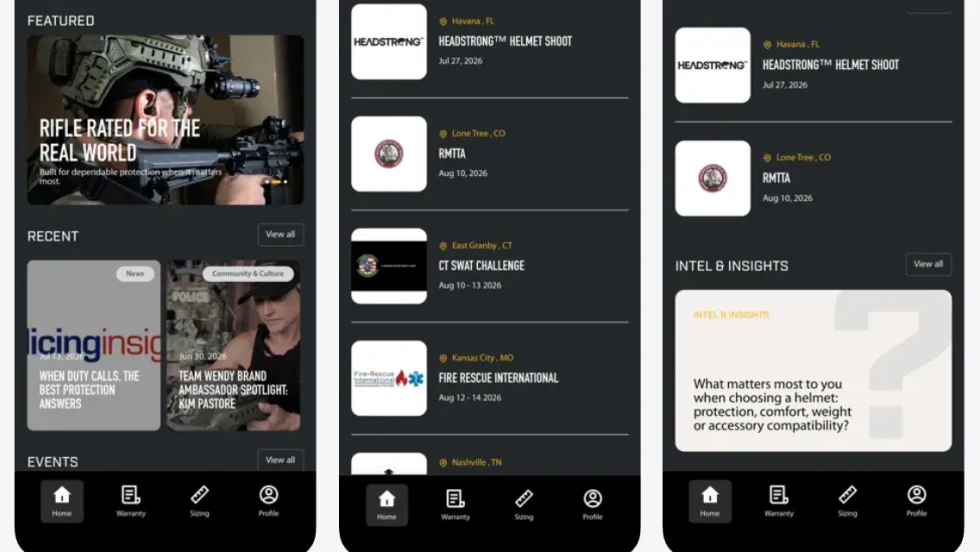
Team Wendy App Creates New Digital Hub for Helmet Owners
The Team Wendy Community App provides one location for warranty registration, size-fit tools, product updates, and community connection. For helmet owners, the new app creates a simpler path to the information and tools that matter most.
Read More →