



First Look: The Personal Legal Recorder
Thin Blue Defend gives officers a tool for recording and maintaining personal information about use-of-force incidents that can support their cases if they are prosecuted or sued.

Thin Blue Defend is a secure web-based app that officers can use to store details of incidents that may lead to future legal complications.
Photo: Thin Blue Defend
During his 30-year career with the Georgia Bureau of Investigation, Douglas Parker spent a lot of time questioning law enforcement officers about their use-of-force incidents. One thing he learned from such investigations was that the officers’ reports often left out a critical part of the story: what they were thinking at the time of the incident.
“Graham v. Connor requires insight into the perception of the officer to determine if the use of force was objectively reasonable given the totality of circumstances. Police use-of-force investigations are not about the who, what, when, and where. We already know that. What we need to know is the why,” Parker says.
Helping officers provide their attorneys with that “why” in situations where the officers may be sued or prosecuted is the reason that Parker founded Seven Eight Technologies and dedicated the time, capital, and resources to develop a web-based app that can run on a phone, tablet, or computer called Thin Blue Defend. Developed in consultation with experts, Thin Blue Defend guides law enforcement officers through the process of documenting the details of use-of-force incidents on a web-based app so that if they need that information later they will have it.
“The app actually prompts the officer as to what types of information they need to capture for the situation involved,” Parker explains. “It’s a framework that allows you to describe what took place by choosing what information to capture with dropdown menus.” The app is very detailed and it helps officers capture small but critical details of the event. Users can vocally record their responses or they can type in information. They can also take photos outside of the area under control of the investigating agency such as images of injuries they suffered during an attack. All of the data is stored in the cloud and not on the officer’s device.
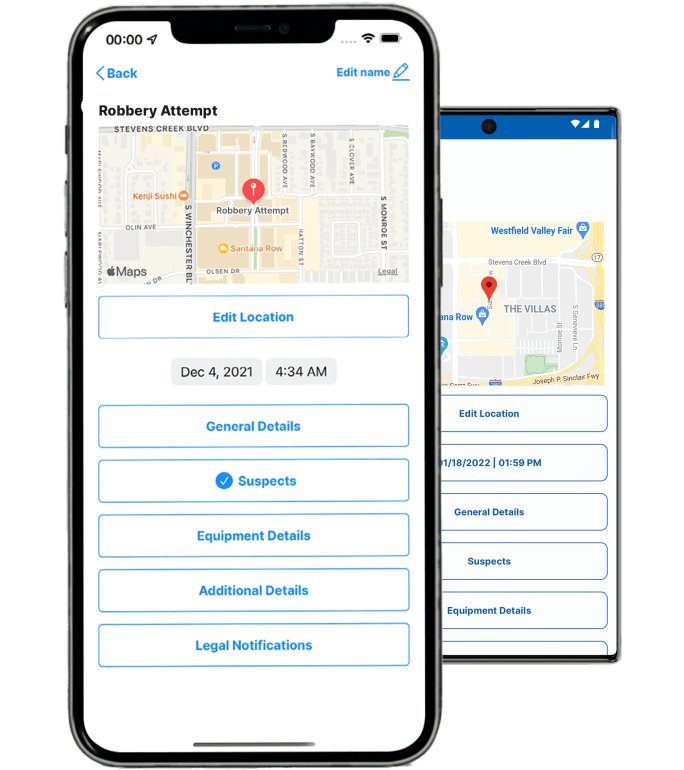
Thin Blue Defend runs on phones, tablets, and computers.
Photo: Thin Blue Defend
Because the information is stored in the cloud. The court cannot subpoena the officer’s phone, tablet, or computer for evidence and see what the officer put in the app. To see the actual information, the court would have to subpoena the cloud service.
Parker recommends that officers write the names and phone numbers of their attorneys in the app. This makes it very difficult for any plaintiff’s attorney to subpoena the officer’s phone or the information from the cloud because it is “attorney-client work product,” Parker contends. For more serious cases such as shootings, he suggests officers sit down with their attorneys and have their attorney enter the information into the app.
Thin Blue Defend was developed over five years in consultation with attorneys and with the Columbia County (GA) Sheriff’s Office. The Columbia County SO was also first to test the app. “We are dedicated to providing our officers with the tools they need to do their jobs correctly and protect themselves physically and legally,” says Columbia County Sheriff Clay Whittle. “[Thin Blue Defend] helps ensure that the officer can provide the detail that may verify the legitimacy of their actions and influence a favorable outcome so they can continue in their law enforcement career.”
Parker says seven entire departments with a total of about 440 officers are currently using Thin Blue Defend, and he expects that number to rise quickly. “We’ve got many departments wanting it, but they have to wait for the yearly budget process.”
Thin Blue Defend is a software as a service (SaaS) product. Subscriptions are available for individual officers or for agencies, the app is available for Android and Apple devices. All information saved in the app is stored in a government cloud that can only be accessed with multi-factor authentication.
More Point of Law

Point of Law: The Limits of Electronic Searches
Can an individual be prosecuted for despicable criminal conduct based on evidence obtained in violation of the United States Constitution? Ultimately, the Ninth Circuit judges wrote, “In the circumstances of this case (United States v. Holcomb, 23-469 (9th Cir. 2025)), respect for the Constitution and the rule of law requires an answer of “no.”
Read More →
Trump Issues Order Cutting Federal Funding in Cashless Bail Jurisdictions
<strong>“</strong>Cashless bail policies allow dangerous individuals to immediately return to the streets and further endanger law-abiding, hard-working Americans because they know our laws will not be enforced,” the administration said.
Read More →Justice Department Sues Los Angeles Over Sanctuary Policies
The DOJ said in a press release that the “sanctuary city” policies of the City of Los Angeles are illegal under federal law.
Read More →
Understanding Officer-Created Jeopardy
Officers can be criminally prosecuted for using force when their actions led to escalation during contact with subjects.
Read More →
Point of Law: The Limitations of Search Warrants
In the Tenth Circuit case of Cuervo v. Sorenson, the Court ruled officers cannot deviate from the language of the warrant.
Read More →DOJ Dismisses Consent Decrees Affecting Louisville and Minneapolis Police
The Civil Rights Division will be taking all necessary steps to dismiss the Louisville and Minneapolis lawsuits with prejudice, to close the underlying investigations into the Louisville and Minneapolis police departments.
Read More →New Michigan Bill would Give Officers Civil Immunity in Self-Defense Cases
House Bill 4404 would create a presumption of civil immunity for individuals who are cleared criminally after using force in self-defense, shifting the burden of proof onto plaintiffs.
Read More →Seattle to Pay Police Captain $1 Million to Settle Lawsuit
Seattle police Capt. Eric Greening sued former Chief Adrian Diaz last year alleging that Diaz retaliated when Greening brought up concerns about racial and gender discrimination.
Read More →Washington Agencies Ordered to Not Delete Critical Facebook Contents
Jim Leighty, a local activist, filed two federal lawsuits last year claiming both agencies deleted or hid critical comments he had written below multiple posts, while keeping comments that were pro-police in nature.
Read More →Washington State Attorney General Sues Sheriff for Helping Immigration Enforcement
The lawsuit claims the Adams County Sheriff’s Office has illegally held people in custody based only on their immigration status, helped federal agents question people in custody, and given immigration officials confidential personal information.
Read More →