



Elder Abuse
The fastest-growing segment of the U.S. population is the cohort of people who are more than 85 years old. The aging of America will present many challenges to law enforcement, including how to protect people who may no longer have the physical or mental capacity to protect themselves and how to investigate cases of elder abuse.

The fastest-growing segment of the U.S. population is the cohort of people who are more than 85 years old. The aging of America will present many challenges to law enforcement, including how to protect people who may no longer have the physical or mental capacity to protect themselves and how to investigate cases of elder abuse.
Elder abuse first gained national attention in 1978 when the House Select Committee on Aging estimated that 1 million senior citizens were victimized annually. A recent study finds that at least twice that number of seniors are now abused each year. As a patrol officer you need to be aware of this heinous crime and how to respond to it.
Abuse Begins at Home
As a person ages, he or she becomes more vulnerable to abuse due to social isolation, illness, frailty, disabilities, and depression. There are three categories of elder mistreatment: abuse (physical or emotional), neglect, and financial exploitation.
Surprisingly, most abuse does not happen in retirement homes; it occurs in the home of the senior citizen. The most common perpetrator of elder abuse is a spouse. A law enforcement officer may be slow to respond to the problem of elder abuse, perceiving it as a “family matter” as opposed to a criminal matter.
Unfortunately, each state has special laws pertaining to the abuse of the elderly. And this puts you as responding officers in a very delicate position where you must proceed with respect and caution. You must also be aware of the laws governing elder abuse in your state.
Investigating Elder Abuse
Many of the skills you have developed in dealing with domestic violence and abused children will be applicable in an elder abuse investigation.
Upon approaching the home of an elder who has been reported as being abused, you will want to note the general condition of the residence. Is the lawn being maintained? Is there a vehicle in the driveway? Is the vehicle registered? Is it operable? Has the garbage been taken out to the curb or is it accumulating on the side of the house? Has the mail been taken in? Is there an accumulation of newspapers on the property? These visual cues will give you a general impression of the living conditions.
When you enter the residence, all of your senses should be working. Be sure to stay within the parameters of the plain view doctrine, but check out the house and ask yourself some of these questions. What is the general condition of the home? Are garbage or pet droppings throughout the home? Is there food left on the stove or unwashed dishes in the sink? What is the general smell in the house? Are the clothes and bed sheets being washed regularly?
Once you’ve considered the state of the residence and the living conditions inside, you may want to initiate a conversation with the alleged victim. As with all interviews, non-verbal cues are as important as the content of the responses. Look for the following tell-tale cues. Is a suspected perpetrator hovering in the area, refusing to leave the senior alone to answer questions? Is the potential victim answering the questions by looking the officer in the eye and giving direct responses or is he or she averting eye contact and giving ambiguous answers?
You also need to use this interview to gauge the potential victim’s mental state. Does he know what day/month it is? Does she know who is president? Does he know what country we are at war with? Can she add 8 and 6 correctly? Answers to these general questions will provide insight as to the senior’s cognitive ability.
As you conduct this interview, assess the potential victim’s physical condition. Does he or she appear to be mobile? Are his or her clothes clean? Are there any marks or bruises on this person that cannot be reasonably explained?
You may also need to make further reasonable inquiries. When was the last time the senior opened his own mail? When did he or she last leave the house alone? Is the senior wearing clean clothes? Are the clothes suitable to the weather? The alleged victim shouldn’t mind showing you his winter coat; what is the condition of this garment? Who is the victim’s best friend and when was the last time they spoke or met?
Many seniors are on some type of prescription medication. You can ask to see the medications and compare the prescription date and the amount of medicine left. This will let you know if the medicine is being dispensed per the doctor’s orders.
Be sure that you establish defensible reasons for your questions and for moving throughout the residence. A trip to the bathroom, a request for a drink of water, or the need for privacy to make a cell phone call may grant you permission to move from the site of the initial contact to different areas of the house. Look for indicators of past violence (broken furniture, blood stains, holes in the walls, etc.) as well as unsanitary conditions.
Preventing Elder Abuse
The best response to elder mistreatment is to prevent it from happening. You can make seniors aware of the circumstances that are most likely to lead to their mistreatment.
Give your senior contacts the following advice. They should remain active in some type of community group (church, social, neighborhood, recreation, etc.). Social isolation is one of the greatest contributors to elder mistreatment.
They should also seek the help of key professionals as needed. For example, they can work with a financial professional to ensure there is no financial
exploitation.
Of course, health care is another major concern for seniors. They should make and keep regular doctor and dentist appointments.
Make sure that your senior contacts know about the services and resource centers in their neighborhood. This information is available from local government or it can be accessed online at www.elderabusecenter.org.
All citizens are entitled to live free of fear and with dignity. As law enforcement officers, we are charged with the task of protecting those who cannot protect themselves.
Recognizing the growing problem of elder mistreatment and having workable solutions prepared will facilitate a proper response to an elder mistreatment call and allow you to better serve this growing segment of the population.
Det. Joseph Petrocelli is a 20-year veteran of New Jersey law enforcement. He can be contacted through SAFECOPS.com and through POLICE Magazine.
- For more information on the investigation and prevention of elder mistreatment and summaries of your state’s laws governing elder abuse, go to www.elderabusecenter.org.
More Patrol

Adept Armor Introduces Two New Rifle Plates
Adept Armor has launched two new Level IV ballistic plates, the Emperor and the Archon Mark 2, which brings Adept Armor’s new Quatroid ceramic to the high-threat, performance-value center of the range at 5.2 pounds.
Read More →
POLICE Product Test: Benchmade Bailout
The Benchmade Bailout is a slim, lightweight carry knife with a deep-ride pocket clip and comes in a variety of blade steels and scales. Here is a detailed review of the Taiga Green Bailout, released earlier this year.
Read More →
NLEOMF Announces July 2026 Officer of the Month
NLEOMF honored a Michigan deputy sheriff as the July 2026 Officer of the Month for rescuing a trapped driver from a burning vehicle following a Fourth of July crash.
Read More →
Streamlight to Showcase Newest Lighting Products at National Safety Council’s Safety Congress & Expo 2026
Streamlight will showcase its latest lights, including the Portable Scene Light III and the LiteBox 1Million, at the 2026 National Safety Council (NSC) Safety Congress & Expo.
Read More →
The 2027 World Police & Fire Games Set for Perth, Australia
The 2027 World Police & Fire Games (WPFG) will take place in Perth, Western Australia, from Friday, March 12 through Sunday, March 21, 2027.
Read More →
5.11 Partners with National Fallen Firefighters Foundation to Support #ForThe343
5.11 has joined the nationwide movement honoring the 343 New York City Fire Department firefighters lost on Sept. 11, 2001.
Read More →
Team Wendy Announces Title Sponsorship of the Jorge Pastore Foundation
Team Wendy’s 3-year partnership with the Jorge Pastore Foundation expands access to programs that strengthen those who serve.
Read More →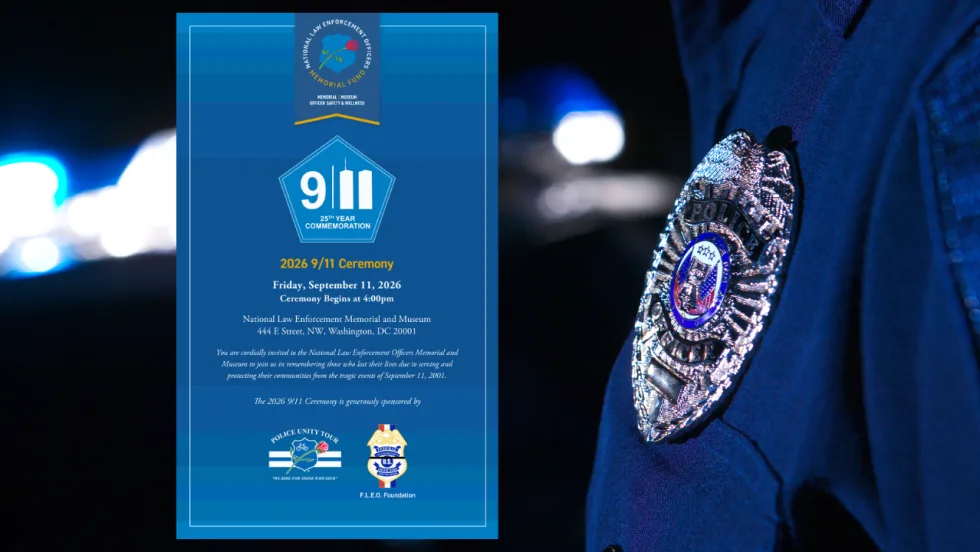
National Law Enforcement Memorial and Museum Hosting 9/11 25th-Year Commemoration Ceremony
The National Law Enforcement Memorial and Museum is hosting a 9/11 25th Year Commemoration Ceremony on Sept. 11 at 4 p.m.
Read More →
National Law Enforcement Officers Memorial Fund Announces June 2026 Officers of the Month
The National Law Enforcement Officers Memorial Fund (NLEOMF) named 15 officers of the Chico Police Department (California) as the Officers of the Month for June 2026 for their roles in responding to an active-shooter incident at a public library.
Read More →
Team Wendy App Creates New Digital Hub for Helmet Owners
The Team Wendy Community App provides one location for warranty registration, size-fit tools, product updates, and community connection. For helmet owners, the new app creates a simpler path to the information and tools that matter most.
Read More →