



E Team Crisis Management
This secure communications and incident management tool is fully scaleable with a user-friendly Windows interface.

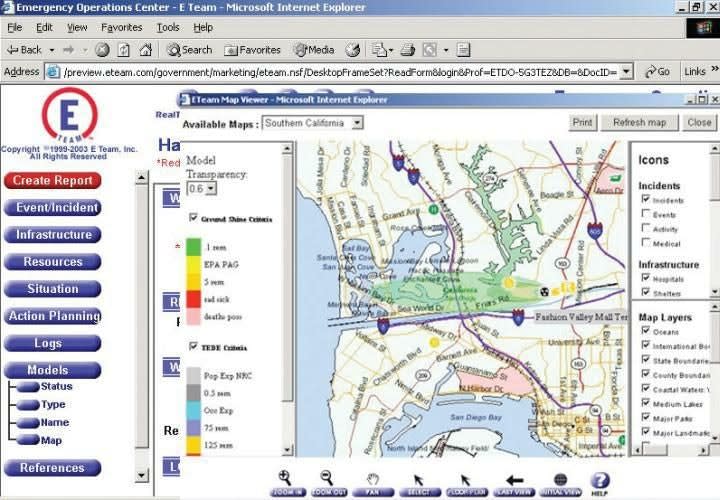
Online mapping tools allow incident managers to evaluate many factors they might otherwise miss.
Critical incidents have long been a fact of life in American law enforcement. But in the post-9/11 world, agencies need new tools to ensure that all local public safety resources can be brought to bear against an accident, natural disaster, terrorist attack, or other operation that involves numerous personnel from multiple agencies.
One such tool is critical incident management software from Canoga Park, Calif.- based E Team. Founded in 1998, E Team is a provider of crisis management software, serving public agencies of all levels and sizes, as well as private entities and nonprofit organizations. The company’s collaborative software was developed for the federal government’s command-and-control systems, and has become the defacto standard for information exchange between agencies during critical incidents and critical incident drills.
If we’ve learned anything from “9/11” it’s that public safety agencies can do a better job with their communications protocols and infrastructure. E Team addresses this problem with an easy-to-use, versatile software tool for communications interoperability.
Don’t let a term like “interoperability” lead you to believe that the E Team package is a complicated, scary piece of software that requires months and months of intensive training to operate. It isn’t. E Team’s critical management software features an Internet browser-based interface that is so user-riendly even the most novice users can get up to speed with only two to four hours of basic training.
Such ease of use may raise a few skeptical eyebrows with agencies that need serious software. But let me assure you that E Team’s critical incident management tool is a professional product that has been employed to aid communications at some of the largest agencies in the United States.
In fact, one of the best features of the E Team product is its versatility. The software is fully scaleable, and it can meet the needs of a small, rural volunteer fire department or a major metropolitan police department, allowing them to work together and securely transfer information as quickly as e-mail.
Any agency looking to procure a critical incident management tool is going to have massive amounts of existing digital data that needs to be accessed by the software. E Team’s solution to this problem is a partially open source architecture that allows E Team’s engineering integration personnel to, in most cases, import your existing sources of data. Whether it’s your Computer Aided Dispatch system, GEO, or mapping files, E Team can merge data from your systems onto its servers and into the application.
Once the data is in the system, you have full control and complete access to it. Whether you prefer to store your data on a wholly owned server, multisite servers managed by your agency’s IT department, or one of E Team’s remote triple secure and redundant servers, you can login and access it from anywhere in the world via wired or wireless access.
What good is that? you might ask. Well, just imagine that you’re in line at Starbucks waiting to get your favorite latte before going into work. Suddenly your pager wails that special alert tone, and your cell phone starts simultaneously vibrating off your waist. You sense something’s up, but you haven’t had that first cup of coffee. Not a problem. Just grab your cup, find a seat, and take out your notebook computer.
In a Starbucks, you’re in one of the newest “wi-fi” hotspots in the nation. So all you have to do is slap in that new “air-card” you’ve wanted to try. Boot your notebook, surf over to one of E Team’s servers, and login. In a matter of moments you’ll be reading alert summaries, status changes, and actions plans. You can even check your available resources and see what’s committed and what’s still available.
Run a critical incident from a Starbucks? It’s not as far-fetched as you might think. And with E Team it’s very secure. E Team’s 128-bit encryption secure socket layer ensures your data is safe. In fact, it’s as safe as your online brokerage account and that trade you just made last week. The software also has internal rules allowing your managers or system administrators to decide who gets to see what and when they see it.
This software is not only nearly impossible to hack, it’s also really difficult to infect. The E Team system is built on IBM’s Domino Web server, making it nearly immune to Web viruses specifically designed to attack Microsoft Web servers.
This came in very handy during last year’s Super Bowl when E Team software was used by my agency, the San Diego Police Department. An Internet worm was released that Sunday just hours prior to Super Bowl XXXVII, and as the virus spread rapidly along the West Coast, our E Team servers continued uninterrupted throughout the entire event, never missing a beat.
Designed to work under the “functional role” position of Emergency Management Centers, E Team’s software licenses are issued to the individual positions such as logistics, personnel, or scribe rather than individual users. This means that a full installation requires only a few seat licenses for several computers rather than a license for each individual user. That can be a real saving on the bottom line, and the company’s assessment group can show you numerous other cost-cutting solutions.
Regardless of how many users you have, the E Team information flow works pretty much the same. Users are required to login and verify their personal profiles, identities, and functional roles. Once this login process is completed, they can create incidents, set status levels, establish triage criteria, and make requests for resources and information sharing.
Accountability is one of the greatest strengths of the E Team solution. The software records every aspect of the incident management from who is logging in, to requests for resources and who fulfilled them, to real-time messaging from the personnel involved in the incident. All of this information is very useful for after-action analysis.
Whether it’s planning dignitary routes and sharing intelligence info with the U.S. Secret Service or working to recover from a natural or manmade disaster, E Team can track and store every little nuance of data from an incident or exercise.
And a new post-incident management module is being tested now in Southern California with the Federal Emergency Management Agency (FEMA). The company and FEMA are working together to develop new ways to help the victims of the massive Southern California wildfires by linking home site info with county assessors’ records with new temporary addresses and phone numbers for the burned out property owners.
A 25-year police veteran and member of the San Diego Police Department, Bob Davis has extensive experience managing technology for major events. He currently runs the SDPD computer lab.
More Technology

A police agency's guide to data-driven fleet management
Costs are rising and the public expects more transparency into how their tax dollars are spent. This e-book shows how police agencies can use fleet data to take control of fleet expenses while improving officer safety and demonstrating fiscal responsibility to the communities they serve.
Read More →
AI and analytics for law enforcement: Turning data into insights
Law enforcement agencies are managing more video, sensor data and digital evidence than ever before. Discover how AI and analytics can help turn that data into actionable insights that strengthen situational awareness, accelerate investigations and support more informed decisions.
Read More →
Vasco Electronics Adds Automatic Language Detection to Vasco Translator Q1
Vasco Electronics’ software update introduces hands-free language switching and expanded offline translation across 45 language pairs, empowering law enforcement, healthcare, and front-office enterprise teams
Read More →
North Miami Police Department Deploys Mark43
The North Miami Police Department has deployed Mark43 as part of its Five-Year Strategic Plan that represents its collective vision and goals for a more proactive police department, anchored by a core commitment to leveraging modern technology to enhance efficiency and public safety.
Read More →
Cellebrite Genesis for Enterprise Now Generally Available
Made available to the public sector in June, Cellebrite Genesis is serving a growing mix of national, regional, and local agencies worldwide, including some of the largest regional and metropolitan police departments. It is now available for enterprise organizations.
Read More →
2026 Vision FirstNet Users Summit to Host Emerging Leaders Training on Grassroots Advocacy for Public Safety
“Emerging Leaders Training: Understanding the Importance of Grassroots Advocacy for Public Safety," a session during the 2026 Vision FirstNet Users Summit, will offer a roadmap for unified advocacy at the federal level.
Read More →
Motorola Solutions Completes Acquisition of D-Fend Solutions
Motorola Solutions has acquired D-Fend Solutions, an industry leader in counter-drone technology. This deal provides public safety and enterprise customers with access to advanced counter-unmanned aerial systems.
Read More →
ZeroEyes, Advantech & Camden Police Partner to Bring AI Gun Detection Technology to Delaware School District
ZeroEyes has partnered with Advantech and the Camden Police Department to deploy ZeroEyes’ AI gun detection and intelligent situational awareness platform at Delaware’s Caesar Rodney School District (CRSD).
Read More →
Leonardo U.S. Cyber & Security Solutions Introduces SignalTrace, the Next Evolution in Electronic Signature Detection Technology
SignalTrace reflects years of product refinement and a clearer expression of the technology’s purpose of recognizing and correlating electronic signatures in publicly broadcast wireless signals to reveal patterns, relationships, and trends that might otherwise go undetected.
Read More →
Pimloc Launches Secure File Sharing to Streamline Release of Redacted Video
Pimloc’s Secure File Sharing lets organizations deliver redacted video, audio, and documents through expiring, passcode-protected links, accelerating delivery while reducing security, compliance, and chain-of-custody risks.
Read More →