



Child Burn Investigations
Child abuse is a wide reaching problem entailing physical and emotional abuse. This article will address one segment of child abuse, specifically burn injuries sustained by children.

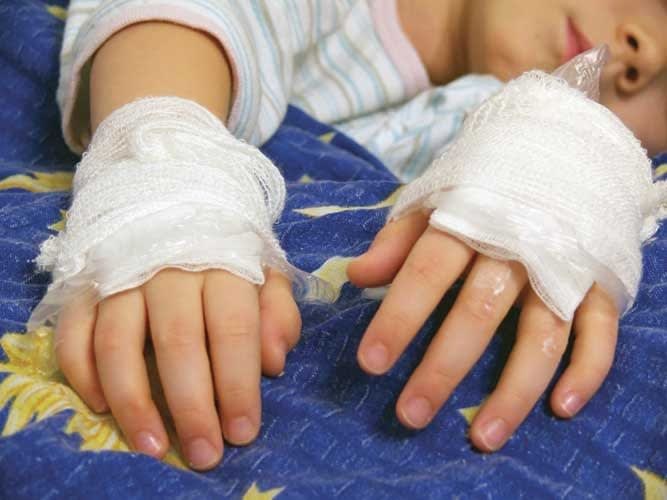
Child abuse calls are among the most emotionally taxing that you will ever receive. Coming upon a scene where an innocent, vulnerable child is the victim forces an officer to fight his or her emotions in order to do the job effectively. It is incumbent upon you to protect these innocent victims. And oftentimes, the best way this can be done is to perform a comprehensive investigation and gather strong evidence against the criminal actor.
Unfortunately, in many cases officers are not schooled on how to conduct a complete investigation. Street cops are not well trained to distinguish accidental injuries from intentional injuries.
In the last few decades, child abuse has emerged from the shadows. It was once considered a "family problem" outside the purview of the police. Current thinking sees child abuse as a matter to be handled by the criminal justice system with the street cop as the initial point of contact.
Child abuse is a wide reaching problem entailing physical and emotional abuse. This article will address one segment of child abuse, specifically burn injuries sustained by children.
Burn Units
Our awareness of child abuse has increased greatly in recent years, but deliberate injury caused by burning often goes unrecognized by police.
Child abuse accounts for about 10 percent of hospital admissions of children entering burn units. Statistically, an intentionally burned child will be much younger than a child who is accidentally burned. The abused child will have a higher mortality rate and endure longer hospital stays.
The burning of a child as a result of abuse comes in two basic forms-immersion and intentional burning. Immersion involves forcibly placing the child in water that is too hot for the skin to bear. Intentional burning involves placing a hot item against the skin.
Almost invariably, the caretaker claims the child accidentally came in contact with the burning medium. Consequently, you will want to be armed with certain information to assist in conducting a good investigation.
Intentional or Accidental
There are some commonalities that you should look for when investigating a burn injury. For example, look for multiple burns across the body.
Are there a number of burns in various stages of healing? Are the burns located in areas a child couldn't reach? An intentional injury will probably be deeper into the skin.
Look for soft tissue injury such as bruising, which may indicate that the child was forcibly held as the injury was inflicted. Interview anyone who was present; be wary in a crowded home when a caretaker states the child was unattended during the time leading up to injury. Monitor the general feelings of the caretaker toward the child.
It may be difficult to determine whether a burn is intentional or accidental, particularly when the burn is caused by a hot solid object. Even brief accidental contact with a hot item can result in partial (second-degree) burns.
A child can be burned by contact with hot pavement or exposure to strong sun. Injuries have resulted from inadvertently touching a hot seat belt buckle. An accidental burn can result from a child walking into a lit cigarette being held waist high; of course this burn should be to the eye area, face, or upper torso, not to the soles of the feet.
An accidental burn will have an irregular pattern whereas an intentional injury will be much more clearly defined. Accidental burns are also more shallow than intentional burns.
Scalding Burns
One common type of burn inflicted on a child is caused by immersing the victim in hot water. A telltale sign of this type of crime is a "waterline," a distinct border showing where the injury ends.
The injury will have very little tapering near the edges, indicating the child was held in place. Any child who is subjected to hot water will thrash about in an effort to escape the pain.
Immersion is often a punishment for failing to respond to toilet training. Deliberate immersion is the only way a child can sustain deep burns to the buttocks or the area between the buttocks and groin. Check the clothes the child was wearing just prior to the injury to determine if the pants were soiled with feces. You may want to retain these dirty items as possible evidence.
Check the area where the injury occurred. If the story is that a child pulled down a pot of hot water, determine how high the pot would have been and compare that to the height of the child. Try to determine if there is reasonable explanation for water to be boiling at that time of day. Was the stove hot, preventing a child from climbing on it?
If the injury occurred in a bathtub, check the temperature and depth of the water in the tub. Is it too deep for an infant? In an accidental burn scenario, there should be water outside of the tub, the remnants of the child thrashing to escape the hot water.
Not only would a child thrash, but also he would be likely to do his best to protect himself. This reflexive protection mechanism would lead to "sparing."
A child whose hand is forced into hot water will make a fist, thereby "sparing" the palm of the hand from burning. Toes will be curled up if the feet were immersed. If the legs were forced into hot water, the child would have folded his legs, protecting the area behind his knees. "These sparing actions prevent burning within the body creases, causing a striped configuration of burned and unburned zones, or a zebra pattern," writes Charles Swanson in the book "Criminal Investigation."
Common Sense
In general, some good common sense questions will assist you in determining whether a burn injury is intentional or accidental. Was the injury caused by an item the child could not operate (like a cigarette lighter)? Is the item too heavy or too high for the child to access? Would the child's level of development and coordination allow him to complete the alleged accidental action?
If the item was heated, how long did it take to heat and what were the caretaker and child doing during this time? Could the child reach the burn site? Is the injury clear and crisp or shallow and irregular?
As in all investigations, when the time is right, walk through the accident site to help re-create the scene for the investigator. Locate the item that likely caused the injury.
Interviewing a parent whose child has just suffered an injury is a delicate process. But the answers to these questions are essential to a successful investigation. Coupling the answers to these questions with the physical evidence at the scene and the determinations of medical professionals will help you determine whether a child's burn injury was the result of an accident or a crime.
Det. Joseph Petrocelli is a 20-year veteran of New Jersey law enforcement. You can comment on this article, suggest other topics, or reach the author by e-mailing the editor at editor@PoliceMag.com.
Immersion Burn Patterns
Deliberate immersion burns result in injury patterns that you should learn to identify.
Doughnut pattern on the buttocks. When a child accidentally falls into hot water, the immediate reaction is to thrash about. In a deliberate immersion, the child is often held down with his buttocks in contact with the bottom of the container, sparing that portion of the buttocks from injury.
Soles of the feet. The soles of the feet will be similarly spared if the child is forced to stand in hot water. Even in an accidental situation where the child is jumping around trying to get out of the hot water, the soles of the feet would be burned. Only by deliberately holding a child in place could the soles be spared.
Waterlines. If a child is held in place, there will be a sharp and distinct line of injury. A child who accidentally falls into hot water will splash about, causing irregular injury patterns.
Stocking or glove pattern injuries. If a hand or foot is immersed, the injury will look like a glove or a stocking. Once again, look for a clear line of demarcation around the injury.
Burn Classifications Have Changed
To perform a thorough investigation, you must first understand how burns are classified.
Different grades of burns are assigned by how "deep" the burn goes into the skin. The names given to burns have changed over the recent decades, but you should know the names and characteristics of each type of burn.
An injury to the top layer of skin is called a superficial burn (formerly known as a first-degree burn); it heals within five to seven days. When the second layer of skin is damaged it is known as a partial burn (formerly second degree). When the damage goes through to subcutaneous tissue and fat, it is known as a full thickness burn (formerly third degree) and requires skin grafts.
Several factors affect the severity of an injury. The injury location and the victim's age determine the thickness of the skin. Water and oil content, the amount of subcutaneous fat, and the number of blood vessels vary from one location in the body to another. A child's skin is thicker on the palms of the hands, soles of the feet, and the back. Skin is thinner on the front of the trunk, the inner arms and thighs, and the bottom of the forearms.
Only a trained medical professional can make a complete determination as to the severity of a burn. Develop a good rapport with responding medical personnel to help assess the types of burns that have been inflicted.
More Patrol

Team Wendy Introduces the EXFIL Endurance Ballistic Helmet, Engineered to Reduce the Burden of Extended Wear
Team Wendy has launched its EXFIL Endurance, a new lightweight ballistic helmet engineered to deliver protection, comfort, and fit during demanding, extended operations.
Read More →
The First Responders Children’s Foundation National First Responders Day Roll Call of Heroes Ceremony Returns to Times Square, NYC
First Responders Children’s Foundation (FRCF), in collaboration with T-Mobile, will host the Roll Call of Heroes ceremony in Times Square to commemorate National First Responders Day on Wednesday, Oct. 28. During the event, FRCF will present 18 Hero Awards.
Read More →
Streamlight to Showcase Newest Lighting Products for Law Enforcement Professionals at IACP 2026
Streamlight will showcase its newest lights for law enforcement at the International Association of Chiefs of Police Annual Conference & Expo. Featured lights will include the TLR-3 X, the PolyTac 1X, and more.
Read More →
Streamlight Portable Scene Light III Wins 2026 OH&S New Product of the Year Award
Streamlight’s Portable Scene Light III has won the 2026 Occupational Health & Safety (OH&S) New Product of the Year Award in the Lighting category.
Read More →
Adept Armor Introduces Two New Rifle Plates
Adept Armor has launched two new Level IV ballistic plates, the Emperor and the Archon Mark 2, which brings Adept Armor’s new Quatroid ceramic to the high-threat, performance-value center of the range at 5.2 pounds.
Read More →
POLICE Product Test: Benchmade Bailout
The Benchmade Bailout is a slim, lightweight carry knife with a deep-ride pocket clip and comes in a variety of blade steels and scales. Here is a detailed review of the Taiga Green Bailout, released earlier this year.
Read More →
NLEOMF Announces July 2026 Officer of the Month
NLEOMF honored a Michigan deputy sheriff as the July 2026 Officer of the Month for rescuing a trapped driver from a burning vehicle following a Fourth of July crash.
Read More →
Streamlight to Showcase Newest Lighting Products at National Safety Council’s Safety Congress & Expo 2026
Streamlight will showcase its latest lights, including the Portable Scene Light III and the LiteBox 1Million, at the 2026 National Safety Council (NSC) Safety Congress & Expo.
Read More →
The 2027 World Police & Fire Games Set for Perth, Australia
The 2027 World Police & Fire Games (WPFG) will take place in Perth, Western Australia, from Friday, March 12 through Sunday, March 21, 2027.
Read More →
5.11 Partners with National Fallen Firefighters Foundation to Support #ForThe343
5.11 has joined the nationwide movement honoring the 343 New York City Fire Department firefighters lost on Sept. 11, 2001.
Read More →