



Chemical Suicides
When called to suicide scenes, emergency personnel don't always know what they're up against. With some 90 percent of chemical suicides posting warnings on the windows of the cars and rooms in which they kill themselves, one would hope that officers and firefighters would think twice before opening doors and breaching windows.

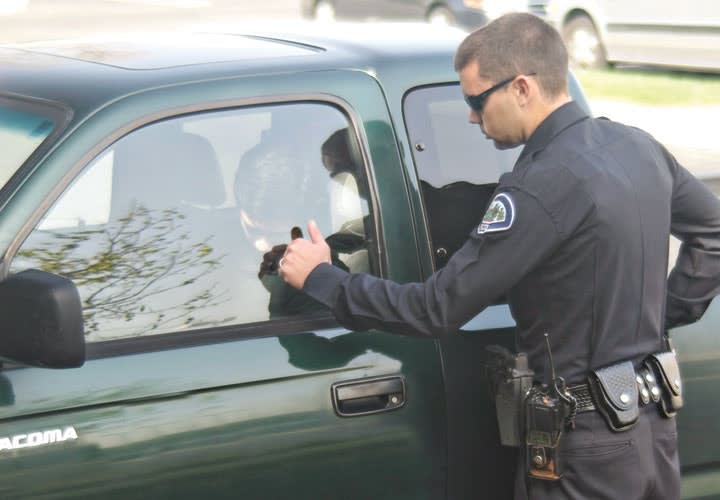
Photo: Vince Taroc.
Pouring herself a cup of coffee, Teresa sat down and contemplated her future. To her fellow California Institute of Technology students and the faculty that taught her, it seemed like a future that portended great and wondrous discoveries for a 22-year-old already making her mark as a researcher and teaching assistant in organic chemistry.
But Teresa saw no such future, and where others found her cup running over with blessings, the graduate student found her life lacking. So she added something extra to her morning cup of joe, spoon-stirred it, supped its contents, then lay down.
When Teresa's body was discovered on a bright morning in May 1999, a piece of paper was found near her person.
Written on it was a single word.
"Cyanide."
Poison Control
Whatever your take on Teresa's suicide, she at least exhibited the foresight to attempt to spare others from being taken with her. That singular consideration gave emergency personnel the opportunity to evacuate her apartment complex and have a hazardous materials team decontaminate the scene of granular potassium cyanide without incident.
But first responders cannot always count on such considerations or know what they're up against. Even those with the benefit of prior warning may fail to heed it.
"We thought the scene was safe. We thought the incident was over."
Those were the words of Undersheriff Richard Perrin of Lake County, Mich., explaining how eight emergency services workers became exposed to toxic fumes while attempting to rescue a 28-year-old male who'd mixed household cleansers to asphyxiate himself. Unfortunately, their assumption that the incident was over was proven wrong.
"There was a re-mixture of the chemicals which started another chemical reaction and created more gas that we weren't prepared for," Perrin told Fox 17 news.
Like Teresa, the suicidal man had taken the time to leave a warning, plastering the windows on both sides of his vehicle with signs announcing the threat inside his car: "Do not open. One breath can kill," read one. "Do not enter without protective gear. H2S inside. Hazmat only. Hydrogen sulfide gas suicide," read another.
With some 90 percent of chemical suicides posting warnings on the windows of the cars and rooms in which they kill themselves, one would hope that officers and firefighters would think twice before opening doors and breaching windows in the face of such admonitions.
But Deputy Chief Jake Oreshan of the New York State Office of Fire Prevention and Control says the incident illustrates an ongoing problem in the first responder community.
"Even when they have some kind of warning, cops will bust windows probably 85 to 90 percent of the time," Oreshan notes. "It's that visceral reaction of the first responder who's been conditioned to 'take charge' at the scene, and it's something that law enforcement agencies are going to have to deal with."
And rest assured, they will be dealing with it.[PAGEBREAK]
Two Breaths
Chemical suicides have figured prominently throughout history, mostly in the form of cyanide poisoning. High ranking members of the Third Reich — Joseph Goebbels, Heinrich Himmler, and Hermann Göring among them — used cyanide capsules to evade a hangman's noose. Members of the Sri Lankan Liberation Tigers of Tamil Eelam wore cyanide vials around their necks with the intent of ingesting their contents if captured by government officials.
But within recent years a cheaper and more easily effected means of chemical suicide has emerged: hydrogen sulfide (H2S).
Easily produced through the mixing of common laundry detergents, hydrogen sulfide smells like rotten eggs in low concentrations. At higher levels, the colorless and flammable gas can irritate mucous membranes and cause headaches, dizziness, and even memory loss. When concentrated at 50-400 ppm, H2S can induce coughing, breathlessness, nausea, vertigo, and vomiting. At 700 ppm, two breaths can cause immediate death.
Since 2007, Japan has experienced a statistical spike in chemical suicides using hydrogen sulfide, with some 500 people choosing to end their lives using the gas in the first six months of 2008 alone.
Domestically, there have been relatively few instances of chemical suicides. But the presence of online "how-to" manuals and growing numbers of U.S. incidents suggest that may soon change:
2008: Two cases.
2009: Nine cases.
2010: 36 — a four-fold increase over the previous year.
As of mid February, there had already been 14 H2S suicides in the United States, a pace that suggests a conservative projection of more than 80 chemical suicides by year's end.
More ominously, these numbers may tell only part of the story.
"The problem that we have at this point is the variations in protocol between law enforcement, fire, and EMS agencies. There is no single central reporting location for all three agencies to report to," notes Oreshan. "The actual numbers may be higher."
By default, Oreshan has found himself something of a clearing house for such data.
"People across the country reach out to me whenever they hear about one," he says. "I try to do a personal follow-up with every location that has one."
To get education and training out to first responders, Oreshan has reached out to the national Hazmat Fusion Center and LEO centers. He hopes an ancillary benefit will be the eventual establishment of a more linear system of reporting.
In the meantime and whatever the numbers, the risks of such incidents have significant implications for EMS workers.
Recipe for Disaster
Oreshan notes that there haven't yet been any known first responder fatalities as a direct result of exposure to hazardous materials or chemical assaults associated with chemical suicides. But he also believes it is only a matter of time as first responders continue to put themselves at risk. Upward of 90 percent of all officers involved in such incidents are treated at hospitals in their aftermath-largely as a result of their own actions.
Oreshan hates to think what might have happened had some of these first responders not had the benefit of prior warnings from the suicidal subjects.
James Simmerman, director of Training for the Saline County (Mo.) Criminal Justice Training Center, worries that some suicides "may not be a fan of the police" and not be concerned with first responder safety when they plan on killing themselves with poison gas.[PAGEBREAK]
Whether by the decedent's intent or by accident, some first responders may end up suffering a fate similar to that of Edwards County (Ill.) Sheriff Eugene Smith. Sheriff Smith rushed inside a house to rescue a couple who'd been overcome by carbon monoxide poisoning. He succeeded in getting the two outside before collapsing himself. Two days later, Sheriff Smith died.
Officers not immediately incapacitated by hydrogen sulfide exposure may still suffer long-term setbacks such as bronchitis, asthma, and other upper respiratory complications that may themselves turn deadly.
"When you have people using any type of sulfur-based compound with an acid, you're dealing with something that can be fatal in low concentrations alone. But the dangers associated with these suicides can be easily exacerbated.
"First, there's always the threat of gases not having escaped the vehicle. Then-as the Michigan situation illustrates-there's the possibility for a chemical remix which can be deadly in low concentrations. Factor in people who make at least one or two gallons of product who then fill a vehicle with X parts per million and it has nowhere to go, and it's a recipe for disaster. And the fact is, these people often make this stuff in vast quantities," Oreshan explains.
Training and Handling
Just a few days before Christmas 2009, a man in a pickup truck committed suicide in Sugar Creek, Mo., by mixing up cyanide. Several first responders were subsequently affected by the poison.
About a month earlier, James Simmerman read about chemical suicides in a bulletin directed to fire and emergency services personnel provided by the New York State Office of Fire Prevention and Control. At the time, he thought, "Nobody in Missouri would do something like that."
The incident changed Simmerman's mind.
"If it can happen in Sugar Creek," Simmerman says, "it can happen anywhere."
Realizing that there was a need for a safety program on chemical suicides, Simmerman developed a PowerPoint presentation, "Chemical Suicides-First Responder Safety." To date, he has provided the presentation and lesson plan to more than 680 requesting public safety agencies around the world.
Preventing officers from becoming collateral casualties, like all aspects of officer safety, comes down to training, logistics, and adhering to proper procedures.
Unless the officer happens upon a suspicious vehicle, the odds are that he or she will be dispatched to a call of a chemical suicide. It is therefore imperative that desk personnel and dispatchers be trained not only to acquire the best information possible from informants, but to keep those informants from coming to harm, as well.
Michele French is a communications training officer with the Lake County (Fla.) Sheriff's Office and she is developing a training program for the agency's desk personnel. "Training in this area is relatively new," French concedes. "We're educating dispatchers on basic questions to ask: Do you see anything suspicious around the vehicle? Are there any notes posted on the windows?"
When it comes to accurate information, French believes it is as important to acquire it as it is to share it: It does nobody any good if either informants or first responders get too close to contaminated vehicles or structures.
"We are the first point of contact. It's very important to ask the right questions. Always get plenty of information. Even if you think you may not need it, go ahead and get it. Officer safety is a top priority."[PAGEBREAK]
It's an admirable ambition. Unfortunately, it can be a daunting one given the instinct to aid somebody found slumped over a steering wheel. "It's the first responder reaction," notes Oreshan. "There's a man down inside of a vehicle who appears to be unresponsive. The immediate reaction is to try the door. There are unwritten rules on how to [commit chemical suicide]. If the victim hasn't followed those rules, the door may not be locked. The law enforcement officer opens that door and he's going to get a face full of this. If the door is locked, I know of many cases in which law enforcement has taken a baton to the window. They take out the window and get a face full of this stuff.
"You don't know [if it's safe] until the fire department gets there with an air monitoring unit. There is no way to know how big an area will be affected. The layman's answer to that would be to refer to the North American Emergency Response Guidebook. For hydrogen sulfide, it recommends a quarter mile in all directions."
That's why Oreshan encourages officers to take a 10-second overview of the scene.
"Depending on how long the vehicle has been there, there may be an odor of rotten eggs or sulfur emanating from the vehicle. The concern that we have is that once you've smelled that, you've probably been exposed to more than you should. You need to immediately back away from that.
"They may find mixing vessels in the vehicle. In the majority of cases, they're going to find at least one mixing vessel, e.g., five-gallon pail, mop pail, anything that will hold a quantity of this liquid. To make it properly, they need to batch mix it in two different containers and then mix it together in one big swoop.
"They can also look for a yellow residue in the interior of the vehicle in the area of these mixing vessels. They're going to find acid containers and containers of products that don't belong inside a vehicle.
"Look for copper pennies. A lot of people throw change in their cup holders. Pennies will be almost bright green from the oxidation."
If you find an unresponsive person inside the vehicle, before opening doors or windows, attempt to wake the person with a bullhorn or public address system.
Look for signs of asphyxiation. The symptoms of chemical suicide are very similar to a carbon monoxide poisoning: cherry red skin, cyanosis around the lips. Discoloration or mottling of the skin will set in after a couple of hours.
If such efforts to determine a threat prove fruitless, entry should be effected only by EMS workers wearing fully encapsulated chemical protective clothing with self-contained breathing apparatus.
Approaching a Chemical Suicide
Out on patrol you see a parked car with a person slumped over the steering wheel. All the windows and doors are firmly shut. Approach with caution and look for the following signs of a chemical suicide:
Note from subject warning you to stay out. Take this seriously. Do not charge in. Be glad the subject had the decency to leave you a note.
Not all do. So take a few seconds to look for the following tell-tale signs of a chemical suicide:
Unusual smell such as rotten eggs or almonds
Pails or buckets (mixing vessels) in car
Yellow residue in the interior of the vehicle in the area of these mixing vessels
Subject with cherry red skin and blue lips (cyanosis)
Bright green coins in cup holders or other change-gathering parts of the car
If you are unsure, try to wake the subject using PA or bullhorn. If that doesn't work, don't open the door or smash a window. Call in a hazmat team.
Resources
The following people who have been quoted in this article can be contacted for additional information:
Deputy Chief Oreshan would also like to be advised of any chemical suicide incidents. jake.oreshan@dos.state.ny.us.
Michelle French is willing to share her department's policies for dispatchers as they relate to such incidents. Michele.French@lcso.org
James Simmerman'sPowerPoint slide presentation, "Chemical Suicides-First Responder Safety," can be viewed/downloaded from the Website of the Wrongful Death Institute. He can be reached at james.simmerman@att.net.
More Patrol

Adept Armor Introduces Two New Rifle Plates
Adept Armor has launched two new Level IV ballistic plates, the Emperor and the Archon Mark 2, which brings Adept Armor’s new Quatroid ceramic to the high-threat, performance-value center of the range at 5.2 pounds.
Read More →
POLICE Product Test: Benchmade Bailout
The Benchmade Bailout is a slim, lightweight carry knife with a deep-ride pocket clip and comes in a variety of blade steels and scales. Here is a detailed review of the Taiga Green Bailout, released earlier this year.
Read More →
NLEOMF Announces July 2026 Officer of the Month
NLEOMF honored a Michigan deputy sheriff as the July 2026 Officer of the Month for rescuing a trapped driver from a burning vehicle following a Fourth of July crash.
Read More →
Streamlight to Showcase Newest Lighting Products at National Safety Council’s Safety Congress & Expo 2026
Streamlight will showcase its latest lights, including the Portable Scene Light III and the LiteBox 1Million, at the 2026 National Safety Council (NSC) Safety Congress & Expo.
Read More →
The 2027 World Police & Fire Games Set for Perth, Australia
The 2027 World Police & Fire Games (WPFG) will take place in Perth, Western Australia, from Friday, March 12 through Sunday, March 21, 2027.
Read More →
5.11 Partners with National Fallen Firefighters Foundation to Support #ForThe343
5.11 has joined the nationwide movement honoring the 343 New York City Fire Department firefighters lost on Sept. 11, 2001.
Read More →
Team Wendy Announces Title Sponsorship of the Jorge Pastore Foundation
Team Wendy’s 3-year partnership with the Jorge Pastore Foundation expands access to programs that strengthen those who serve.
Read More →
National Law Enforcement Memorial and Museum Hosting 9/11 25th-Year Commemoration Ceremony
The National Law Enforcement Memorial and Museum is hosting a 9/11 25th Year Commemoration Ceremony on Sept. 11 at 4 p.m.
Read More →
National Law Enforcement Officers Memorial Fund Announces June 2026 Officers of the Month
The National Law Enforcement Officers Memorial Fund (NLEOMF) named 15 officers of the Chico Police Department (California) as the Officers of the Month for June 2026 for their roles in responding to an active-shooter incident at a public library.
Read More →
Team Wendy App Creates New Digital Hub for Helmet Owners
The Team Wendy Community App provides one location for warranty registration, size-fit tools, product updates, and community connection. For helmet owners, the new app creates a simpler path to the information and tools that matter most.
Read More →