



Can We Minimize K-9 Deaths?
In 2015, 27 police dogs were killed on duty, compared to an average of 10 dogs killed each year 15 years ago. This year, eight police K-9s were killed in January alone.

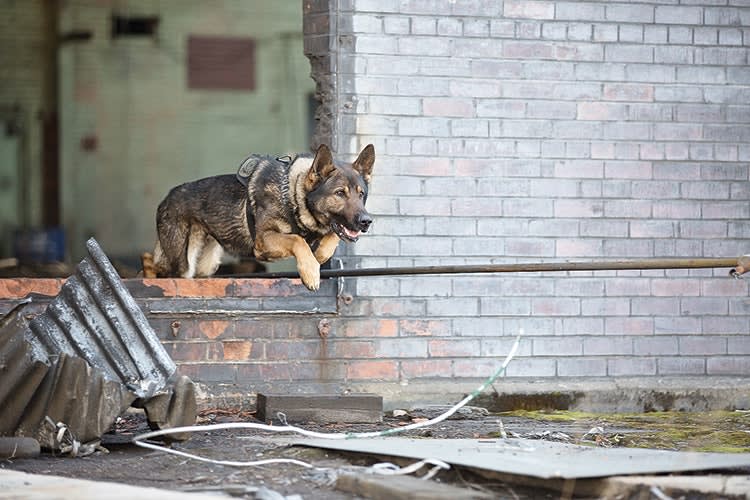
Photo: Carla Blazek
In 2015, 27 police dogs were killed on duty, compared to an average of 10 dogs killed each year 15 years ago. This year, eight police K-9s were killed in January alone.
"Police violence is on the increase it seems, and there is more anger toward police. Perhaps some of this is manifesting itself in violence toward the police service dog," says Dr. David "Lou" Ferland, a retired police chief, longtime K-9 handler and trainer, and current executive director of the United States Police Canine Association (USPCA).
There is no required formal reporting system for K-9 deaths in the line of duty as there is for human law enforcement officers, so some K-9 deaths in previous years may have gone unreported. Nowadays, each K-9 duty death is shared almost immediately via social media and broadcast on the local news.
Whatever the trend may be, there is no doubt that law enforcement wishes to make efforts to prevent unnecessary K-9 deaths whenever possible.
Inherent Danger
Law enforcement is a dangerous profession, but some details are more hazardous than others, and on a more frequent basis.
"The K-9 guys are the ones exposed to the most dangerous situations by far," says Officer Craig Hamilton of the Spokane (WA) Police Department's K-9 Unit. "By contrast, yeah, SWAT is in a high-risk situation, but SWAT is able to control and slow things down more. Tracking is the most dangerous thing we do. The last K-9 at our agency to be shot was shot on a track."
Many K-9 operations involve violent individuals whose motivations and even whereabouts are often unknown. Handlers, K-9s, and all officers involved could be doing everything by the book, but there are always surprises.
"In most cases, it looks like tactics were used appropriately," says Ashabranner regarding recent K-9 duty deaths. "Sometimes the bottom line is, when suspects make their mind up that they're going to take out the police, it's just a hard thing to eliminate."
This is why it's so important for handlers and their K-9s to continually prepare themselves and those they work with for how to handle different types of encounters.
"Officers need to do as much scenario-based training as possible, watch for behavior changes in the dog, and have adequate backup to support them," says Rick Ashabranner, Master Trainer and president of the North American Police Work Dog Association (NAPWDA). "Do everything in your power to eliminate anything that could go wrong."
Sharing Best Practices
As is the case for any law enforcement position, constantly innovating and improving tactics is imperative for success and survival. "That's the biggest way of saving dogs and handlers: Think of new ways of doing things and share them," says Hamilton. "That's why we hold our yearly advanced handler school; to expose others to the way we do things and ways we have found that work."
If you don't have something similar in your immediate area, you can seek out something farther afield. Individual departments and associations hold events across the country where K-9 handlers can meet and share ideas. For example, the United States Police Canine Association and its different regions and districts sponsor certifications and seminars throughout the year.
"NAPWDA holds state workshops as well as the weeklong North American Police Work Dog Association National Workshop each year," says Ashabranner. "That brings all the officers and handlers together. They get to train with master trainers and share methodologies, to be the best teams they can be."
After attending a Los Angeles County SWAT K-9 school, Spokane PD K-9 handlers brought back a tactic that they practiced with their SWAT team and now use on the street regularly. "We used to always send our dog out to the first room, down him, and then the team would move up to the dog. But they had some good examples of why you should call the dog back to you and then move up," explains Hamilton. "We used to down him in a hallway where we could see him, with the thought that maybe the suspect would come out and the dog could get him. But if the suspect starts a gunfight and the dog is there, he might engage with the wrong person."
Hamilton feels it's important to distinguish when something is a "dog problem" and when it's not a "dog problem." Otherwise it can cause unnecessary safety issues, as in this case. After the dog clears the room, the situation now becomes the purview of SWAT. In other instances a call may not be a "dog problem" at all. It is up to the handler to determine whether it's best to use a K-9 in any given situation at most agencies, even overriding the police chief's order to deploy, says USPCA's Ferland. If it's not a good deployment because there is too much that could go wrong, the handler makes that final decision.
It's also important to make other officers at your agency and at other agencies aware of how to interact with K-9s. "If you're deploying your dog on a suspect and you don't want other officers to get between the dog and the suspect, they need to learn that they need to stay out of the sight of the dog so he has a clear picture off the person he's trying to run down," says NAPWDA president Ashabranner.
If you want to attend training but money is tight, many grants are available. And closer to home, you can make more of an effort to incorporate outside agencies into your K-9 unit's current ongoing training and to be open to sharing each other's tactics and techniques.
"The big thing is training and exposure," says Hamilton. "And realizing the dogs are one of many tools out there on the street. They're not the magic bullet."
Tools of the Trade
Equipment can be used to help keep K-9s safe while they are on duty, but they have their limits. Cameras specially made to be worn by a K-9 allow the handler and other officers to view what the dog is seeing. But they aren't always practical.
K-9 ballistic vests can protect dogs from gunfire, but they are usually not stab resistant and they only cover and protect certain areas. Unlike humans, K-9s can't wear ballistic vests all the time, especially in hot weather, because the dogs will overheat. Vests can also catch on nails and other items in tight spaces like small attics. "It's a piece of equipment and you need to train enough so they're used to having them on," adds Hamilton. "Otherwise, when you first put it on a dog they're walking funny and can't figure out how to lie down. We only use them in high-risk situations, such as on SWAT calls."
All of these can be helpful in certain situations. But when it comes down to it, the most important "equipment" on a K-9 team is the K-9. "Of course we all love our dogs. But they're a tool, they've got a purpose," says Hamilton.
Social media is abuzz with people decrying K-9s' deaths in the line of duty. Which is understandable. These dogs are innocent animals who are just following their training and their orders. But their deaths are not in vain.
"I've seen and heard some people making comments, questioning why the dog was being utilized," says Ashabranner. "The dog is an extra tool to locate a suspect. It's quicker, more efficient, and safer. And in most cases the K-9 took the shot that would have been meant for the officer. As unfortunate as it is, it does save a life."
"There's an old saying: the police dog is the police that the police officers call for," says Ferland. "I don’t want dogs dying, but I would not trade that for a human dying. We need to look at what the alternative would be if we're not deploying a dog."
More Patrol

Adept Armor Introduces Two New Rifle Plates
Adept Armor has launched two new Level IV ballistic plates, the Emperor and the Archon Mark 2, which brings Adept Armor’s new Quatroid ceramic to the high-threat, performance-value center of the range at 5.2 pounds.
Read More →
POLICE Product Test: Benchmade Bailout
The Benchmade Bailout is a slim, lightweight carry knife with a deep-ride pocket clip and comes in a variety of blade steels and scales. Here is a detailed review of the Taiga Green Bailout, released earlier this year.
Read More →
NLEOMF Announces July 2026 Officer of the Month
NLEOMF honored a Michigan deputy sheriff as the July 2026 Officer of the Month for rescuing a trapped driver from a burning vehicle following a Fourth of July crash.
Read More →
Streamlight to Showcase Newest Lighting Products at National Safety Council’s Safety Congress & Expo 2026
Streamlight will showcase its latest lights, including the Portable Scene Light III and the LiteBox 1Million, at the 2026 National Safety Council (NSC) Safety Congress & Expo.
Read More →
The 2027 World Police & Fire Games Set for Perth, Australia
The 2027 World Police & Fire Games (WPFG) will take place in Perth, Western Australia, from Friday, March 12 through Sunday, March 21, 2027.
Read More →
5.11 Partners with National Fallen Firefighters Foundation to Support #ForThe343
5.11 has joined the nationwide movement honoring the 343 New York City Fire Department firefighters lost on Sept. 11, 2001.
Read More →
Team Wendy Announces Title Sponsorship of the Jorge Pastore Foundation
Team Wendy’s 3-year partnership with the Jorge Pastore Foundation expands access to programs that strengthen those who serve.
Read More →
National Law Enforcement Memorial and Museum Hosting 9/11 25th-Year Commemoration Ceremony
The National Law Enforcement Memorial and Museum is hosting a 9/11 25th Year Commemoration Ceremony on Sept. 11 at 4 p.m.
Read More →
National Law Enforcement Officers Memorial Fund Announces June 2026 Officers of the Month
The National Law Enforcement Officers Memorial Fund (NLEOMF) named 15 officers of the Chico Police Department (California) as the Officers of the Month for June 2026 for their roles in responding to an active-shooter incident at a public library.
Read More →
Team Wendy App Creates New Digital Hub for Helmet Owners
The Team Wendy Community App provides one location for warranty registration, size-fit tools, product updates, and community connection. For helmet owners, the new app creates a simpler path to the information and tools that matter most.
Read More →