



Body-Worn Cams: Making Sure You Get the Video
Many of the most innovative features on the current generation of law enforcement body-worn camera systems are all about ensuring the evidence is captured as accurately as possible, that it can be integrated with other video capture systems, and it can be redacted.

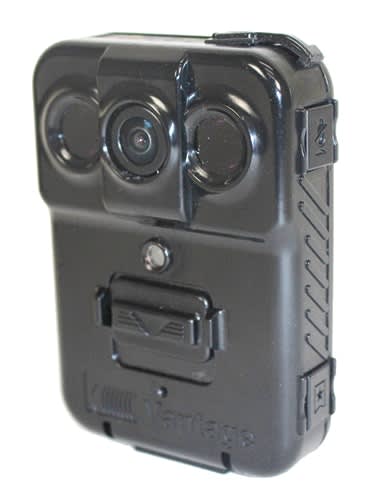
Kustom Signals' Vantage body-worn camera can upload files wirelessly to the company's Eyewitness in-car system so that officers don't have to turn in their cameras at the end of their shifts. Photo: Kustom Signal
The idea of outfitting law enforcement officers with cameras to capture evidence of crimes is probably first found in some science fiction story that was published before World War II. Much of contemporary technology was envisioned in such volumes long ago. But the equipment has only been practical for about a decade.
In that decade, the cameras systems, the memory components, the batteries, and the software for managing the evidence they capture have become exponentially more sophisticated. The body-worn cameras of 2016 are much more capable than the systems of five years ago. And with more and more companies scrambling for a piece of the market and seeking to meet the demands of American law enforcement agencies, we're going to see a wide variety of new features and capabilities in these systems in the near future.
Currently, just about every major American law enforcement agency that doesn't equip its officers with cameras is looking into the feasibility of doing so. It used to be that the major selling point for body-worn cameras was the ability to reduce liability in cases where false accusations were levied against officers. Now, in the age of Black Lives Matter and the war on police, agencies see a need to document officer actions on video to placate activists and quell unrest. But in order to do so, contemporary law enforcement body-worn camera systems need to have features that facilitate their ability to capture evidence under the most challenging of conditions and to enable agencies to share that evidence with the media without endangering officers or innocents.
That's why many of the most innovative features on the current generation of law enforcement body-worn camera systems are all about ensuring the evidence is captured as accurately as possible, that it can be integrated with other video capture systems to deliver multiple angles of the event, and it can be redacted so that innocent people will not be shown when the video is broadcast or distributed on the Internet.
Camera Activation
One of the earliest concerns about equipping officers with body cameras was how to ensure officers will have the systems running when they are most needed. The fear was that officers would forget to activate the devices under stress.
The original solution to this problem was to make the on-off operation of the camera as simple as possible. Usually the systems are manually activated by pressing or pushing a large button, bar, or switch. But regardless of ease of use, such buttons, bars, and switches require the officer to manually activate them. Agencies needed technology that would automatically turn on the cameras at critical moments.
Automatic triggering of recordings through such events as lightbar activation was for some time one of the advantages that in-car video systems had over body cams. So it was no coincidence that one of the first companies to address this concern was Digital Ally, a maker of both in-car and body-worn video evidence capture tools. Digital Ally's VuLink simultaneously starts a recording on the officer's FirstVu body camera when the in-car system is triggered by stimulus such as G forces, vehicle speed, or lightbar activation. Other companies have since added similar hands-free activation to their product lines.
One of the most unusual innovations in hands-free activation debuted in January at the SHOT Show. Vievu, recently acquired by Safariland, now offers technology that activates the camera when an officer draws his or her sidearm. This system is in its rudimentary stages of development and requires a special duty belt, but it has promise.
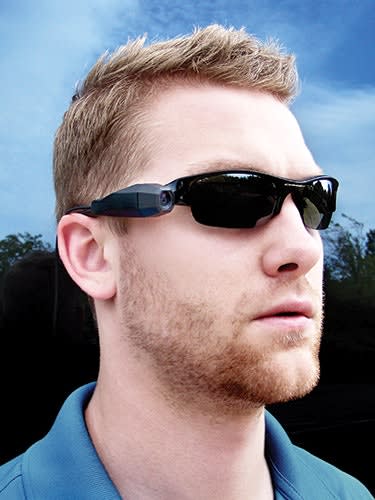
The FirstVu HD from Digital Ally is available in two configurations, a flat box and a "bullet" shape that can be attached to glasses or epaulettes. Both can be automatically activated using VuLink. Photo: FirstVu
Image Quality
Video is useless as evidence if you can't see what happened. Which is why so many law enforcement video manufacturers have stressed the quality of their video capture since the days of VHS. The quality of video that can be captured by small, digital camera systems today is truly impressive.
Most manufacturers of quality body-worn camera systems now offer their customers video quality ranging from 480p SD to 1080p HD at 60 frames. While every agency would like to have the highest resolution video capture possible, the limiting factor is often the cost of storage for the larger HD files.
Often a bigger concern for agencies than the resolution of the video is what can be seen in the frame. This is why companies tout wide-angle systems. Just as important for police operations are night and low-light capabilities. Most systems offer low-light capabilities, some with infrared assist. Kustom Signals even allows configuration of its Vantage system for day/night mode to enhance low-light video performance.
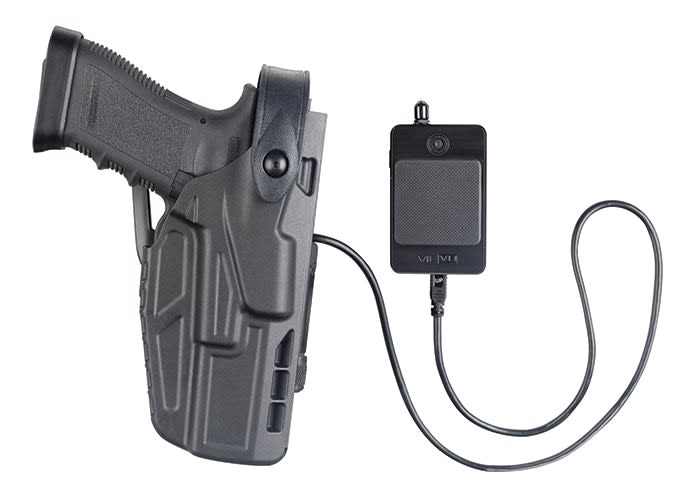
Vievu (Safariland) showed new technology at this year's SHOT Show that activates the officer's camera when he or she draws a tool or weapon from a special duty belt. Photo: Vievu
Integration with Car Systems
As discussed, Digital Ally was one of the first companies to combine the capabilities of in-car systems with body-worn cameras. At the time, Digital Ally was one of the few companies to make both body-worn and in-car systems. Today, just about every maker of law enforcement video for cars makes a body cam as well.
These companies are now offering synergies between their systems to entice agencies using a particular brand of in-car system to give serious consideration to using the same make of body-worn camera. The systems often integrate video capture as seen with Digital Ally's VuLink, upload either wirelessly or through a dock as with Kustom Signals Vantage, and/or share evidence management as seen with Panasonic's Arbitrator Body Worn Camera and Arbitrator in-car systems, which both use the company's Unified Evidence Management System.
Even TASER International, which makes body cameras but doesn't make in-car systems, is now offering ways to integrate in-car capabilities with its systems. TASER's Evidence.com cloud-based evidence management system has long had the capability to work with a variety of video, including files captured by in-car systems. And this year, TASER began offering a modified version of its Axon camera called the Axon Fleet designed to be used as an in-car system. Axon Fleet features wireless activation from triggers such as the lightbar switch or other sensors, Retina HD video for low-light performance, a rear-facing camera for prisoner surveillance, and wireless upload to Evidence.com, so the camera doesn't have to be removed from its mount.
Before and After Activation
A problem that was quickly discovered with the earliest analog in-car video systems was that incidents often begin before the video is triggered. Digital in-car video systems were able to address this by adding pre-event recording. And now so are body-worn systems.
A pre-event recording is created in a memory buffer. Basically, this means the camera is always recording the same loop over and over in the same small sector of its memory. When a recording is triggered, it also captures the buffer in the file. For a body-worn camera, this pre-event recording might actually be an attack on the officer, which could be critical in justifying an officer using force on a subject. A variety of body camera makers offer pre-event recording, usually with the buffers capturing from 30 seconds to two minutes of action before the camera was activated.
One of the most innovative features currently available on any in-car or body-worn system is WatchGuard Video's Record After the Fact. This literally means the camera can capture an event, even if the officer never activated the system when it was occurring. Record After the Fact is a feature on WatchGuard's 4RE in-car systems and Vista body cams, and it can literally capture an event more than a day after it happened. The technology works sort of like pre-event recording. The camera is always recording, except unlike pre-event recording, it actually writes the data to the memory, which means as long as the memory is not overwritten, the data can be recovered using WatchGuard's software.
Protecting the Innocent
Perhaps the most in-demand feature for law enforcement body-worn video systems is some form of automated redaction. The need for this capability is easily understood. Agencies are sending their officers out on the street capturing video, and when incidents happen, that video becomes evidence—and in some states public record—that must be released on demand. There are often minors, crime victims, witnesses, and even undercover officers whose identities must be protected on these videos, which means someone will have to go in and redact the video.
Video editors, even those with elementary skills, are expensive. So body-worn camera customers have been asking manufacturers for automated redaction features in the evidence management software of their body-worn camera systems. Numerous companies, including TASER, Digital Ally, Vievu, and Utility now offer this feature.
Automatic redaction of video speeds up the process of editing 30 or 60 frames a second into a simple point-and-click operation that an officer or trusted civilian employee can be trained to perform in a few hours. Using the software, the viewer can mark a target such as an object or person and the software will track the target throughout the video and blur it using a variety of techniques. Only a copy of the video is redacted. The original evidentiary file is not changed in the process.
Body-Worn Camera Companies:
More Technology
A police agency's guide to data-driven fleet management
Costs are rising and the public expects more transparency into how their tax dollars are spent. This e-book shows how police agencies can use fleet data to take control of fleet expenses while improving officer safety and demonstrating fiscal responsibility to the communities they serve.
Read More →
AI and analytics for law enforcement: Turning data into insights
Law enforcement agencies are managing more video, sensor data and digital evidence than ever before. Discover how AI and analytics can help turn that data into actionable insights that strengthen situational awareness, accelerate investigations and support more informed decisions.
Read More →
Vasco Electronics Adds Automatic Language Detection to Vasco Translator Q1
Vasco Electronics’ software update introduces hands-free language switching and expanded offline translation across 45 language pairs, empowering law enforcement, healthcare, and front-office enterprise teams
Read More →

North Miami Police Department Deploys Mark43
The North Miami Police Department has deployed Mark43 as part of its Five-Year Strategic Plan that represents its collective vision and goals for a more proactive police department, anchored by a core commitment to leveraging modern technology to enhance efficiency and public safety.
Read More →
Cellebrite Genesis for Enterprise Now Generally Available
Made available to the public sector in June, Cellebrite Genesis is serving a growing mix of national, regional, and local agencies worldwide, including some of the largest regional and metropolitan police departments. It is now available for enterprise organizations.
Read More →
2026 Vision FirstNet Users Summit to Host Emerging Leaders Training on Grassroots Advocacy for Public Safety
“Emerging Leaders Training: Understanding the Importance of Grassroots Advocacy for Public Safety," a session during the 2026 Vision FirstNet Users Summit, will offer a roadmap for unified advocacy at the federal level.
Read More →
Motorola Solutions Completes Acquisition of D-Fend Solutions
Motorola Solutions has acquired D-Fend Solutions, an industry leader in counter-drone technology. This deal provides public safety and enterprise customers with access to advanced counter-unmanned aerial systems.
Read More →
ZeroEyes, Advantech & Camden Police Partner to Bring AI Gun Detection Technology to Delaware School District
ZeroEyes has partnered with Advantech and the Camden Police Department to deploy ZeroEyes’ AI gun detection and intelligent situational awareness platform at Delaware’s Caesar Rodney School District (CRSD).
Read More →
Leonardo U.S. Cyber & Security Solutions Introduces SignalTrace, the Next Evolution in Electronic Signature Detection Technology
SignalTrace reflects years of product refinement and a clearer expression of the technology’s purpose of recognizing and correlating electronic signatures in publicly broadcast wireless signals to reveal patterns, relationships, and trends that might otherwise go undetected.
Read More →
Pimloc Launches Secure File Sharing to Streamline Release of Redacted Video
Pimloc’s Secure File Sharing lets organizations deliver redacted video, audio, and documents through expiring, passcode-protected links, accelerating delivery while reducing security, compliance, and chain-of-custody risks.
Read More →