



Analyzing DNA Blueprints
Parabon NanoLabs' Snapshot does much more than reveal an unknown subject's hair color and eye color. It can also be used to determine a subject's ancestry in detail.

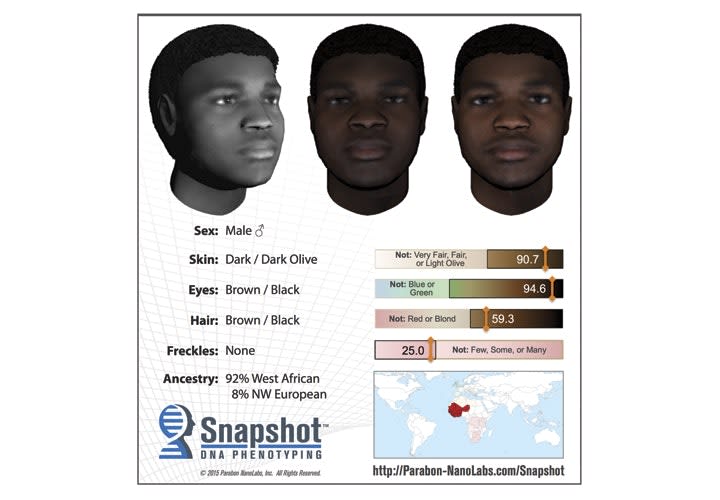
Photo: Parabon NanoLabs
Last month, Columbia, S.C., Chief of Police, Skip Holbrook, announced his department was releasing a computer-generated image of a person of interest in a double murder. The image was produced using a new DNA phenotyping service called Snapshot from Parabon NanoLabs.
Snapshot was developed with funding from the Department of Defense by combining a massive catalog of single nucleotide polymorphisms (SNPs) from thousands of willing subjects with a lot of data mining know-how and high-end computing power. A SNP ("snip") is a change in the DNA sequence that can determine variation of physical traits within a species; for example, the difference in humans between blue and brown eyes. Parabon's DNA scientists and computer technologists have identified the SNPs responsible for such traits and for more subtle aspects of a person's appearance and ancestry.
"A copy of this 'DNA blueprint' exists in every cell of the body, which makes DNA a potentially invaluable source of investigative information," says Ellen McRae Greytak, Ph.D., Parabon's director of bioinformatics. "However, traditional DNA forensic analysis treats DNA as simply a biometric identifier, a 'DNA fingerprint' for matching to a known individual."
Greytak says there are two major law enforcement applications for Snapshot: narrowing down a suspect pool in cases where there are no witnesses and no traditional DNA matches and putting a face on unidentified remains.
Parabon's founder and CEO Steven Armentrout, Ph.D., says Snapshot presents law enforcement with an entirely new way to use DNA analysis. "Heretofore, DNA hasn't been used much as an investigative tool; it's brought in at the end of an investigation for the final ID of the suspect. Snapshot moves DNA analysis to the front of an investigation, which saves both time and money."
Snapshot does much more than reveal an unknown subject's hair color and eye color. It can also be used to determine a subject's ancestry in detail.
One of the stages of Snapshot's development was a validation protocol that was used to test its mathematical models. Potential clients were asked to send Parabon samples of DNA from people unknown to the testers.
Greytak says the validation tests have been very successful and have also shown the value Snapshot offers to investigators. During one of the validation tests, Snapshot revealed the person's ancestry was 50% East Asian, 40% Native American, and 10% European, and detailed analysis determined that the subject's mother was Mexican-American and his father was Japanese. "In a real investigation that result could really narrow your suspect pool," Greytak says.
Once a law enforcement agency contracts with Parabon for the Snapshot service, it sends evidence or extracted DNA to one of Parabon's partner labs, which performs processing to determine the SNP sequences. These sequences are then processed using Parabon's prediction models. The client agency then receives a detailed analysis of the physical characteristics and ancestral background of the subject, including confidence levels for each prediction and a list of characteristics that can be excluded with high confidence. With this information, investigators can streamline their investigation by excluding a wide range of individuals from the suspect pool and focus on the most likely suspects.
Snapshot is available now, and Armentrout says the company is receiving a great response from its potential law enforcement clients. "The big thing we want the law enforcement community to understand is that this is a completely different way to use DNA," he says.
More Technology

A police agency's guide to data-driven fleet management
Costs are rising and the public expects more transparency into how their tax dollars are spent. This e-book shows how police agencies can use fleet data to take control of fleet expenses while improving officer safety and demonstrating fiscal responsibility to the communities they serve.
Read More →
AI and analytics for law enforcement: Turning data into insights
Law enforcement agencies are managing more video, sensor data and digital evidence than ever before. Discover how AI and analytics can help turn that data into actionable insights that strengthen situational awareness, accelerate investigations and support more informed decisions.
Read More →
Vasco Electronics Adds Automatic Language Detection to Vasco Translator Q1
Vasco Electronics’ software update introduces hands-free language switching and expanded offline translation across 45 language pairs, empowering law enforcement, healthcare, and front-office enterprise teams
Read More →
North Miami Police Department Deploys Mark43
The North Miami Police Department has deployed Mark43 as part of its Five-Year Strategic Plan that represents its collective vision and goals for a more proactive police department, anchored by a core commitment to leveraging modern technology to enhance efficiency and public safety.
Read More →
Cellebrite Genesis for Enterprise Now Generally Available
Made available to the public sector in June, Cellebrite Genesis is serving a growing mix of national, regional, and local agencies worldwide, including some of the largest regional and metropolitan police departments. It is now available for enterprise organizations.
Read More →
2026 Vision FirstNet Users Summit to Host Emerging Leaders Training on Grassroots Advocacy for Public Safety
“Emerging Leaders Training: Understanding the Importance of Grassroots Advocacy for Public Safety," a session during the 2026 Vision FirstNet Users Summit, will offer a roadmap for unified advocacy at the federal level.
Read More →
Motorola Solutions Completes Acquisition of D-Fend Solutions
Motorola Solutions has acquired D-Fend Solutions, an industry leader in counter-drone technology. This deal provides public safety and enterprise customers with access to advanced counter-unmanned aerial systems.
Read More →
ZeroEyes, Advantech & Camden Police Partner to Bring AI Gun Detection Technology to Delaware School District
ZeroEyes has partnered with Advantech and the Camden Police Department to deploy ZeroEyes’ AI gun detection and intelligent situational awareness platform at Delaware’s Caesar Rodney School District (CRSD).
Read More →
Leonardo U.S. Cyber & Security Solutions Introduces SignalTrace, the Next Evolution in Electronic Signature Detection Technology
SignalTrace reflects years of product refinement and a clearer expression of the technology’s purpose of recognizing and correlating electronic signatures in publicly broadcast wireless signals to reveal patterns, relationships, and trends that might otherwise go undetected.
Read More →
Pimloc Launches Secure File Sharing to Streamline Release of Redacted Video
Pimloc’s Secure File Sharing lets organizations deliver redacted video, audio, and documents through expiring, passcode-protected links, accelerating delivery while reducing security, compliance, and chain-of-custody risks.
Read More →