



Accent on Officer Safety
Given the ever-present risks to your survival, it's important for you to know that in numerous decisions, the U.S. Supreme Court has created special rules to allow you to investigate crimes and apprehend suspects without undue restrictions that jeopardize your safety. Being aware of these cases can help you avoid taking chances you don't have to take.


Photo: iStockphoto.com.
Nobody knows why, but at the same time that serious crime rates have fallen substantially, dangerous and deadly attacks on law enforcement officers have risen sharply. In 2010, according to figures posted by the National Law Enforcement Officers Memorial Fund, on-duty officer fatalities increased 40 percent over the year before, and so far this year, the total is 14 percent higher than last year's shocking level. Nearly 60,000 officers are assaulted each year, with about one-third of those attacks resulting in injuries, according to the FBI Uniform Crime Reports.
Given the ever-present risks to your survival, it's important for you to know that in numerous decisions, the U.S. Supreme Court has created special rules to allow you to investigate crimes and apprehend suspects without undue restrictions that jeopardize your safety. Being aware of these cases can help you avoid taking chances you don't have to take.
Ordering Vehicle Occupants to Get Out
At a lawful traffic stop, you need not take a chance that occupants may have access to concealed weapons inside the vehicle. You have the option to order everyone out (safety and control permitting). You do not have to give any justification for doing so. "It appears that a significant percentage of murders of police officers occur when the officers are making traffic stops. We hold that once a motor vehicle has been lawfully detained for a traffic violation, the police officers may order the driver to get out of the vehicle without violating the Fourth Amendment." (Pennsylvania v. Mimms) Also, "An officer making a traffic stop may order passengers to get out of the car pending completion of the stop." (Maryland v. Wilson)
Once occupants are outside, you have the right to detain them in place, without them moving around behind you. "No one in the car is free to leave without police permission." (Brendlin v. California) "A traffic stop of a car communicates to a reasonable passenger that he or she is not free to terminate the encounter with the police and move about at will." (Arizona v. Johnson)
Weapons Frisk
Although most searches require "probable cause," you may pat down the outer clothing of a person you have lawfully detained whenever you have only the lower level of "reasonable suspicion" that he is armed and dangerous. "We cannot blind ourselves to the need for law enforcement officers to protect themselves and other prospective victims of violence in situations where they may lack probable cause for arrest." (Terry v. Ohio)
Reasonable suspicion may be based on less information, of a less-reliable nature, than PC. (Alabama v. White)[PAGEBREAK]
When your detainee was the recent occupant of a vehicle, you may "frisk" the vehicle for weapons with the same lower level of reasonable suspicion that there may be a weapon inside (looking into places and containers that might conceal a weapon). "The search of the passenger compartment of an automobile, limited to those areas in which a weapon may be placed or hidden, is permissible if the police officer possesses a reasonable belief based on specific and articulable facts which, taken together with the rational inferences from those facts, reasonably warrant the officer in believing that the suspect is dangerous and the suspect may gain immediate control of weapons." (Michigan v. Long)
Occupant Control During Search Warrant Service
Even non-suspects who are present during service of a search warrant may be detained. "The risk of harm to both the police and the occupants is minimized if the officers routinely exercise unquestioned command of the situation. We hold that a warrant to search carries with it the limited authority to detain the occupants while a proper search is conducted." (Michigan v. Summers)
If handcuffing is necessary, "Inherent in the authorization to detain an occupant of the place to be searched is the authority to use reasonable force to effectuate the detention. In such inherently dangerous situations, the use of handcuffs minimizes the risk of harm to both officers and occupants." (Muehler v. Mena)
Safety Sweep
Once you're lawfully inside a residence, your articulable suspicion that there may be a potential assailant present justifies a safety sweep of the premises. "Unlike an encounter on the street or along a highway, an in-home arrest puts the officer at the disadvantage of being on his adversary's 'turf.' An ambush in a confined setting of unknown configuration is more to be feared than it is in open, more familiar settings. The Fourth Amendment permits a properly limited protective sweep when the searching officer possesses a reasonable belief that the area harbors a dangerous individual." (Maryland v. Buie)
Arrestee Control
Once a person has been lawfully arrested, you may accompany him wherever he goes (including into his house). "Every arrest must be presumed to present a risk of danger to the arresting officer. The officer's need to ensure his own safety is compelling. We hold, therefore, that it is not unreasonable for a police officer to routinely monitor the movements of an arrested person, as his judgment dictates, following the arrest." (Washington v. Chrisman)
Deadly Force
Where a dangerous criminal is suspected, the reasonable use of deadly force to prevent serious injury or death to you or to others, or to prevent escape, does not violate the Fourth Amendment. "Where the officer has probable cause to believe that the suspect poses a threat of serious physical harm, either to the officer or to others, it is not constitutionally unreasonable to prevent escape by using deadly force. Thus, if the suspect threatens the officer with a weapon or there is probable cause to believe that he has committed a crime involving the infliction or threatened infliction of serious physical harm, deadly force may be used if necessary to prevent escape, and if, where feasible, some warning has been given." (Tennessee v. Garner)
If a vehicle pursuit endangers pursuing officers or other motorists or bystanders, tactics to end the pursuit may include steps that raise fatal risks for the offender. "A police officer's attempt to terminate a dangerous high-speed car chase that threatens the lives of innocent bystanders does not violate the Fourth Amendment, even when it places the fleeing motorist at risk of serious injury or death." (Scott v. Harris)
Custodial Interrogation Outside Miranda
If you need to ask questions of a person in custody in order to neutralize an immediate threat to officer safety or public safety, Miranda does not apply. "The need for answers in a situation posing a threat to the public safety outweighs the need for Miranda warnings. An objectively reasonable need to protect the police or the public from any immediate danger [justifies a Miranda exception]. Police officers can and will distinguish almost instinctively between questions necessary to secure their own safety or the safety of the public and questions designed solely to elicit testimonial evidence from the suspect." (New York v. Quarles)
Remember...
Neither the prospect of suppression of evidence nor the hazard of civil liability should cause you to take unwise chances with your safety. "Certainly, it would be unreasonable to require that police officers take unnecessary risks in the performance of their duties." (Terry v. Ohio)
Devallis Rutledge is a former police officer and veteran prosecutor who currently serves as Special Counsel to the Los Angeles County District Attorney. He is the author of 12 books, including "Investigative Constitutional Law."
More Patrol

Adept Armor Introduces Two New Rifle Plates
Adept Armor has launched two new Level IV ballistic plates, the Emperor and the Archon Mark 2, which brings Adept Armor’s new Quatroid ceramic to the high-threat, performance-value center of the range at 5.2 pounds.
Read More →
POLICE Product Test: Benchmade Bailout
The Benchmade Bailout is a slim, lightweight carry knife with a deep-ride pocket clip and comes in a variety of blade steels and scales. Here is a detailed review of the Taiga Green Bailout, released earlier this year.
Read More →
NLEOMF Announces July 2026 Officer of the Month
NLEOMF honored a Michigan deputy sheriff as the July 2026 Officer of the Month for rescuing a trapped driver from a burning vehicle following a Fourth of July crash.
Read More →
Streamlight to Showcase Newest Lighting Products at National Safety Council’s Safety Congress & Expo 2026
Streamlight will showcase its latest lights, including the Portable Scene Light III and the LiteBox 1Million, at the 2026 National Safety Council (NSC) Safety Congress & Expo.
Read More →
The 2027 World Police & Fire Games Set for Perth, Australia
The 2027 World Police & Fire Games (WPFG) will take place in Perth, Western Australia, from Friday, March 12 through Sunday, March 21, 2027.
Read More →
5.11 Partners with National Fallen Firefighters Foundation to Support #ForThe343
5.11 has joined the nationwide movement honoring the 343 New York City Fire Department firefighters lost on Sept. 11, 2001.
Read More →
Team Wendy Announces Title Sponsorship of the Jorge Pastore Foundation
Team Wendy’s 3-year partnership with the Jorge Pastore Foundation expands access to programs that strengthen those who serve.
Read More →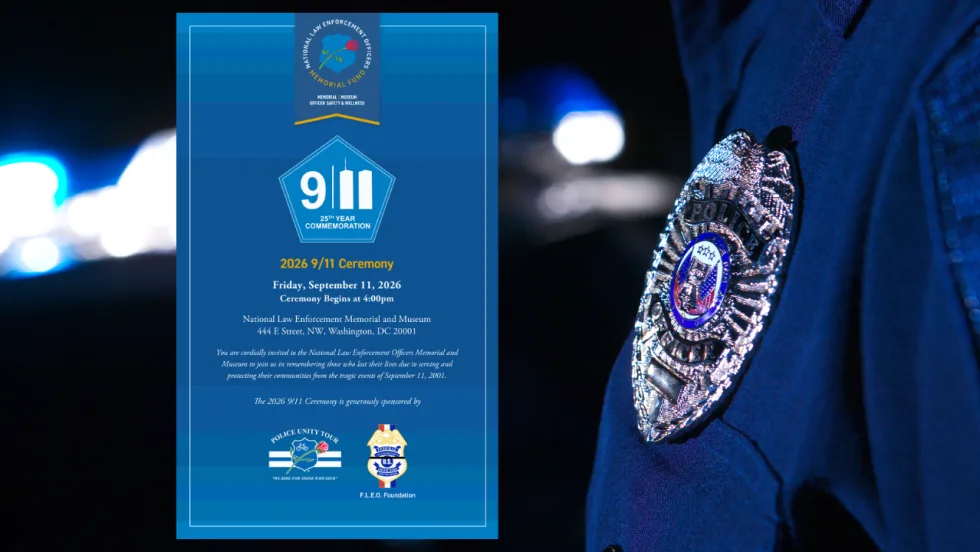
National Law Enforcement Memorial and Museum Hosting 9/11 25th-Year Commemoration Ceremony
The National Law Enforcement Memorial and Museum is hosting a 9/11 25th Year Commemoration Ceremony on Sept. 11 at 4 p.m.
Read More →
National Law Enforcement Officers Memorial Fund Announces June 2026 Officers of the Month
The National Law Enforcement Officers Memorial Fund (NLEOMF) named 15 officers of the Chico Police Department (California) as the Officers of the Month for June 2026 for their roles in responding to an active-shooter incident at a public library.
Read More →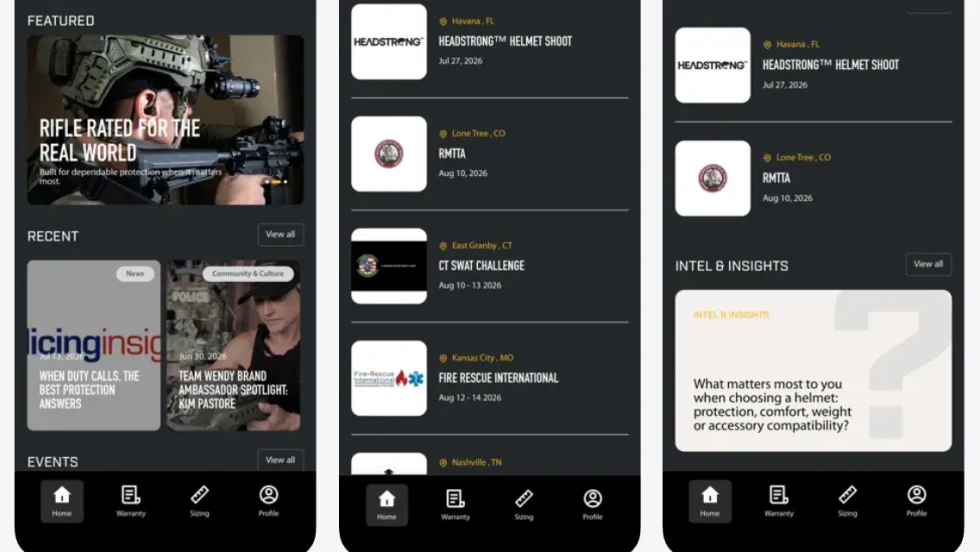
Team Wendy App Creates New Digital Hub for Helmet Owners
The Team Wendy Community App provides one location for warranty registration, size-fit tools, product updates, and community connection. For helmet owners, the new app creates a simpler path to the information and tools that matter most.
Read More →