



30 Years and Still Going Strong
Give or take a few weeks, Police Magazine was born 30 years ago this month as Police Product News. The magazine was the brainchild of Rodney A. Dornsife, its first editor and a San Diego cop. And like many small magazine startups it was a family project. Rod’s brother Chad was the advertising director, and according to Chad their father worked distribution.

Give or take a few weeks, Police Magazine was born 30 years ago this month as Police Product News. The magazine was the brainchild of Rodney A. Dornsife, its first editor and a San Diego cop. And like many small magazine startups it was a family project. Rod's brother Chad was the advertising director, and according to Chad their father worked distribution.
To promote their magazine, the Dornsifes produced posters of a beautiful young woman dressed in a sexy motorcycle cop uniform posing next to a Kawasaki police bike. They then dropped off the posters and boxes of their first issue to police stations across the West.
The cheesecake photography worked and the promotional poster became one of the signatures of the magazine. Its "Do You Have Court Today?" calendars are still remembered fondly by cops who read Police from 1976 to the early 1980s when the calendars were discontinued.
Times changed. And the magazine changed with them.
For example, the first edition of Police Product News featured ads for revolver holsters, speed loaders, and speed loader pouches. Today, there may still be a few cops using revolvers as their primary sidearms, but the semi-auto dominates and our gun ads reflect that fact.
The rise of the semi-auto wasn't the only major change in police technology, equipment, and tactics in the last 30 years. Here's a quick look at just some of the gear, equipment, and tactics that you now take for granted that were developed in the last three decades.
Ballistic Vests. Yes, the six-point Kevlar police ballistic vest was developed in the early 1970s. But it really came on line about the time that Police Product News was launched. An ad in the first issue touts the 76th save for a Second Chance vest. Currently, Second Chance (now part of Armor Holdings) says its vests have saved 987 officers. Since 1976, thousands of officers have been saved by the fact that their agencies mandate that they wear ballistic vests on duty.
OC Spray. Some police in 1976 had CS and CN gas sprays on their belts. They were much less effective than OC and not nearly as common in patrol use.
Tasers. Yes, police had Tasers in 1976, but they were much weaker, much bulkier weapons than the M26 or X26 that's now on the belts of patrol officers nationwide.
SWAT. SWAT was developed in Los Angeles in the late 1960s in response to the Watts riots. But the concept really caught on in the mid-1970s and early 1980s.
Hostage / Crisis Negotiation. This concept was developed following the Munich Olympics Massacre in 1972. It reached American police agencies a few years later and became widespread in the 1980s and 1990s.
Patrol Rifles. For a century, the standard long gun of the American police officer was the 12-gauge shotgun. Many agencies adopted patrol rifles, usually AR-15 variations, following the 1997 North Hollywood bank robbery.
Communications. Where do we start this discussion? In 1976, you had your car radio, bulky walkie-talkies, or pay phones. Now you have car computers, small digital radios that clip to your belts, and cell phones.
That's just a small sample of the law enforcement innovations that have changed police work since the Dornsifes launched Police Product News 30 years ago. But one thing that hasn't changed in the last three decades is the mission of this magazine. Rod Dornsife wrote in his first editorial that this is the magazine for the "working cop." That's still our mission at Police, and it always will be.
Thank you for reading Police and a special thank you to the officers who have read this magazine all of the last 30 years. We hope you'll be with us another 30.
More Patrol

Streamlight Portable Scene Light III Wins 2026 OH&S New Product of the Year Award
Streamlight’s Portable Scene Light III has won the 2026 Occupational Health & Safety (OH&S) New Product of the Year Award in the Lighting category.
Read More →
Adept Armor Introduces Two New Rifle Plates
Adept Armor has launched two new Level IV ballistic plates, the Emperor and the Archon Mark 2, which brings Adept Armor’s new Quatroid ceramic to the high-threat, performance-value center of the range at 5.2 pounds.
Read More →
POLICE Product Test: Benchmade Bailout
The Benchmade Bailout is a slim, lightweight carry knife with a deep-ride pocket clip and comes in a variety of blade steels and scales. Here is a detailed review of the Taiga Green Bailout, released earlier this year.
Read More →
NLEOMF Announces July 2026 Officer of the Month
NLEOMF honored a Michigan deputy sheriff as the July 2026 Officer of the Month for rescuing a trapped driver from a burning vehicle following a Fourth of July crash.
Read More →
Streamlight to Showcase Newest Lighting Products at National Safety Council’s Safety Congress & Expo 2026
Streamlight will showcase its latest lights, including the Portable Scene Light III and the LiteBox 1Million, at the 2026 National Safety Council (NSC) Safety Congress & Expo.
Read More →
The 2027 World Police & Fire Games Set for Perth, Australia
The 2027 World Police & Fire Games (WPFG) will take place in Perth, Western Australia, from Friday, March 12 through Sunday, March 21, 2027.
Read More →
5.11 Partners with National Fallen Firefighters Foundation to Support #ForThe343
5.11 has joined the nationwide movement honoring the 343 New York City Fire Department firefighters lost on Sept. 11, 2001.
Read More →
Team Wendy Announces Title Sponsorship of the Jorge Pastore Foundation
Team Wendy’s 3-year partnership with the Jorge Pastore Foundation expands access to programs that strengthen those who serve.
Read More →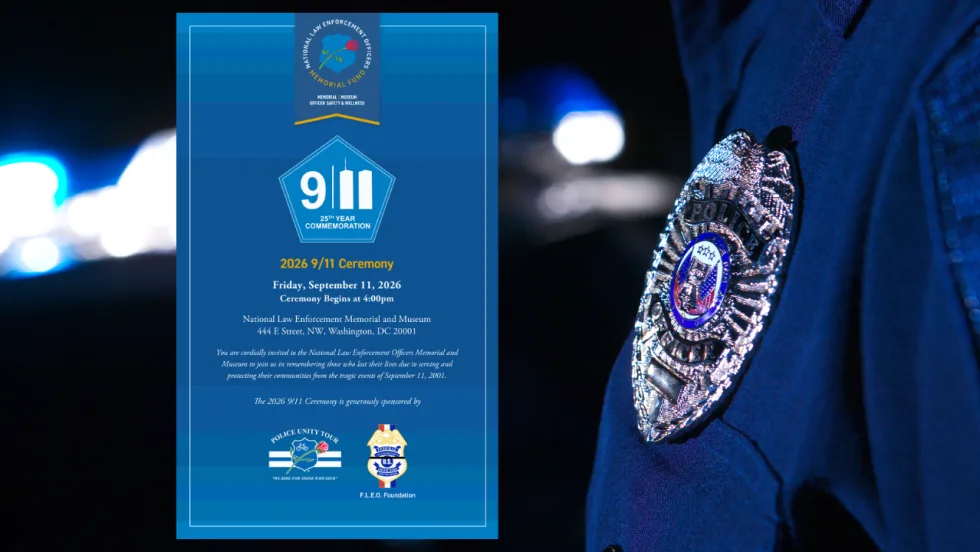
National Law Enforcement Memorial and Museum Hosting 9/11 25th-Year Commemoration Ceremony
The National Law Enforcement Memorial and Museum is hosting a 9/11 25th Year Commemoration Ceremony on Sept. 11 at 4 p.m.
Read More →
National Law Enforcement Officers Memorial Fund Announces June 2026 Officers of the Month
The National Law Enforcement Officers Memorial Fund (NLEOMF) named 15 officers of the Chico Police Department (California) as the Officers of the Month for June 2026 for their roles in responding to an active-shooter incident at a public library.
Read More →