



Shots Fired: Anderson, South Carolina 04/07/2004
With six years of law enforcement experience, Officer Susanne Simonson-Mullis of the Anderson (S.C.) Police Department hardly considered herself a rookie, and she felt fortunate to have another patrol veteran, Officer Dusty Ashley, working with her on the same beat.

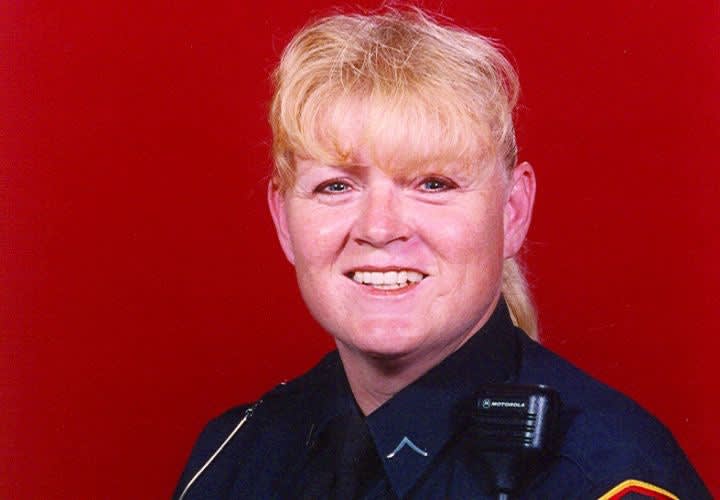
With six years of law enforcement experience, Officer Susanne Simonson-Mullis of the Anderson (S.C.) Police Department hardly considered herself a rookie, and she felt fortunate to have another patrol veteran, Officer Dusty Ashley, working with her on the same beat.
Simonson-Mullis and Ashley were working sister cars on April 7, 2004, when around 11 p.m. the call of a silent burglary alarm at Grady's Great Outdoors outlet store went out.
Ashley's patrol car was first in the parking lot, with Simonson-Mullis quick on his heels. Neither had ever rolled on a silent alarm call at the store.
The two officers parked and exited their cars and approached the front of the business. They noted the absence of bars or cages on the building's facade. But their check of the doors and windows revealed nothing unusual.
They headed toward the rear of the building, skirting a chain link fence and an offset storage room before heading up a ramp to the rollup door. Nothing. Simonson-Mullis angled her flashlight into a dumpster standing next to the door. Still nothing.
The two pressed on, the beams of their flashlights snaked across brick and mortar, but nothing appeared out of place. All was as it should be, just as it was on a hundred other insignificant alarm calls.
Simonson-Mullis and Ashley were just about to close the call as an accidental activation when something caught their eye: A lock on a canoe storage area had been broken.
Man in the Lights
They requested that the station night detective respond to the incident. Then Simonson-Mullis and Ashley decided to escape the cold in their patrol cars, which they pulled into the rear parking lot of the store.
As Ashley's headlights swept across the rear of the building, they illuminated something that neither officer had noticed during their initial search nor on their subsequent pass in their cars: the figure of a young white man standing near the ramp some 20 feet in front of them.
The man stood between the rollup door and the same trash bin that Simonson-Mullis had shined her flashlight into only moments before. Decked out all in black with a charcoal hoodie sweater, jeans, boots, and ski mask, he remained immobile even when bathed in their spotlights. Ashley jumped out the driver's side of his patrol car. Almost simultaneously, Simonson-Mullis did likewise from hers.
That's when they noticed the man was carrying a gun.
Simonson-Mullis positioned herself at the apex of her open driver's door and the body of the patrol car as she used the car radio to advise that they had an armed suspect on scene.
Same as Monday morning, she thought.
Two Days Earlier
Only two days before, Simonson-Mullis had responded to a suspicious person call.
Upon her arrival at that location, she found the subject of the call seated inside the driver's seat of a Geo Prizm. Contacting the man, Simonson-Mullis suddenly found herself facing the barrel of a handgun.
Despite the fact that the driver had gotten the drop on her, Simonson-Mullis was eventually able to move herself to a position of cover to the rear of the car without getting shot.
That had been the start of a barricade situation that would ultimately involve a good many officers and a crisis negotiation team. It had ended with the gunman shooting himself in the head.
In the aftermath of Monday's shooting, the stench of death—that iron-like smell of blood and gunpowder—enveloped Simonson-Mullis. It was in her clothes, in her hair, and seemed to emanate from her very pores, so the first thing she wanted to do when she got home was to take a shower.
But although the shooting incident had left Simonson-Mullis shaken, it had not been enough to keep her out of the field.
Now, in the parking lot behind the closed outlet store, Simonson-Mullis was once again dealing with a man who was armed and equally inclined to take her life as he was his own.
She contemplated the odds of an officer facing two similar situations in an equal number of days. Conventional wisdom put the likelihood of any one of two officers being involved in a shooting at perhaps once every 20 years. Factoring in the reality of working in Anderson, a city of 25,000 that until Monday hadn't had a suspect killed incident in an officer-involved confrontation for more than 20 years, and the odds against it should have been astronomical.
Think of Your Family
But here she was.
The engine block of Simonson-Mullis' patrol car provided good cover, but less than optimum concealment. Keeping the suspect in her gun sights, she moved to the rear of her car where she crouched down near the right rear taillight. In doing so, she afforded herself an extra half a car length of cover and concealment, and placed herself a mere five feet away from her partner, who had assumed a similar position at the left rear of his vehicle.
Ashley yelled at the man, "Put the gun down!" But he didn't answer and he didn't comply.
Simonson-Mullis wanted to get the man back into some other frame of mind, something away from the standoff of the moment. A mere 20 feet separated the officers and the suspect and, though his features were obscured, Simonson-Mullis had a good view of what remained. The man's size and posture suggested that he was in his mid-20s. She decided to appeal to the man's sense of responsibility.
"Think about your family," she said.
"I'm too young to have a family," he replied.
Simonson-Mullis tried again.
"Think about your dad."
"I don't have a dad."
"Think about your mom."
"F**k my mom!" There was so much hatred in the man's voice, so much vitriol.
He's going to kill himself. God help me, he's going to kill himself. Please don't make us have to shoot this kid.
Dark Agenda
The suspect rotated the gun from his right temple to his throat, to the underside of his chin, and back to his temple.
By now, county cops, state police, and the whole of the Anderson Police Department had descended upon the scene, but Ashley and Simonson-Mullis remained front and center, their attentions committed to the man before them.
"I've got sixteen rounds in my gun," the suspect said. "I wonder how many of you f**king pigs I can take out with me!"
Simonson-Mullis's hands had always been her Achilles heel, obligating her to carry a smaller frame gun than that wielded by the rest of the Anderson PD. As the incident wore on, the more aware she became of the weapon's weight and the slight tightening of her finger on its trigger. An elongation settled into her breathing as she anticipated the split-second need to take the shot. Throughout, she could feel her heart pounding with such unrelenting force that she feared it might come out of her chest.
The suspect's rant continued, his mouth spewing garbage. Simonson-Mullis noted that instead of any conciliatory overture, the man was working in another direction, his speech becoming more adamant, more agitated, more emboldening. At some point, she realized that anything directed at them was incidental to a primary agenda: The man was working himself up. He was summoning the courage to commit to some private course of action.
The man's gun gravitated downward, its barrel coming to rest beneath his chin, and he appeared momentarily reflective, the barrel of the gun serving as a prop like the hand of Rodin's sculpture of "The Thinker."
Then the barrel swung outward toward the officers. Twin bursts of gunfire flashed from the barrels of Simonson-Mullis' and Ashley's .40-caliber handguns. The suspect fell, his legs kicking feebly outward…then stopping.
The Teenager
A single high-pitched scream from a female on the outside of the containment punctuated the scene. The emergency medical services that had been on standby now went to work, trying to save the suspect.
At 11:46 p.m., Christopher Nash, 16, who'd envisioned a last stand shootout with the cops, was pronounced dead.
The lack of identification on the suspect's person or hits in any fingerprint database hindered suspect identification. An autopsy revealed that Ashley's single round had taken out the kid's heart, killing him instantly. Simonson-Mullis' single round had missed.
In retrospect, Simonson-Mullis and Ashley wondered how they could have missed the suspect during their initial search. They subsequently speculated that he hid near a couple of offset structures behind the store before migrating forward, possibly as they returned to their patrol cars. But they could never be sure. Later investigation revealed that Nash had planned to steal weapons from the outlet store so that he could go out in a blazing shootout with the cops.
The South Carolina State Law Enforcement Division investigation found both officers' actions within policy and justified.
Shattered Lives
In the days following the shooting, an impromptu memorial popped up at the site as local kids spray painted the wall with goodbye sentiments to the deceased, along with an occasional expletive, just to let the cops know that they hadn't been forgotten, either.
The shooting had left its mark elsewhere, as well. The scars were less visible than graffiti on the walls of the store, but deeper, more permanent.
For Simonson-Mullis, the scars manifested themselves in a heightened awareness, both at work and at home. She found herself hyper-vigilant for tell-tale signs of danger.
Then at a ceremony far away from the media limelight usually reserved for such awards, Simonson-Mullis and Ashley were decorated for bravery. If the ceremony had been meant to underscore to the officers the validity of their actions, the self-conscious overtures of the department had the opposite effect. They made the officers wonder if they had, in fact, done the right thing. The succeeding months found Simonson-Mullis and Ashley wrestling with demons.
Each officer ended up dealing with post traumatic stress disorder: Simonson-Mullis in part because her shot had missed; Ashley, because his hadn't and he had taken the life of a 16-year-old. In and of itself the shooting would have affected Simonson-Mullis, but coming within 48 hours of the previous incident, the effects were likely amplified.
In time, Simonson-Mullis found herself in need of counseling and was twice taken off duty by a psychologist during the following year. She used as much worker's compensation and family leave as she had available, but eventually her leave time with the department was depleted. She found herself in a Catch-22, knowing that she was unfit to return to duty, but threatened with termination if she didn't.
By March 2006, Simonson-Mullis was out of a job. Today she continues to pursue retirement status with the department.
Ashley held out a little longer. But early in 2006, he, too, found himself out of a job.
Consider These Questions
Think about the situation that faced Officer Susanne Simonson-Mullis and Officer Dusty Ashley of the Anderson (S.C.) Police Department, and ask yourself the following questions:
When handling alarm calls, to what extent do you check off-set structures on property grounds? Do you tend to take more time investigating private property calls or those occurring on commercial properties?
The officers involved in this shooting faced-off against the suspect for more than 15 minutes, yet each fired within a split-second of one another. What have you done to prepare yourself for a possible armed confrontation? Is a long standoff in favor of law enforcement or the suspect?
One of the officers involved in this shooting had been involved in a stressful shooting incident only two days prior. Ultimately, it factored into the loss of her job. How much time do you believe officers should take off before returning to work after a shooting? Whose call should it be?
Are you aware of any officers who have been terminated for their inability to return to work in the aftermath of a shooting?
More Patrol

Streamlight Portable Scene Light III Wins 2026 OH&S New Product of the Year Award
Streamlight’s Portable Scene Light III has won the 2026 Occupational Health & Safety (OH&S) New Product of the Year Award in the Lighting category.
Read More →
Adept Armor Introduces Two New Rifle Plates
Adept Armor has launched two new Level IV ballistic plates, the Emperor and the Archon Mark 2, which brings Adept Armor’s new Quatroid ceramic to the high-threat, performance-value center of the range at 5.2 pounds.
Read More →
POLICE Product Test: Benchmade Bailout
The Benchmade Bailout is a slim, lightweight carry knife with a deep-ride pocket clip and comes in a variety of blade steels and scales. Here is a detailed review of the Taiga Green Bailout, released earlier this year.
Read More →
NLEOMF Announces July 2026 Officer of the Month
NLEOMF honored a Michigan deputy sheriff as the July 2026 Officer of the Month for rescuing a trapped driver from a burning vehicle following a Fourth of July crash.
Read More →
Streamlight to Showcase Newest Lighting Products at National Safety Council’s Safety Congress & Expo 2026
Streamlight will showcase its latest lights, including the Portable Scene Light III and the LiteBox 1Million, at the 2026 National Safety Council (NSC) Safety Congress & Expo.
Read More →
The 2027 World Police & Fire Games Set for Perth, Australia
The 2027 World Police & Fire Games (WPFG) will take place in Perth, Western Australia, from Friday, March 12 through Sunday, March 21, 2027.
Read More →
5.11 Partners with National Fallen Firefighters Foundation to Support #ForThe343
5.11 has joined the nationwide movement honoring the 343 New York City Fire Department firefighters lost on Sept. 11, 2001.
Read More →
Team Wendy Announces Title Sponsorship of the Jorge Pastore Foundation
Team Wendy’s 3-year partnership with the Jorge Pastore Foundation expands access to programs that strengthen those who serve.
Read More →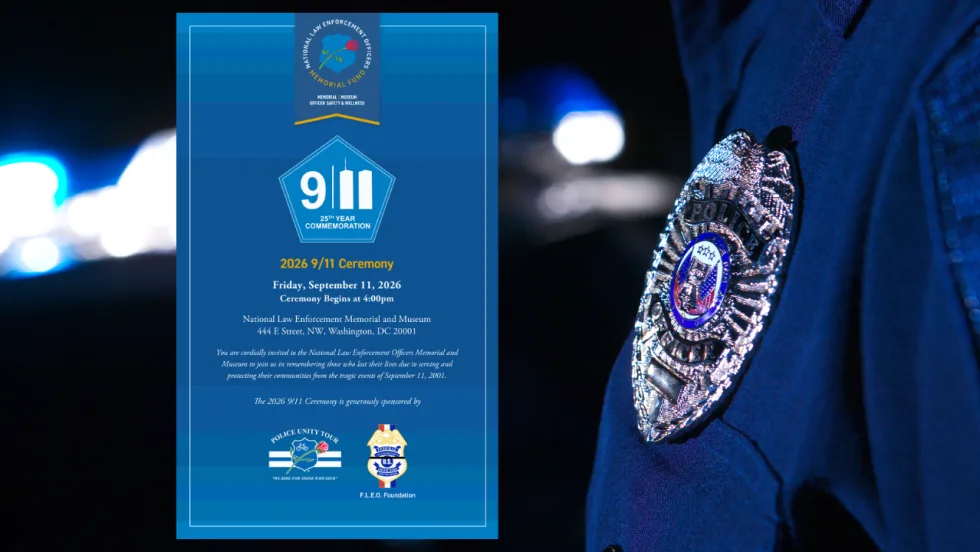
National Law Enforcement Memorial and Museum Hosting 9/11 25th-Year Commemoration Ceremony
The National Law Enforcement Memorial and Museum is hosting a 9/11 25th Year Commemoration Ceremony on Sept. 11 at 4 p.m.
Read More →
National Law Enforcement Officers Memorial Fund Announces June 2026 Officers of the Month
The National Law Enforcement Officers Memorial Fund (NLEOMF) named 15 officers of the Chico Police Department (California) as the Officers of the Month for June 2026 for their roles in responding to an active-shooter incident at a public library.
Read More →