



Information and Tips
In addition to good citizens reporting suspicious behavior, police may receive tips from fellow officers, criminal informants, or anonymous sources. The more reliable the source of information, the less independent police investigation is necessary to verify the veracity of the tip.

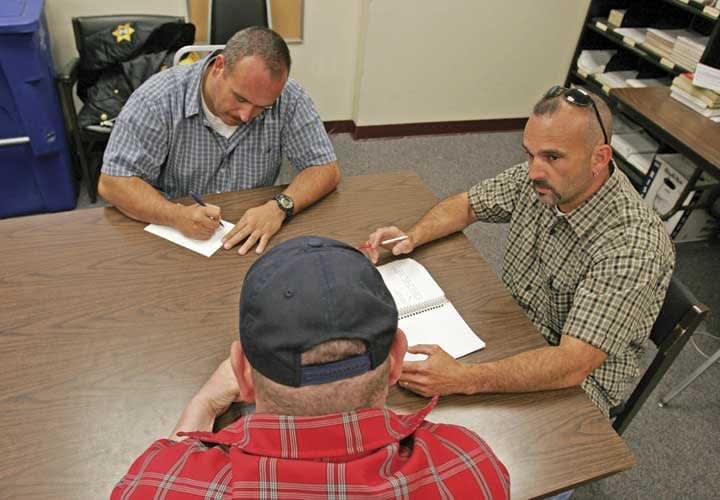
Those in law enforcement, being comparatively few in numbers compared to the size of their jurisdictions, must rely on the citizenry to be their eyes and ears. It would be impossible to have a cop on every corner. Instead, they must rely on those outside their ranks. With technological progress, it's become easier to receive tips from various sources.
In addition to good citizens reporting suspicious behavior, police may receive tips from fellow officers, criminal informants, or anonymous sources. The more reliable the source of information, the less independent police investigation is necessary to verify the veracity of the tip.
Likely Credible Sources
The most reliable source of information is another law enforcement officer. As a general rule, courts consider information from another law enforcement source to be inherently reliable. Therefore there is no need for the receiving officer to take steps to check the reporting officer's credibility or reliability.
While not as ironclad, another reliable source of information is the citizen informant. These are ordinary citizens who observe suspicious behavior and are courageous enough to step forward, identify themselves, and report the activities to the police. The court sees these citizens as fighting the same fight as the police, with their sole motivation being an attempt to suppress crime.
It is presumed that these citizens have no ties to criminals and no ulterior motives. Unlike a criminal informant, the citizen informant is not motivated by an expectation of gain, concession, revenge, or leniency. So it usually takes a minimal number of steps to verify the person's credibility.
Some ordinary citizens enjoy a higher degree of credibility and reliability based on their connections to their communities. Courts have held in very high esteem the information provided by firefighters, EMTs, and security personnel. Though these individuals are not sworn law enforcement, their commitment to the community makes them presumably more public spirited than the average citizen. The information provided by these servers of the community can be considered credible sources of information.
Criminal Informants
What makes the citizen informant so credible is that he or she is providing information with no hopes of reimbursement. The same cannot be said for criminal informants, who provide information to police for a number of dubious reasons including revenge, a reduction of pending charges, and a hope of leniency at the time of sentencing.
Understandably, courts are skeptical of information provided by criminals. For this reason, it's best to use the information provided by criminal informants as a piece of a totality of circumstance equation. Knowing the criminal informant's reliability will be scrutinized by the courts, take proactive steps at the beginning of the investigation to ensure the informant's information is reliable.
The most common way to establish a criminal informant's reliability is to document past use. You'll certainly want to note all the times the informant's information was correct. Taking this one step further, note how often the informant's tips led to an arrest and conviction. Also include the types of investigations the informant assisted with. If you can show the informant has been consistently correct in matters of "street drug sales" or "burglary investigations" this specialized knowledge will lend credence to his or her reliability.
Another factor that can enhance the perceived reliability of an informant in court is if one makes statements against his own interests while providing the tips. The courts have realized that admitting to criminal behavior to the police is not something a person would usually do. When an informant takes this unusual step his or her statements are viewed as more credible.
It also makes sense that someone who has been personally involved in a criminal activity would have a greater degree of knowledge about that criminal activity. Further, it would not make sense for a past criminal who is seeking leniency to send the police on a wild goose chase by providing inaccurate information. Courts have also looked favorably on informants who provided information as part of a process of changing their behavior. In one case where a user turned in his dealer, the court felt the reliability of the statement was greatly enhanced.
But not every tip is gold. An informant's degree of reliability is directly related to the degree of detail provided. "There is a guy selling drugs near the bus station" would be considered a vague statement, not a reliable tip. The informant needs to provide precise details to enhance his or her credibility.
In this example, obviously a physical description of the drug dealing suspect is needed. But what other details about the suspect show the informant has intimate knowledge about him? Does the suspect have an accent? How about a tattoo in a hidden location on his body? What is the suspect's domestic situation? Who does he live with? Where is the contraband sold from? Does the suspect work alone or with others? Who gets the contraband? Who handles the money?
This depth of detail fortifies the reliability of the information provided. It is unlikely the informant will provide this information unless the police are smart enough to ask for it.
Vetting Anonymous Tips
All tips should be verified by some type of independent police corroboration. You don't want to take any tip from a non-law enforcement source and consider it gospel. Such corroboration serves at least two important functions. First, it helps add to the reliability of the tip and confirms the accuracy of the informant's information. Second, it will help make up for any deficiencies in the informant's information. Independent police corroboration helps complete the totality of circumstance equation.
The type of tip that requires the most independent police corroboration is the anonymous tip. All of the traditional indicators of reliability are lacking in a tip provided by an anonymous source. Verifying the reliability of an anonymous tip involves two steps: detail development and independent verification.
The first step, detail development, is in the hands of the call taker. To establish what the informer's basis of knowledge is, the call taker must obtain as much information as possible from the informant. How does the informant have knowledge of the criminal activity? Was it observed personally or is this secondhand information? From what distance is the informant observing the action? How long ago did this event occur? How often does this event occur? What specifically is the informant observing?
This last question is important. Don't let the informant draw legal conclusions such as, "I am observing a robbery." Non-police personnel lack the legal sophistication to accurately draw such conclusions. Instead, have the informant describe actions he or she is observing such as, "A male is pinning another male to a car and holding a knife to his neck."
Specifics about the criminal actor and victim should also be obtained, of course. Only after these general questions have been exhausted should the call taker begin to ask some "hot questions," questions likely to draw a dial tone as a response.
These questions include, Do you live in the neighborhood? Do you know the actor's name? Are you related to the actor? Would the actor know you? Do you have a callback number?
It is unlikely the informant would provide answers to these questions (otherwise, it wouldn't really be an anonymous tip). But if you can get answers to these questions, you can better establish the reliability of the information.
Armed with the information the call taker has gotten from the anonymous source, the police must endeavor to independently verify the information. This second step should be designed to confirm or deny the information provided; a key aspect of this step is ascertaining from the informant how often the criminal activity occurs.
In the case of illegal drugs being sold out of a house, the police should be able to confirm the information within 30 minutes of setting up on the location. It would be assumed that at least three separate purchasers would approach the location in a half hour. On the other hand, if the information is about a house that occasionally hosts illegal parties (with underage drinking, illegal drugs, and prostitutes) the timetable to observe the criminal behavior will have to be longer than 30 minutes.
As you observe the suspicious activities, compare what you see with the information provided by the informant. If the informant states that individuals from outside the neighborhood are arriving at a certain house to buy drugs, you can confirm this information by checking the license plates of the visitors to the house. If the anonymous tip states the walk up traffic to the house comes and goes very quickly, you'll want to time how long each person stays at the house.
The court is going to consider that if the informant was right about some things it can be assumed he would be right about other things. So you want to take the information collected by the call taker and confirm as many facts as possible. This will add veracity to the other statements made by the informant.
Tips are a valuable source of information. The police must rely on good citizens for good information. But the citizens rely on the police to take the information provided and proceed in a legal and judicious manner.
Det. Joseph Petrocelli is a 20-year veteran of New Jersey law enforcement. You can comment on this article, suggest other topics, or reach the author by writing to Editor@PoliceMag.com.
More Patrol

Streamlight Portable Scene Light III Wins 2026 OH&S New Product of the Year Award
Streamlight’s Portable Scene Light III has won the 2026 Occupational Health & Safety (OH&S) New Product of the Year Award in the Lighting category.
Read More →
Adept Armor Introduces Two New Rifle Plates
Adept Armor has launched two new Level IV ballistic plates, the Emperor and the Archon Mark 2, which brings Adept Armor’s new Quatroid ceramic to the high-threat, performance-value center of the range at 5.2 pounds.
Read More →
POLICE Product Test: Benchmade Bailout
The Benchmade Bailout is a slim, lightweight carry knife with a deep-ride pocket clip and comes in a variety of blade steels and scales. Here is a detailed review of the Taiga Green Bailout, released earlier this year.
Read More →
NLEOMF Announces July 2026 Officer of the Month
NLEOMF honored a Michigan deputy sheriff as the July 2026 Officer of the Month for rescuing a trapped driver from a burning vehicle following a Fourth of July crash.
Read More →
Streamlight to Showcase Newest Lighting Products at National Safety Council’s Safety Congress & Expo 2026
Streamlight will showcase its latest lights, including the Portable Scene Light III and the LiteBox 1Million, at the 2026 National Safety Council (NSC) Safety Congress & Expo.
Read More →
The 2027 World Police & Fire Games Set for Perth, Australia
The 2027 World Police & Fire Games (WPFG) will take place in Perth, Western Australia, from Friday, March 12 through Sunday, March 21, 2027.
Read More →
5.11 Partners with National Fallen Firefighters Foundation to Support #ForThe343
5.11 has joined the nationwide movement honoring the 343 New York City Fire Department firefighters lost on Sept. 11, 2001.
Read More →
Team Wendy Announces Title Sponsorship of the Jorge Pastore Foundation
Team Wendy’s 3-year partnership with the Jorge Pastore Foundation expands access to programs that strengthen those who serve.
Read More →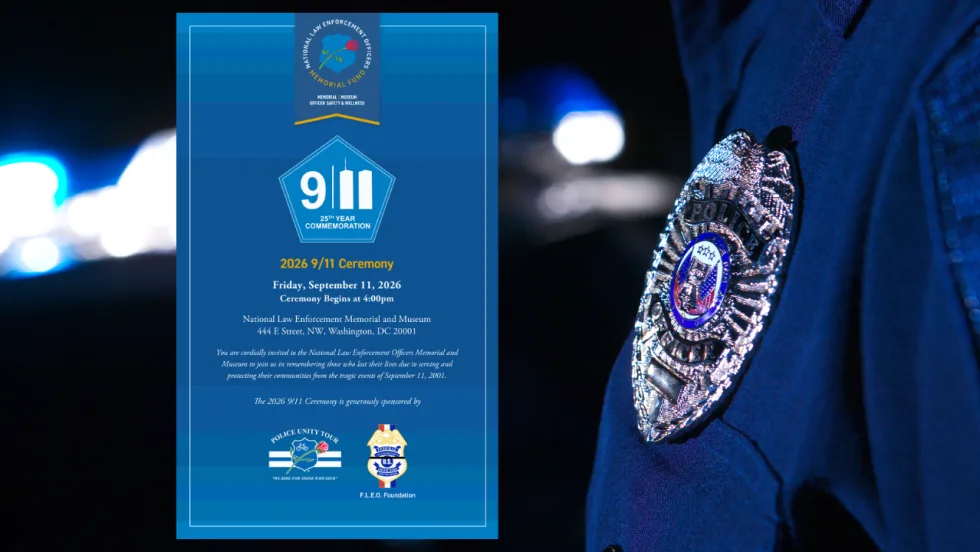
National Law Enforcement Memorial and Museum Hosting 9/11 25th-Year Commemoration Ceremony
The National Law Enforcement Memorial and Museum is hosting a 9/11 25th Year Commemoration Ceremony on Sept. 11 at 4 p.m.
Read More →
National Law Enforcement Officers Memorial Fund Announces June 2026 Officers of the Month
The National Law Enforcement Officers Memorial Fund (NLEOMF) named 15 officers of the Chico Police Department (California) as the Officers of the Month for June 2026 for their roles in responding to an active-shooter incident at a public library.
Read More →