



YouTube Legal Advice Traffic Stop
As you approach the vehicle you notice that her window is rolled up and she has a sign pressed up on her window that says, "I am NOT talking to you, NO you can't search my vehicle, and I want my attorney." She also has her driver's license pressed onto the glass so you can see it.

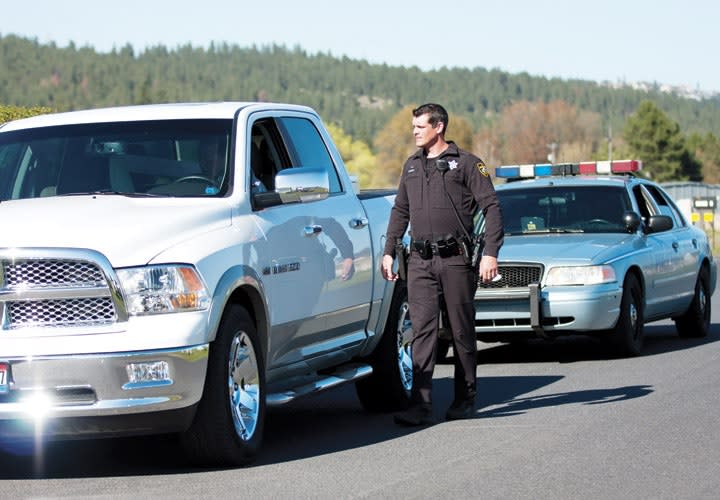
Photo: Carla Blazek
In every call for service, you should think things through before you begin your response. Each call can be broken down into three phases: pre-response, response, and post response. The following scenario is designed to help you think things through rather than give you a specific way to handle the call.
Situation
You are out patrolling your zone in full uniform and driving your marked patrol car. It's a busy Saturday morning and people are out in droves driving around as they run their weekend errands and complete honey-do lists. You see a vehicle blow through a red light, forcing on-coming traffic to hit their brakes. The vehicle appears to have one occupant. At your first safe opportunity, you activate your lights but the driver is not stopping. The vehicle has its emergency flashers on, the driver is doing the speed limit, and the person taking no evasive action to get away from you.
Initial Thoughts
Your first thought is it might be a female driver worried about safety trying to find a more populated area to park. Your next thought is the driver might be using this as a delaying tactic, so you keep an eye out for chase/blocker cars in case you're dealing with a drug situation. Your final thought is it might be a lost tourist with no clue about your state's traffic laws. Regardless, you decide to continue with the traffic stop.
Pre-Response
Think It Through Questions:
Why is the car not stopping?
If it's a nervous female, what can I do to assure her I'm a real cop and I'm handling a traffic violation?
If drugs are involved, and it goes south, what are my priorities?
What type of information can I get from running the tag and then the registered owner?
Most of your preparation comes before you decide to make the stop and turn on your emergency lights. You have already called it in by using TLC (tag, location, and color of vehicle) and you have picked an area to try to conduct the vehicle stop – one that places you and the driver in a safe location. Hopefully the location will also give you some type of tactical advantage including room to maneuver (car and on foot) and provide high visibility. Since you don't know why the driver wasn't stopping, you also notify dispatch to have a backup officer start to head your way.
Response
Think It Through Questions:
What's my first action when the car stops?
What do I do if the driver runs?
What if a passenger appears out of nowhere and runs?
What if there is a language barrier?
Does my supervisor know what's happening?
The car stops in a grocery store parking lot and you notice the driver is female. You observe that there are plenty of people around so that should help you in case she is worried about you being a fake cop. As you approach the vehicle you notice that her window is rolled up and she has a sign pressed up on her window that says, "I am NOT talking to you, NO you can't search my vehicle, and I want my attorney." She also has her driver's license pressed onto the glass so you can see it.
You realize you are dealing with someone who has chosen to follow a popular YouTube video for legal advice. You don't get angry; you start to regroup and form your response.
You now know your biggest challenge will be trying to explain to the driver what she can and can't do based on statutes, legal precedents, and what your state's Supreme Court and the U.S. Supreme Court have already ruled on such matters. You'll have to work in mention of the fact that just because a lawyer has expressed his opinion on YouTube doesn't mean he is right.
Every state is different, but in Florida it goes like this. F.S.S 322.15(1) states you must present or exhibit (interpreted as handover) your license. Failure to do so is a second-degree misdemeanor under F.S.S. 322.39. Pressing it up against the glass is not enough. Common sense requires that a physical inspection be made to make sure the driver's license is not fake or altered. Your first task then becomes convincing the driver she must comply with that portion of the request.
You very politely identify yourself and tell the driver why you stopped her. You then ask if there is any reason she can think of that caused her to run the red light (maybe she has one). Then you ask her for her license, registration, and insurance card. She doesn't tell you anything and just keeps pointing to her sign. You then try to educate her on how your state statutes work and how the courts have already ruled on what can and can't be done on a traffic stop.
You advise her that in Florida, failure to present her driver's license is a second-degree misdemeanor and an arrestable offense. You tell her that if she doesn't want to speak to you, that's fine but that's a separate issue. You also explain she doesn't have to agree with the ticket, that signing it is not an admission of guilt but one of receipt, and that she can always argue it in court.
You stress that there is no need for anyone to go to jail over running a red light in this instance and that is not your intention unless her actions dictate otherwise. In other words, you do everything possible to explain the situation to the driver so she can make a decision based on fact and not on someone else's opinion.
Finally, the driver rolls down her window and you engage in a friendly conversation. Even if she still wouldn't say anything at this point, you could explain the relevant case law, what your state Supreme Court has ruled, and include any other legal information to bolster your case for cooperation.
If it had gone badly because the driver continued to refuse to cooperate by not giving you her license then you would have followed agency policy and procedure on the matter.
Luckily for me, or for any member of our traffic unit, we have never had to escalate into a physical arrest (but we are always ready to make one). Trust me when I tell you, it's well worth the extra time and effort it takes to talk to the driver.
Post-Response
Think It Through Questions:
Is there any need to follow up with my supervisor?
Was there anything I could have done any better?
Should I touch base with my staff attorney and suggest the agency put out a training bulletin?
There is a good chance you're going to get complained about no matter how well you handle a situation like this.
Hopefully you'll have some video and audio to back you up. But if not, I'd jot down some notes because you never know when you will need them. Definitely write something down on the ticket for your reference and the judge's if it goes to court. Try to find the videos on YouTube and familiarize yourself with the advice that's floating around so you are better prepared next time.
Final Thoughts
Although I explained this scenario in the context of a stop in Florida, the basic principles of using good verbal skills apply in every state. I must admit I have toyed with the idea of carrying around my own sign: "I have made you aware of the law; comply or you go to jail. Your choice."
People who take advice often forget they are responsible for their actions regardless of from whom or where they get it. If you haven't dealt with a YouTube-educated "legal expert," chances are it's only a matter of time before you do.
As the public distrust of law enforcement continues to be fueled by the media, the use of counter-police tactics will increase. I suggest you think through your response to this type of traffic stop now instead of being caught off guard and making it into a YouTube video yourself either getting angry or looking like a deer caught in someone's headlights.
As always, thinking it through now saves you time later.
Amaury Murgado is a special operations lieutenant with the Osceola County (Fla.) Sheriff's Office and an adjunct professor for Valencia College in Orlando, Fla.
More Patrol

Streamlight Portable Scene Light III Wins 2026 OH&S New Product of the Year Award
Streamlight’s Portable Scene Light III has won the 2026 Occupational Health & Safety (OH&S) New Product of the Year Award in the Lighting category.
Read More →
Adept Armor Introduces Two New Rifle Plates
Adept Armor has launched two new Level IV ballistic plates, the Emperor and the Archon Mark 2, which brings Adept Armor’s new Quatroid ceramic to the high-threat, performance-value center of the range at 5.2 pounds.
Read More →
POLICE Product Test: Benchmade Bailout
The Benchmade Bailout is a slim, lightweight carry knife with a deep-ride pocket clip and comes in a variety of blade steels and scales. Here is a detailed review of the Taiga Green Bailout, released earlier this year.
Read More →
NLEOMF Announces July 2026 Officer of the Month
NLEOMF honored a Michigan deputy sheriff as the July 2026 Officer of the Month for rescuing a trapped driver from a burning vehicle following a Fourth of July crash.
Read More →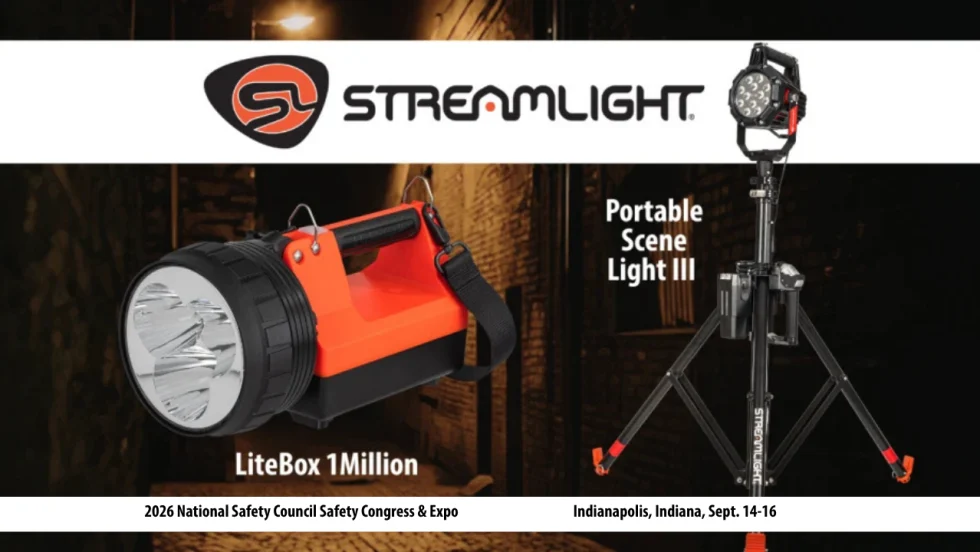
Streamlight to Showcase Newest Lighting Products at National Safety Council’s Safety Congress & Expo 2026
Streamlight will showcase its latest lights, including the Portable Scene Light III and the LiteBox 1Million, at the 2026 National Safety Council (NSC) Safety Congress & Expo.
Read More →
The 2027 World Police & Fire Games Set for Perth, Australia
The 2027 World Police & Fire Games (WPFG) will take place in Perth, Western Australia, from Friday, March 12 through Sunday, March 21, 2027.
Read More →
5.11 Partners with National Fallen Firefighters Foundation to Support #ForThe343
5.11 has joined the nationwide movement honoring the 343 New York City Fire Department firefighters lost on Sept. 11, 2001.
Read More →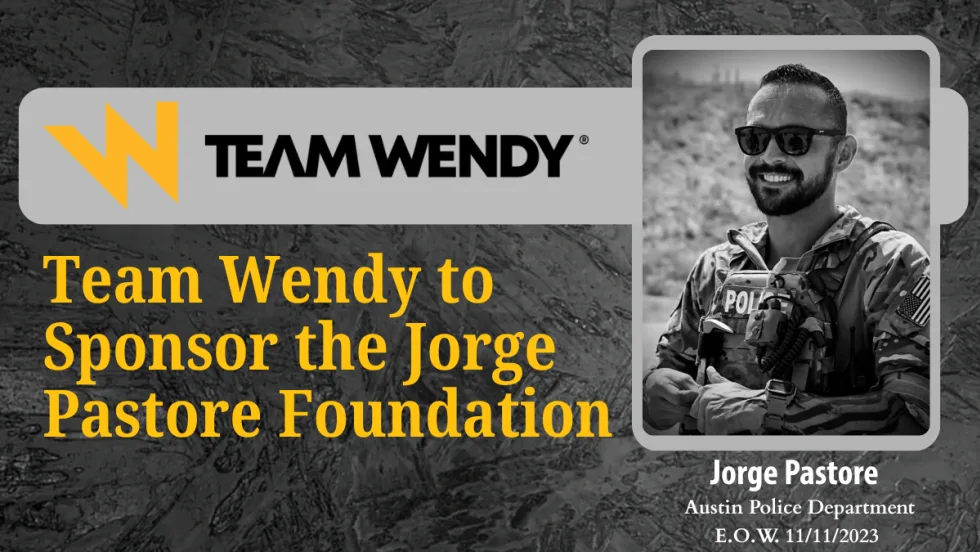
Team Wendy Announces Title Sponsorship of the Jorge Pastore Foundation
Team Wendy’s 3-year partnership with the Jorge Pastore Foundation expands access to programs that strengthen those who serve.
Read More →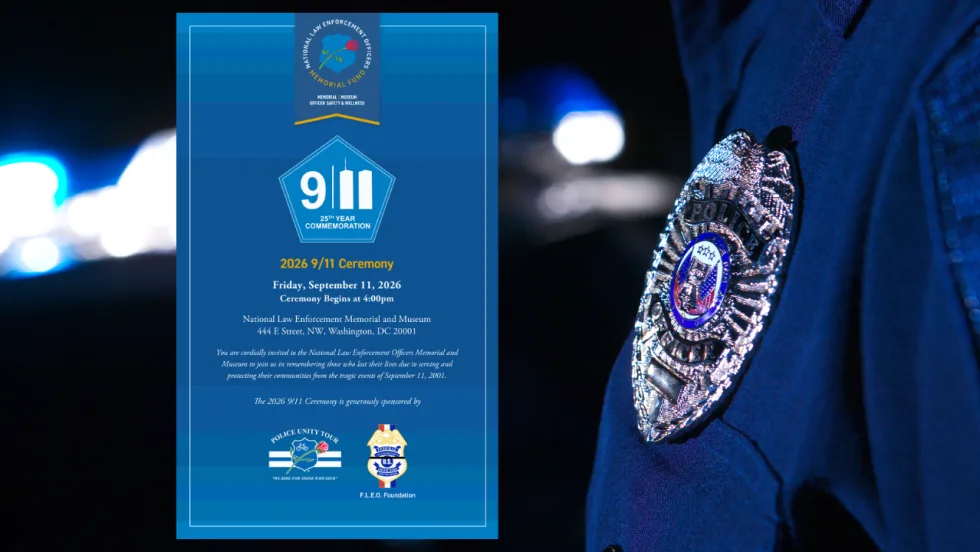
National Law Enforcement Memorial and Museum Hosting 9/11 25th-Year Commemoration Ceremony
The National Law Enforcement Memorial and Museum is hosting a 9/11 25th Year Commemoration Ceremony on Sept. 11 at 4 p.m.
Read More →
National Law Enforcement Officers Memorial Fund Announces June 2026 Officers of the Month
The National Law Enforcement Officers Memorial Fund (NLEOMF) named 15 officers of the Chico Police Department (California) as the Officers of the Month for June 2026 for their roles in responding to an active-shooter incident at a public library.
Read More →