



LEID Products Awarded Patent for BACS System
LEID Products has been awarded a new patent for its Biometric Access Control System (BACS) by the U.S. Patent and Trademark Office, the company announced.

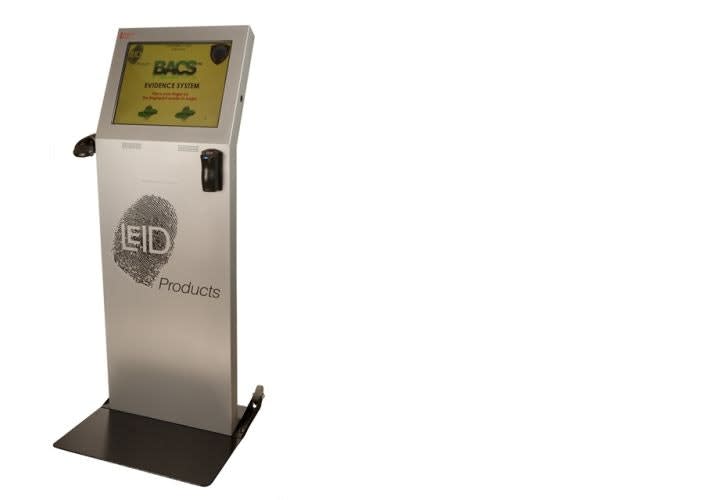
LEID Products' BACS kiosk. Photo: LEID
LEID Products has been awarded a new patent for its Biometric Access Control System (BACS) by the U.S. Patent and Trademark Office, the company announced.
The BACS computer ID Station Kiosk interfaces with electronic access cabinets, lockers and SmartRail gun rack systems to provide the highest level of secure management and tracking of assets, weapons, and evidence.
U.S. Patent No. 8,207,816 covers the system developed by LEID Products. LEID Products' state-of-the-art BACS ID Station Kiosk serves as the control point for access to assets stored in LEID's electronic storage units. The kiosk houses a biometric (fingerprint) reader to allow only authorized users to access assets; each user is restricted to access only the items they have been qualified to use.
For tracking purposes, the kiosk includes a RFID or barcode reader for asset verification. Additional layers of security can be added with options including a hand geometry scanner and card reader. Web-enabled remote management allows the administrator to manage the system at all times on and off-site.
Law enforcement clients typically use the BACS system to secure weapons, night vision goggles, tasers, AEDs, shotguns, AR-15 rifles, and surveillance equipment. BACS eliminates paper log methods, saving valuable employee time and resources while providing easily accessed and credible electronic tracking reports. The proven asset management system is used by federal, state and private sector clientele throughout the country to streamline operations. Added benefits of the asset management software include tracking equipment maintenance requirements and officer firearm training qualifications.
The BACS Evidence Management System is designed to help departments meet standards required by the Commission on Accreditation for Law Enforcement (CALEA) as outlined in Chapter 84 "Property and Evidence Control." Chain of custody for evidence is electronically tracked and accounted for with the BACS Evidence Management System, limiting liability and consequences of exposure to human error.
Recent enhancements to the system include version 2.0 of the BACS ID Station Kiosk, which enhances its sleek tamper proof construction with a larger kiosk screen for additional security and functionality. The system will often pay off the initial investment in less than 18 months, according.
“Our systems offer the highest level of security and accountability available today,” said Sam Hoff, president of LEID Products. “The issuance of this patent supports our investment in BACS and its innovative technology; it reinforces our position as a leader in access control systems with built in asset management and inventory control software.”
More Technology

A police agency's guide to data-driven fleet management
Costs are rising and the public expects more transparency into how their tax dollars are spent. This e-book shows how police agencies can use fleet data to take control of fleet expenses while improving officer safety and demonstrating fiscal responsibility to the communities they serve.
Read More →
AI and analytics for law enforcement: Turning data into insights
Law enforcement agencies are managing more video, sensor data and digital evidence than ever before. Discover how AI and analytics can help turn that data into actionable insights that strengthen situational awareness, accelerate investigations and support more informed decisions.
Read More →
Vasco Electronics Adds Automatic Language Detection to Vasco Translator Q1
Vasco Electronics’ software update introduces hands-free language switching and expanded offline translation across 45 language pairs, empowering law enforcement, healthcare, and front-office enterprise teams
Read More →

North Miami Police Department Deploys Mark43
The North Miami Police Department has deployed Mark43 as part of its Five-Year Strategic Plan that represents its collective vision and goals for a more proactive police department, anchored by a core commitment to leveraging modern technology to enhance efficiency and public safety.
Read More →
Cellebrite Genesis for Enterprise Now Generally Available
Made available to the public sector in June, Cellebrite Genesis is serving a growing mix of national, regional, and local agencies worldwide, including some of the largest regional and metropolitan police departments. It is now available for enterprise organizations.
Read More →
2026 Vision FirstNet Users Summit to Host Emerging Leaders Training on Grassroots Advocacy for Public Safety
“Emerging Leaders Training: Understanding the Importance of Grassroots Advocacy for Public Safety," a session during the 2026 Vision FirstNet Users Summit, will offer a roadmap for unified advocacy at the federal level.
Read More →
Motorola Solutions Completes Acquisition of D-Fend Solutions
Motorola Solutions has acquired D-Fend Solutions, an industry leader in counter-drone technology. This deal provides public safety and enterprise customers with access to advanced counter-unmanned aerial systems.
Read More →
ZeroEyes, Advantech & Camden Police Partner to Bring AI Gun Detection Technology to Delaware School District
ZeroEyes has partnered with Advantech and the Camden Police Department to deploy ZeroEyes’ AI gun detection and intelligent situational awareness platform at Delaware’s Caesar Rodney School District (CRSD).
Read More →
Leonardo U.S. Cyber & Security Solutions Introduces SignalTrace, the Next Evolution in Electronic Signature Detection Technology
SignalTrace reflects years of product refinement and a clearer expression of the technology’s purpose of recognizing and correlating electronic signatures in publicly broadcast wireless signals to reveal patterns, relationships, and trends that might otherwise go undetected.
Read More →
Pimloc Launches Secure File Sharing to Streamline Release of Redacted Video
Pimloc’s Secure File Sharing lets organizations deliver redacted video, audio, and documents through expiring, passcode-protected links, accelerating delivery while reducing security, compliance, and chain-of-custody risks.
Read More →