



Indianapolis PD Tests WMD Sensors in Vehicles
The pilot, a part of DARPA’s SIGMA+ program, involved integrating highly sensitive chemical, biological, radiological/nuclear, and explosive (CBRNE) sensors into several IMPD vehicles and gathering real-world environmental background data over a large part of the Indianapolis metropolitan region.

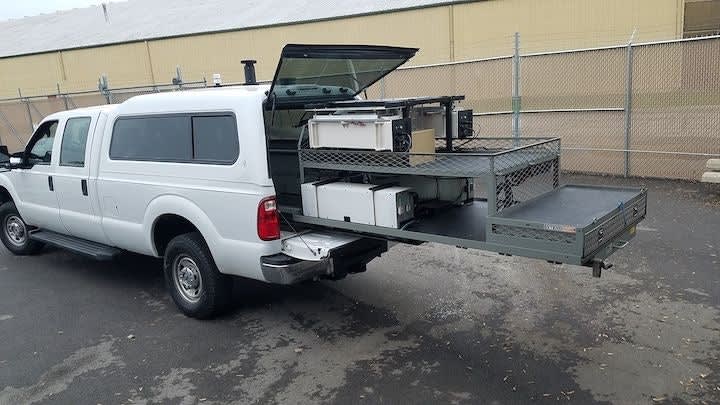
SIGMA+ sensors detecting the entire spectrum of weapons of mass destruction threats slide into the back of a police vehicle with additional space on the racks for regular police cargo. (Photo: DARPA)
The Defense Advanced Research Projects Agency (DARPA), in partnership with the Indianapolis Metropolitan Police Department (IMPD), recently concluded a three-month-long pilot study with sensors intended to support early detection and interdictions of weapons of mass destruction (WMD) threats.
The pilot, a part of DARPA’s SIGMA+ program, involved integrating highly sensitive chemical, biological, radiological/nuclear, and explosive (CBRNE) sensors into several IMPD vehicles and gathering real-world environmental background data over a large part of the Indianapolis metropolitan region, building on a smaller event conducted in Indianapolis in August 2020.
“The Indianapolis pilot study and field testing marked the first time we were able to demonstrate the integration of cutting-edge SIGMA+ sensor technology across the entire CBRNE threat space into a law-enforcement (LE) vehicle,” said Mark Wrobel, SIGMA+ program manager in DARPA’s Defense Sciences Office. “The ultimate goal is to outfit a citywide fleet of LE or other public service vehicles to enable a continuously refreshed mobile network that can detect WMD threats with low false-alarm rates across a city or region.”
DARPA also worked with IMPD to understand how SIGMA+ advanced sensor systems could support broader law enforcement mission needs, including holding several workshops with IMPD stakeholders. The workshops addressed current sensor and analytics capabilities and how these capabilities could address mission areas such as detecting narcotics manufacturing.
More Technology

A police agency's guide to data-driven fleet management
Costs are rising and the public expects more transparency into how their tax dollars are spent. This e-book shows how police agencies can use fleet data to take control of fleet expenses while improving officer safety and demonstrating fiscal responsibility to the communities they serve.
Read More →
AI and analytics for law enforcement: Turning data into insights
Law enforcement agencies are managing more video, sensor data and digital evidence than ever before. Discover how AI and analytics can help turn that data into actionable insights that strengthen situational awareness, accelerate investigations and support more informed decisions.
Read More →
Vasco Electronics Adds Automatic Language Detection to Vasco Translator Q1
Vasco Electronics’ software update introduces hands-free language switching and expanded offline translation across 45 language pairs, empowering law enforcement, healthcare, and front-office enterprise teams
Read More →

North Miami Police Department Deploys Mark43
The North Miami Police Department has deployed Mark43 as part of its Five-Year Strategic Plan that represents its collective vision and goals for a more proactive police department, anchored by a core commitment to leveraging modern technology to enhance efficiency and public safety.
Read More →
Cellebrite Genesis for Enterprise Now Generally Available
Made available to the public sector in June, Cellebrite Genesis is serving a growing mix of national, regional, and local agencies worldwide, including some of the largest regional and metropolitan police departments. It is now available for enterprise organizations.
Read More →
2026 Vision FirstNet Users Summit to Host Emerging Leaders Training on Grassroots Advocacy for Public Safety
“Emerging Leaders Training: Understanding the Importance of Grassroots Advocacy for Public Safety," a session during the 2026 Vision FirstNet Users Summit, will offer a roadmap for unified advocacy at the federal level.
Read More →
Motorola Solutions Completes Acquisition of D-Fend Solutions
Motorola Solutions has acquired D-Fend Solutions, an industry leader in counter-drone technology. This deal provides public safety and enterprise customers with access to advanced counter-unmanned aerial systems.
Read More →
ZeroEyes, Advantech & Camden Police Partner to Bring AI Gun Detection Technology to Delaware School District
ZeroEyes has partnered with Advantech and the Camden Police Department to deploy ZeroEyes’ AI gun detection and intelligent situational awareness platform at Delaware’s Caesar Rodney School District (CRSD).
Read More →
Leonardo U.S. Cyber & Security Solutions Introduces SignalTrace, the Next Evolution in Electronic Signature Detection Technology
SignalTrace reflects years of product refinement and a clearer expression of the technology’s purpose of recognizing and correlating electronic signatures in publicly broadcast wireless signals to reveal patterns, relationships, and trends that might otherwise go undetected.
Read More →
Pimloc Launches Secure File Sharing to Streamline Release of Redacted Video
Pimloc’s Secure File Sharing lets organizations deliver redacted video, audio, and documents through expiring, passcode-protected links, accelerating delivery while reducing security, compliance, and chain-of-custody risks.
Read More →