



Lessons from the Onion Field
"How could this have happened?" The answer is found when you realize that in the past half century you have had the benefit of improved tactical training that came at the cost of the blood and minds of officers like Ian Campbell and Karl Hettinger.

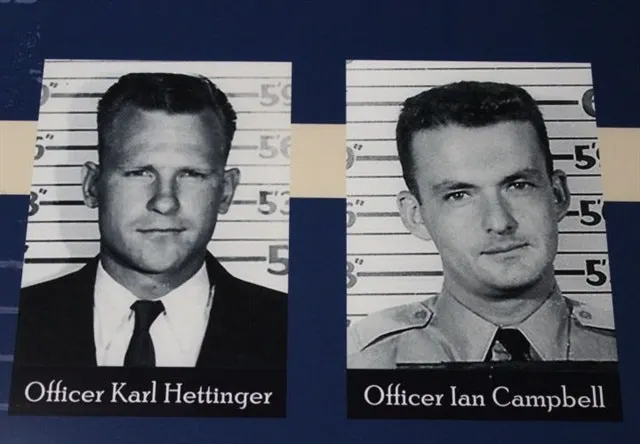
Photo by Greg Meyer.
It was a memorable day on March 9 at the opening of "The Onion Field" exhibit at the Los Angeles Police Museum marking the 50th anniversary of a police tragedy. By all means, if you are in Los Angeles, come see the exhibit.
Imagine visiting with the families and descendants of murdered LAPD Officer Ian Campbell and his partner Karl Hettinger, now also deceased, and speaking with author and former LAPD Sergeant Joseph Wambaugh, who has spent more than half his life telling the story of "The Onion Field." I did those things that day, and doing so caused me to reflect beyond the tragedy itself.
"The Onion Field" was one of those occasional police incidents that changes the game for all of us in law enforcement. Prior to this incident, officers were occasionally disarmed by suspects, who then fled without doing violence. In Los Angeles alone in the weeks prior to "The Onion Field," three officers were known to have been unarmed, but unharmed.
This time was different. After Campbell and Hettinger (both ex-Marines) were disarmed and kidnapped, Campbell was murdered while standing at gunpoint with his arms up in the air. The crooks (both now deceased) fired at Hettinger. He managed to escape, but only physically. Hettinger was doomed to a life of what we now call post-traumatic stress disorder (PTSD), which was unheard of in the 1960s.
Younger readers may scratch their heads. "How could this have happened?" The answer is found when you realize that in the past half century you have had the benefit of improved tactical training that came at the cost of the blood and minds of officers like Ian Campbell and Karl Hettinger.
Consider these phrases—officer-survival skills; weapon-retention skills; improved holsters; training to not ever give up your gun; the warrior mindset; pre-determined code words between partners that mean, "I'm in trouble, SHOOT HIM NOW;" physical-fitness emphasis; front- and rear-gun takeaway training; close-contact shooting; back-up guns; hideaway guns; and finish the fight.
My first case as a use-of-force expert 23 years ago involved a California Highway Patrol officer who literally saved his own life by killing the suspect with a five-shot back-up gun he wore on his boot. He had lost his duty pistol in a knock-down, drag-out fight. I sure hope YOU carry a back-up gun.
A few days after "The Onion Field" tragedy, legendary LAPD Commander John "Two Gun" Powers—a World War II veteran involved in quite a few shoot-outs—issued what came to be known as "The Hettinger Memorandum." Here are a few lines:
"The police are engaged in a hot war. There are no truces, and there is no hope of an armistice. The enemy abides by no rules of civilized warfare.
"The individual officer, when taking his oath of office, enters a sacred trust to protect his community to the best of his ability, laying down his life if necessary.
"All men return to dust. The manner of a man's living and dying is of paramount importance. Although some moderns have attempted to sap the strength and ideals of this nation by slogans such as 'I'd rather be red than dead,' there are situations more intolerable than death."
"Two Gun" Powers even mentioned that shoving a sharp Number 2 pencil through the suspect's jugular would do the trick. How's that for creative?
My final thoughts: DO NOT give up your gun to a crook. Whatever it takes to save your life, do it. Finish the fight. Win the fight.
And if you have never read Wambaugh's book or seen the movie, please do. Your mind and heart will be impacted forever. The mindset that comes from the lessons of "The Onion Field" may just save your life.
Greg Meyer is a retired LAPD captain who is an internationally known use-of-force expert. He is a member of the POLICE Advisory Board.
More Blog Posts
Preventing Heat Injury in Police K-9s
In the relentless heat of summer and even early fall in some parts of the country, officers face the important task of protecting their K-9 partners while working in sweltering temperatures. Recognizing changes in a dog’s behavior is the key.
Read More →
Why Your Agency Needs to Attend the ILEETA Conference
ILEETA is a complete resource for trainers to address trainers' needs. Its mission is to enhance the skills and safety of criminal justice practitioners while fostering stronger and safer communities.
Read More →
IACP 2023: New Training Products
Technologies for improving law enforcement training and training management were some of the highlights at this year's show.
Read More →
Initial Results Released from MSP 2024 Police Vehicle Testing
The 2024 pursuit-rated vehicles--all pickup trucks or SUVs, including two battery electric models the Chevrolet Blazer EV AWD and Ford Mustang Mach-E--were put through their paces.
Read More →
Officer Safety Considerations Related to Alternative-Fuel Vehicles
As more alternative-fuel and hybrid vehicles hit the road, police and other first responders need to understand that they are no more dangerous than conventional vehicles. However, there are certain safety considerations every cop should know.
Read More →
Garmont Working to Grow LE Market Presence
Garmont Tactical has found wide acceptance by military boot buyers, but now the company is trying to better respond to the needs of police officers. Many cops now are not fans of 8-inch boots, so Garmont is adapting.
Read More →
Publisher’s Note: Our Commitment to You
Through our magazine and website and our Police Technology eXchange event, we promise to provide you with information and access to resources to help you do your job safer and better.
Read More →
10 Tips for Responding to Mental Health Crisis Calls
The Harris County Sheriff's Office is a model for other agencies that want to learn about crisis intervention and mental health crisis response. Sgt. Jose Gomez shares the story of their programs and provides 10 tips for mental health crisis call response
Read More →
5 Things to Know When Buying Concealed-Carry or Off-Duty Holsters
Mike Barham, of Galco Holsters, shares five important considerations to keep in mind when you buy off-duty concealed or plain-clothes carry holsters.
Read More →
10 Tips for Reviewing Use-of-Force Reports
While the burden of accurately reporting use-of-force situations is on an individual deputy or officer, the person reviewing those reports shares in the responsibility of making sure the reporting is done properly, with clear details included.
Read More →