



The Fifth Element
Welcome to the new battleground. Called "fifth-dimensional battlespace," it takes the old three-dimensional battlefield (the spatial dimensions of length, width, height or depth of an area), and the temporal dimension of time, and adds the fifth dimension of cyberspace.

When the United States was attacked by terrorists on 9-11, it was a blow beyond our wildest imagining, devastating beyond belief. Thousands died at the hands of enemies most of us never even knew we had. The ripple effect damaged everything from the economy to our relationships with our government and with one another. Which was exactly the point.
Welcome to the new battleground. Called "fifth-dimensional battlespace," it takes the old three-dimensional battlefield (the spatial dimensions of length, width, height or depth of an area), and the temporal dimension of time, and adds the fifth dimension of cyberspace. It is a place where none of the old rules apply, where attacks can come out of nowhere, and your sworn enemy might be your next-door neighbor.
Fifth-dimensional battlespace is the perfect playground for terrorists, who require anonymity to operate. Yet it also is the very thing that, when used appropriately, can keep the good guys safe.
The concept of fifth-dimensional battlespace, while typically applied to military operations, is beginning to affect law enforcement, especially in the area of SWAT tactics. It moves SWAT officers out of the predictable dance of symmetrical response, where officers respond to a show of force with an equal or greater force, and into an asymmetrical response, where they too can operate with anonymity and exploit their adversary's weaknesses.
Sensory Perceptions
"The old idea was to rush in and dominate the geography as fast as possible," says Sgt. Don Kester, SWAT Supervisor for the Pima County (Ariz.) Sheriff's Department. "Now the emphasis is on officer safety, slowing down, and the ability to switch tactics in the middle of an operation if the circumstances call for it. The way to manage that is through information, and the way to get that is to use different technologies."
Information is the new tool, the fifth element, that lets SWAT officers overcome the physical limitations of the three-dimensional crime scene, where the biggest, the baddest, or the best armed win. It also overcomes the fourth dimension of time, where tactics be damned if the timing is wrong.
Maneuvering in cyberspace means using GPS to locate a suspect or do surveillance from space. It is the ability to intercept cell phone calls or use radar to monitor a suspect's movements inside a building. It is what will allow law enforcement to remotely shut down vehicles, lock and unlock cars, or open and close garage doors.
"The new weapons will be sensing technologies," says Capt. Sid Heal, who heads the Los Angeles Sheriff's Department's Special Enforcement Bureau. "[The bad guys] send a message from one point to another. If we can acquire, manipulate, or deprive them of information of all types, including the message, and if we can do it while it's in transit, then we have the advantage.
"It's not technically difficult to kill people. What is really hard is trying not to kill them. What is really difficult is dealing with the ambiguity of making the right decision. Our intent is to make better decisions, not develop better weapons."
Improving Intel
Better decision making requires the ability to gather information. New technologies are being employed by SWAT departments for just this purpose. Some have been developed by SWAT officers, while others come from research facilities, government labs, or private industry. Some are nothing more than a developer looking for the problem that fits his solution, but others are appropriate, workable tools that can have a dramatic effect on officer safety.
"Our goal is to not be shot at. Period," says Kester. "We use cameras, under-the-door scopes that we can slide in and look around an entire room. We put them in vents or through holes drilled in walls. They can work on radio frequency or a hard line, and transmit a picture back to the team leader at the scene or to the command post. We use microphones that we can slip under doors or attach to windows. Using these things means we don't have to engage people in the same way we used to. If we know what room they're in, we can have the team do a stealth entry. The microphones let us listen to the hostage taker and get an idea of his mental state and his intentions. All of these things help us decide what tactics to use."
Optical Awareness
Night vision and thermal imagers, once the expensive province of the military, are becoming the norm in SWAT operations. Not only has the price dropped considerably since these technologies were first introduced, there are grant programs, most notably from ITT Night Vision, that help underfunded agencies afford them. State-of-the-art night vision devices, dubbed GenIII, are small, light, and provide clearer images than previous generations. They can be handheld or take the form of a monocular that attaches to a helmet.
Pole cameras also are becoming more popular, allowing officers to safely peer around corners, over walls, or into areas outside their field of vision. The Royal Canadian Mounted Police (RCMP) equips its officers with pole cameras, a vest-mounted flat-screen monitor, and a battery pack that operates both units.
An emerging technology that holds some promise is radar that can "see" through walls. One device is being developed by Time Domain Corp. in Huntsville, Ala. Called RadarVision 2000, it broadcasts short, low-powered pulses over wide-band frequencies to show the location of a person and the direction of movement. RadarVision 2000 can detect gross motions, such as walking, running, bending, or turning, through almost everything but solid metallic surfaces. It could be used outside of a house, from the roof of an apartment building, or inside a building to scan the attic, basement, crawlspace, or individual rooms or offices.
The National Institute of Justice has funded the venerable Georgia Tech Research Institute in Atlanta to create a Radar Flashlight. This device transmits a beam and detects anomalies in the frequency of the returning beam. The results are plotted on a bar graph. Although the Radar Flashlight is in the prototype stage, the NIJ offered it to rescue workers at the World Trade Center site. The hope was that it would detect the movement of survivors, but the device was never used.
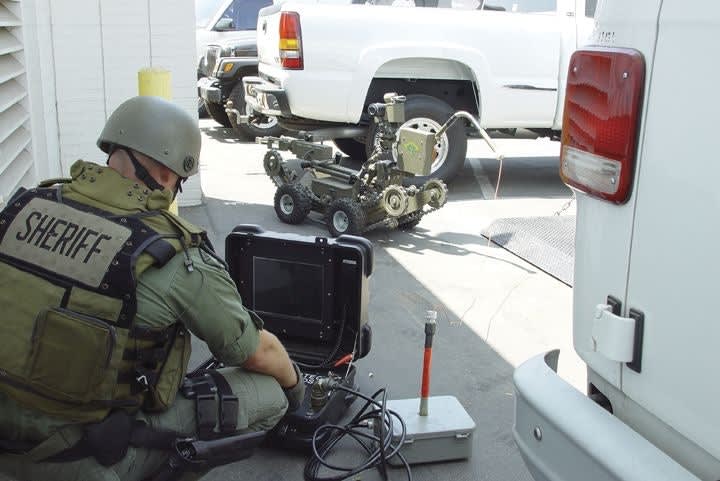
One of the most popular technologies is the robot. It has been used to batter down doors, clear rooms, or make contact with a suspect. In many instances, robots have saved lives.
A case in Pima County, Ariz., had three suspects wanted for aggravated assault hiding in a house. An explosive entry in the rear door got no response, so the team sent in its robot. Two of the suspects were contained, but the third proved elusive until the robot pushed open the door to a darkened laundry room. There stood the drug-addled suspect swinging a samurai sword high over his head. By communicating through the robot, officers convinced the man to surrender. "If we'd have gone in, we'd have been forced to kill him," Kester said.
Robots also have been used to toss "throw" phones, lob tear gas into buildings, or plant cameras or microphones to gather information for SWAT commanders. The disadvantage to deploying robots is that the technology typically has been adapted from bomb disposal teams, which means robots also have limited capabilities. Some cannot climb stairs, for example, or record conversations. Robots engineered specifically for SWAT purposes are a somewhat new device and are still relatively expensive.[PAGEBREAK]
Information Sharing
All of these devices and technologies can increase officer awareness at the scene, but may not be of much help if the information cannot be transmitted to a command post or shared with other officers. Thus far, bringing everybody involved into the information loop has been almost impossible. There are two systems, however, that are in the development and prototype stages that may alleviate the problem.
Gord Scott, a 31-year RCMP veteran who now works in the agency's Bomb Data Center, recently rolled out the prototype of a tactical video system that takes the images of up to 12 cameras and displays them on a 13-inch flat screen that is housed in a small suitcase. Although the system can transmit via radio frequency, Scott prefers using cables "because RF only works about 5 percent of the time."
Such a system would supersede the use of robots, which are restricted to a forward view and to a monitor held by the operator. Scott's battery-operated system sends pictures from anywhere a camera is placed, transmitting it to the vest-mounted monitors of field officers and to a command post up to 2,000 feet away. It can use thermal imagers or night vision, with views appearing individually or multiplexed on the commander's screen. The system has a VCR input to play reconnaissance video, and will send scanned photos of suspects or floor plans from the command post to team members.
The LASD is working with private industry to create a similar system, only one that is wireless and can transmit to officers' PDAs, a nearby command post, an operations center, and finally, that is accessible via the Internet to experts at national labs, university research centers, or other government agencies.
This "ground-link video system" is part of the LASD's Technology Exploration Program, which has officers working with developers to make sure new gadgets meet operational needs. The system's most recent incarnation combined wireless handheld technology with encrypted digital video surveillance and a secure mobile intranet. It would receive images and audio from the field and make them available to command and field personnel, and to a remote emergency operations center. The goal was to create a cyber command post where the limitations of geography and time were irrelevant. The only problem was, it didn't work.
The department stopped working with the developer and has forged relationships with other companies in search of one that can build such a system. Heal envisions using it in any number of situations, whether a chem/bio incident that requires the expertise of scientists from Utah's Dugway Proving Grounds, or a hostage situation where profilers from other agencies or university behavioral scientists lend their expertise while remotely viewing the negotiations. It also could link to any number of local, statewide, or national databases. Such a system forms the basis of what Heal foresees as the LASD's ability to operate in fifth-dimensional battlespace.
"We want our deputies to see through a window or under a door and determine what type of weapon a suspect has so they'll know what level of force they need to respond. We want them to determine whether a less-lethal option is appropriate without making a risky entry into the building. We want them to view the scene without sticking their heads in a window or above a fence. Therefore, we'll continue to use thermal imagers, night vision, infrared, and anything else that works, and we'll continue to find ways to maneuver in cyberspace. Our goal is reliable, accurate, and timely information, which defines every tactical operation. It is the bedrock for dependable intelligence, effective decisions, and efficient operations."
High-Tech is Nice, But...
High-tech gizmos may be the thing of the future, but field officers are interested in only one thing: Does it work?
Such is the disconnect between the front lines and command staff, between the users and the inventors. In an interview with officers of the Los Angeles County Sheriff's Department's specialized SWAT teams, the message was clear. They rely on training and those things that have been proved effective.
Technology is nice, they say, but it is often only applicable in special circumstances. "Take our robot," says Dep. Jim Corrigan. "In the four years we've had it, we've only used it nine or 10 times."
Necessity, coupled with the lack of technology, has forced enterprising officers to come up with a few inventions of their own. Although they are unabashedly low tech, they work like a charm.
Giant Fish Hooks-These enormous iron hooks can rip the door off just about any building. In one instance, officers planned to serve a warrant on an armed robbery and kidnap suspect, who was holed up inside a home barricaded with bars and a steel door. No amount of ramming would break down the door, so in the wee hours of the morning, they quietly attached the hooks to the door and the other end to the hitch on their truck. When the time was right, they drove off, taking the door of the house with them, and allowing other officers to enter and arrest the suspect.
The Burn Safe-This crude metal container is used as a carrier for tear gas canisters when the goal is to arrest a suspect without burning down the house. Created by an officer in the San Diego area, the container is large, heavy, and cumbersome, yet when lobbed into a home, it allows for the dispersal of hot gas without allowing the resultant heat and flame to ignite the area.
The Gas Ax-Developed by the same San Diego officer, the gas ax is yet another inventive way to disperse gas. It looks remarkably like an ax, but with a handle attached to a gas canister that feeds into a hollow, metal pole with holes drilled in the end. It has been used in apartment entries, where the only way to inject gas was to get into the apartment next door to the suspect's, and ram the pole end of the ax through the wall between the two apartments.
"This stuff is high-tech when you think about some of the other things we do," says Dep. Rick Rector. "We've drilled holes in old military ammo cans, put the gas in there and thrown them into the house. Or if we need to put gas in an attic and we're in the house, we'll put the canister in a big spaghetti pot and slide it into the attic."
Clearly, SWAT officers are not picky about their equipment; they'll use just about anything. They have only one single, non-negotiable demand: It has to work. This is not to say they are averse to working with technology developers or trying out new equipment and offering feedback on its performance. "What we want them to understand," says Sgt. Scott Walker, LASD's Blue Team Leader, "is that while we are happy to help and we certainly benefit, nothing is ever going to take the place of a person. Technology can increase our awareness prior to entry, but there is no technology they can come up with that will replace a trained officer and proven SWAT tactics."
Lois Pilant is the former editor of a law enforcement magazine, a writer for the National Institute of Justice, and a frequent contributor to POLICE.
More Technology
TOUGHBOOK in Action at the Third Largest County in the Nation – Harris County, TX
Learn how Harris County, one of the nation’s largest counties, modernized its law enforcement fleet with TOUGHBOOK® rugged laptops—strengthening security, productivity, and operational readiness across every unit.
Read More →
How Motorola Solutions’ New “Insights” Platform Helps Public Safety Agencies Identify Trends to Improve Their Operations
Motorola Solutions has introduced Insights, which leverages Assist, its mission-critical artificial intelligence (AI), to address these challenges and shape what’s next for public safety analytics and reporting technology.
Read More →
What Qualifies a Laptop as Rugged or Fully Rugged?
Police officers face a wide range of working conditions that can damage or even destroy a regular consumer laptop. Learn what qualifies a computer as rugged or fully rugged and why those devices are vital for law enforcement.
Read More →
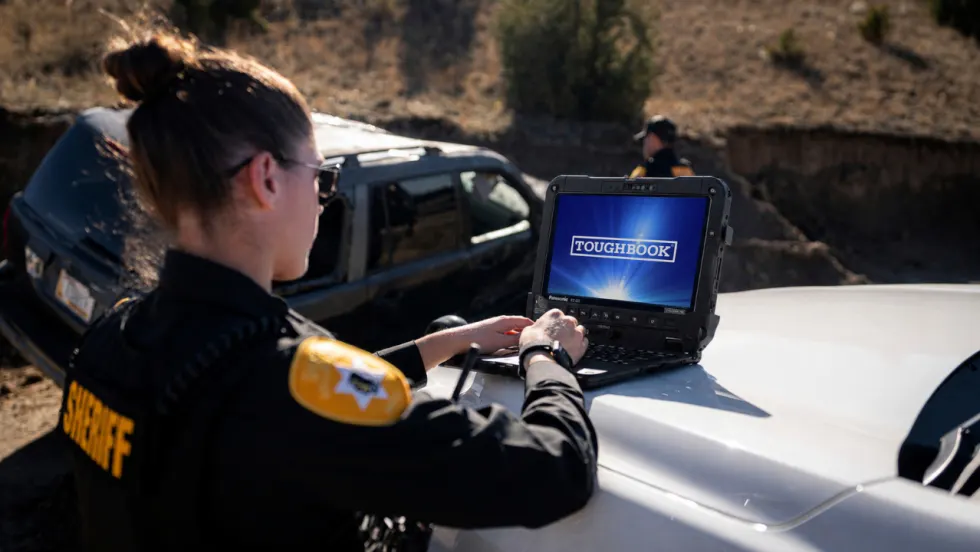
Panasonic Connect Launches the Toughbook 34 and Toughbook G3, Fully Rugged 2-in-1 Mobile Computers
Panasonic Connect has launched the Toughbook 34 and Toughbook G3 to facilitate in-vehicle dispatch, records management, and mobile command operations from any location.
Read More →
A police agency's guide to data-driven fleet management
Costs are rising and the public expects more transparency into how their tax dollars are spent. This e-book shows how police agencies can use fleet data to take control of fleet expenses while improving officer safety and demonstrating fiscal responsibility to the communities they serve.
Read More →
AI and analytics for law enforcement: Turning data into insights
Law enforcement agencies are managing more video, sensor data and digital evidence than ever before. Discover how AI and analytics can help turn that data into actionable insights that strengthen situational awareness, accelerate investigations and support more informed decisions.
Read More →
Vasco Electronics Adds Automatic Language Detection to Vasco Translator Q1
Vasco Electronics’ software update introduces hands-free language switching and expanded offline translation across 45 language pairs, empowering law enforcement, healthcare, and front-office enterprise teams
Read More →
North Miami Police Department Deploys Mark43
The North Miami Police Department has deployed Mark43 as part of its Five-Year Strategic Plan that represents its collective vision and goals for a more proactive police department, anchored by a core commitment to leveraging modern technology to enhance efficiency and public safety.
Read More →
Cellebrite Genesis for Enterprise Now Generally Available
Made available to the public sector in June, Cellebrite Genesis is serving a growing mix of national, regional, and local agencies worldwide, including some of the largest regional and metropolitan police departments. It is now available for enterprise organizations.
Read More →
2026 Vision FirstNet Users Summit to Host Emerging Leaders Training on Grassroots Advocacy for Public Safety
“Emerging Leaders Training: Understanding the Importance of Grassroots Advocacy for Public Safety," a session during the 2026 Vision FirstNet Users Summit, will offer a roadmap for unified advocacy at the federal level.
Read More →