



Social Media Ridealongs
Not only do social media help agencies establish better community ties, they also provide them with auxiliary networks of support personnel, informants, and sympathetic witnesses.

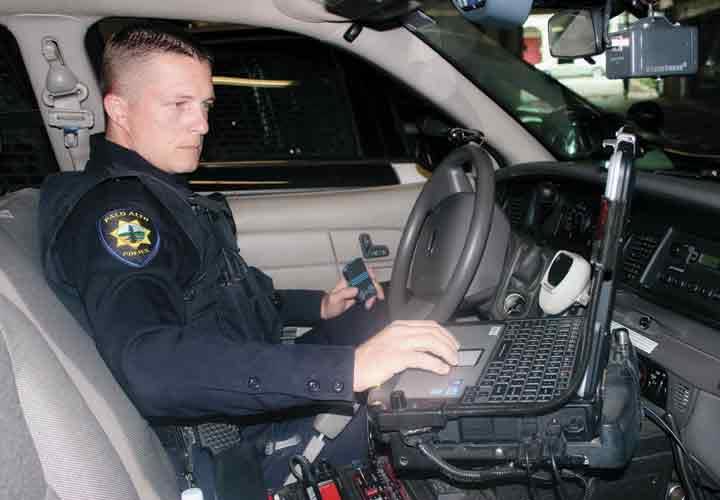
Photo courtesy of Palo Alto PD.
Law enforcement's successful exploitations of social networks are well-documented. Exposés such as "To Catch a Predator" have become familiar even to America's non-police households. Thousands of detectives nationwide use Facebook to keep track of the activities of unwary criminals. And just as fast-food franchises, entertainment venues, and other commercial businesses have used Facebook as marketing tools, and celebrities have developed Twitter followings, so too are a growing number of police agencies finding their own niche in the online community.
Not only do social media help agencies establish better community ties, they also provide them with auxiliary networks of support personnel, informants, and sympathetic witnesses.
Of course, the dialogues they initiate with their readers work both ways and engender both good and bad feedback, some of which can be downright hostile.
According to the International Association of Chiefs of Police (IACP) Center on Social Media, more than 92 percent of police departments surveyed in 2012 use social media, and the majority of those who are not yet using social media are contemplating doing so. The departments with the largest Twitter audiences include those serving the cities of Kansas City, Mo.; Boston; New York; Baltimore; and Seattle.
"Twitter has proved to be an excellent way for us to communicate with the people we serve," says chief of the Kansas City Police Department Darryl Forte.
Tweeting on Patrol
Social media success by one agency is likely to attract the attention of another.
Lt. Zach Perron of the Palo Alto (Calif.) Police Department was already familiar with social media programs and what they can do for law enforcement before he attended the annual IACP conference in San Diego last fall. But it was while in San Diego that Perron met a PIO with the Kansas City PD who'd developed a social network protocol for the department, where the public can follow the tweets of officers on patrol.
The concept is basically a cyber ridealong. And Perron grew determined to see something similar put in place back home in Palo Alto. After speaking with his chief, Perron found a sympathetic audience.
Perron was appreciative of his boss's support, and perhaps a little surprised. "I think it's safe to say that there probably aren't a great number of people with 30 years of experience in the command ranks of law enforcement that are equally as willing to try such innovative technologies."
But support from the brass was just the first step. It was up to Perron to make the concept work, and he undertook the development and implementation of a cyber ridealong for the Palo Alto PD with two agendas in mind.
"First, to give the public some insight into the realities of a day in the life of a Palo Alto police officer," Perron explains. "A second, more auxiliary goal, was to build as many followers of our Twitter account as a means to communicate with as many people as possible during a catastrophic emergency."
Getting as many members of its community following it on Twitter, Facebook, or Nixle, as possible was important to Palo Alto PD. Such subsidy would prove invaluable in the event of a catastrophic earthquake, a major flood, or a terrorist attack—any of which could disrupt telephone communication.
Perron had several advantages as he pursued the Palo Alto PD's social media strategy. Not only did he have buy-in from the chief, but he also had the recent experience of another nearby agency, the Stanislaus County Sheriff's Office—to show him how to implement the cyber ridealong program.
The Palo Alto Program
The game plan was simple for the Palo Alto program: Give people a closer and more varied view of what a patrol officer's experience is like than what they might have vicariously experienced through other media such as the television series "Cops." To achieve this, Perron would rely on multiple social network platforms working in concert with one another, predominantly Facebook and Twitter.
The inaugural ridealong took place on a Friday night with Perron riding shotgun with an officer who also served as one of the department's public information officers. "We tweeted everything that he did during the course of his shift," recalls Perron. "By most people's perspectives, the shift was a quiet one. We're blessed with a relatively low crime rate here in Palo Alto. It isn't the kind of place whose local newscasts are continually cutting to live coverage of felony crimes in progress and police pursuits, even on its weekend nights."
But to Perron's mind, this was an ideal set-up: It would allow the department to give its residents some sense of what an average Friday night was like for its police personnel while at the same time allowing for ancillary opportunities such as sharing edifying information and encouraging dialogue between the department and its Twitter followers.
To that end, Perron had planned ahead of time, drafting contingency-based tweets. When the shift slowed down, he dispatched previously penned informational tweets about local ordinances and police protocols. He also had 12 photographs and two pre-recorded videos at the ready, including an introduction to the ridealong and a look inside the department's 911 dispatch center with an accompanying caution to use 911 in emergencies only.
Meanwhile, the officer he accompanied kept busy, making several proactive DUI investigative stops, as well as responding to a smattering of calls for service and assisting another officer on a warrant.
Throughout, Perron operated from an officer safety perspective. Recognizing the potential for less-desirables to somehow exploit the experience to their own ends, the lieutenant was circumspect when it came to volunteering particular areas of information.
"You don't want people setting up officers for an ambush or having ambulance chasers following your officer around," acknowledges Perron. "To deal with this, we didn't tweet any exact locations, street names, house numbers, or anything like that. People asked where we were and what park we were patrolling. We vetted this beforehand and decided how to handle it. Besides, it's not about exact addresses, it's about the activity. If we had a major crime or a manhunt, we probably would just put out street names and other details because another goal in using social media is to have the public help us find bad guys."
Overwhelming Response
Positive feedback to the Palo Alto PD's cyber ridealong was both immediate and profound.
"We sent out about 130 original tweets over the course of the eight hours, and another 150 to 200 replies to other people," Perron says. "Of the original tweets, 48 percent were re-tweeted by at least one person and 31 percent were favorited by at least one person, which is in my opinion a remarkable amount of engagement for people.
"We received comments like, 'I had never liked the police before, but now I do because this shows that you guys are human.' That was the best compliment that somebody could pay us. To think that was achieved simply by sending a few messages at 140 characters or less is just mind blowing to me. That one tweet made the whole effort worthwhile because we changed one person's opinion of law enforcement. That person wasn't even from Palo Alto. We had people from New York, Colorado, Virginia, and all over the [California] Bay Area following us. The response was just spectacular.
When conducting a cyber ridealong, it is difficult to know how many people are reading the tweets and lurking in the background. By cross-promoting the project on Facebook, Perron was able to track the number of 'Likes' as another measure of the success of the event.
"We were completely humbled by the response that we got, not only from the Palo Alto community, but the entire Bay Area and outside of California," Perron says. "It was amazing. We had tons of two-way communication, people writing in questions, commenting on posts. We looked at it as being a very successful public outreach tool."
Nationwide Trend
Officials with other police agencies believe it's reasonable to expect that such social feeds will play a growing role in police-community relations.
"People spend hard-earned money on taxes to allow the government to provide services. That's police, fire, water, streets, the whole works, and there should be a way for those government agencies to let the public know what they're getting for their money," Chief Steve Allender of the Rapid City (S.D.) Police Department told the Detroit News.
The feedback from the public has been equally positive. Michael Taddesse, a 34-year-old university career specialist in Arlington, Texas, has gone on several ridealongs with police and he regularly follows multiple departments that conduct tweet-alongs.
"Ridealongs on which you're out in the elements are very different than sitting behind a computer during a tweet-along," notes Taddesse. "And the level of danger is dramatically decreased. But in both instances, the passenger gains insight about the call, what laws may or may not have been broken, and what transpires."
Corpus Christi, Texas, Capt. Jason Brady, who oversees a public information office that has twice implemented cyber ridealongs, notes that such programs add a touch of reality to community expectations.
"The last time we had people following along, asking questions and really getting a sense of what it's like," Brady says. "At one point (the officer) was waiting at booking and people would write in and ask, 'What's taking so long?' Shows like COPS only show you the action. People don't realize there's a lot of waiting, a lot of paperwork to fill out."
More Technology

A police agency's guide to data-driven fleet management
Costs are rising and the public expects more transparency into how their tax dollars are spent. This e-book shows how police agencies can use fleet data to take control of fleet expenses while improving officer safety and demonstrating fiscal responsibility to the communities they serve.
Read More →
AI and analytics for law enforcement: Turning data into insights
Law enforcement agencies are managing more video, sensor data and digital evidence than ever before. Discover how AI and analytics can help turn that data into actionable insights that strengthen situational awareness, accelerate investigations and support more informed decisions.
Read More →
Vasco Electronics Adds Automatic Language Detection to Vasco Translator Q1
Vasco Electronics’ software update introduces hands-free language switching and expanded offline translation across 45 language pairs, empowering law enforcement, healthcare, and front-office enterprise teams
Read More →

North Miami Police Department Deploys Mark43
The North Miami Police Department has deployed Mark43 as part of its Five-Year Strategic Plan that represents its collective vision and goals for a more proactive police department, anchored by a core commitment to leveraging modern technology to enhance efficiency and public safety.
Read More →
Cellebrite Genesis for Enterprise Now Generally Available
Made available to the public sector in June, Cellebrite Genesis is serving a growing mix of national, regional, and local agencies worldwide, including some of the largest regional and metropolitan police departments. It is now available for enterprise organizations.
Read More →
2026 Vision FirstNet Users Summit to Host Emerging Leaders Training on Grassroots Advocacy for Public Safety
“Emerging Leaders Training: Understanding the Importance of Grassroots Advocacy for Public Safety," a session during the 2026 Vision FirstNet Users Summit, will offer a roadmap for unified advocacy at the federal level.
Read More →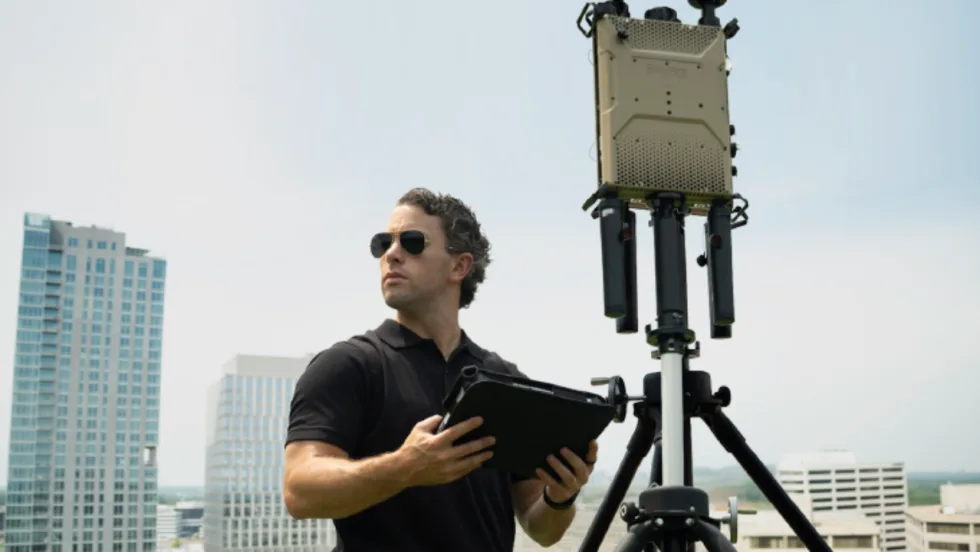
Motorola Solutions Completes Acquisition of D-Fend Solutions
Motorola Solutions has acquired D-Fend Solutions, an industry leader in counter-drone technology. This deal provides public safety and enterprise customers with access to advanced counter-unmanned aerial systems.
Read More →
ZeroEyes, Advantech & Camden Police Partner to Bring AI Gun Detection Technology to Delaware School District
ZeroEyes has partnered with Advantech and the Camden Police Department to deploy ZeroEyes’ AI gun detection and intelligent situational awareness platform at Delaware’s Caesar Rodney School District (CRSD).
Read More →
Leonardo U.S. Cyber & Security Solutions Introduces SignalTrace, the Next Evolution in Electronic Signature Detection Technology
SignalTrace reflects years of product refinement and a clearer expression of the technology’s purpose of recognizing and correlating electronic signatures in publicly broadcast wireless signals to reveal patterns, relationships, and trends that might otherwise go undetected.
Read More →
Pimloc Launches Secure File Sharing to Streamline Release of Redacted Video
Pimloc’s Secure File Sharing lets organizations deliver redacted video, audio, and documents through expiring, passcode-protected links, accelerating delivery while reducing security, compliance, and chain-of-custody risks.
Read More →