



Sightless Training
I suspect a lot of agencies are probably not doing enough "no sight" or limited vision training and should consider its application in the training of defensive tactics, electronic control devices, OC spray, and addressing simple job specific tasks such as handling the equipment on our duty belts.

When one-third or more of an agency's staff works shifts where sunlight is limited, i.e., a midnight or overlap shift, the realism of low-light and no-light training can be invaluable. The old adage of "What you see is what you get" may not always be the case when the lights are low or out.
But very few of us practice defensive tactics or other use-of-force options in low-light conditions. Nationally, we as officers face tens of thousands of physical assaults on an annual basis, and many of these encounters may take place in low-light or no-light conditions. Are we prepared for the loss of vision or a reduction of our sight capacity that could result from injury to our eyes, exposure to OC spray, or low- or no-light conditions?
Are we prepared to not only defend ourselves against an attack, but also address other core tasks such as handcuffing a subject and radioing for help without the use of sight or with diminished vision? If our vision is compromised, will we be able to get the job done and not panic? Or better yet, will we stay "focused," even when we can't see?
I suspect a lot of agencies are probably not doing enough "no sight" or limited vision training and should consider its application in the training of defensive tactics, electronic control devices, OC spray, and addressing simple job specific tasks such as handling the equipment on our duty belts.
The Set-Up
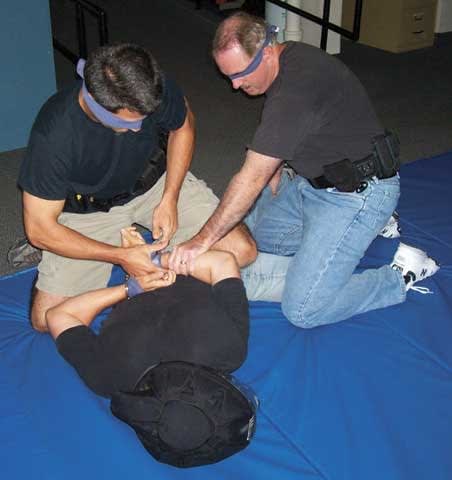
On a recent OC spray training exercise, my agency's officers practiced controlling a subject alone and in two-man teams while blindfolded. These scenarios were based on the possibility that exposure to OC spray could cause temporary blindness and the officer would still need to bring a resisting subject under control.
The training equipment was basic: mats, blindfolds, and headgear for the "resisting subject." Officers not participating in the exercise worked as safety officers to monitor the action. This is especially important to help prevent injuries such as bumped heads.
With their vision impeded by the use of blindfolds, officers had to rely on touch and instinct. When working with partners, officers needed to recognize what their team member was doing such as which part of the subject's body was being controlled, and work together to control and handcuff that subject.
Having studied Goshin Ju-Jitsu, a Japanese martial arts style, I have an appreciation for the importance of learning to work without vision and using other senses and skills when required by circumstances. There were plenty of times during martial arts training when I deliberately closed my eyes while grappling with a fellow student. Once locked up, the use of my eyes wasn't particularly important as I knew where the arms and legs of the student were based on our close proximity and because I was trying to control them with my own.
These principles hold true in law enforcement training. Another advantage to keeping the eyes closed while in close contact was to protect them. An accidental scratch or gouge could result in long-term loss of vision.
The Results
In the single officer exercise, the officers worked from a standing position to establish control and handcuff a standing subject. This was intended to acclimate the officer to working without sight. For some of the students, this was the first time they had done any training without the use of their vision. It was important to start easy to help build confidence and coordination.
This was followed by the two-man exercise where the resisting subject provided light to moderate physical resistance in the form of trying to prevent the officers from bringing his arms together for handcuffing. We began this training from a kneeling position to help prevent injuries while still achieving the benefits of the training. If an officer hit the ground from a lower position, he could brace his fall a little easier, particularly if one of his hands was used to control the resisting subject.
I made it clear that I would not grab for an officer's gun holster simulating an attempt to grab his duty weapon as this could change an officer's use of force option in a serious way. And as the "resisting subject," I would be the recipient of that increased force.
The program went well. Without the use of their eyes, officers were still able to maneuver and bring a subject under control, which was a training objective. It was also valuable as it helped officers gain a better appreciation of what to expect if they lose their sight while still having to complete a job task. As officers will likely react under stress in actual use-of-force situations as they were trained, this type of instruction can be vital for their survival. Also, having the confidence that they can work their way through this type of situation, officers may be less likely to panic when confronted with reduced vision or loss of sight.
Develop Other Drills
The no-sight training provided to our officers was a good introduction and allows for further or expanded exercises of a similar nature. A simple exercise, such as standing blindfolded and then turning to face an opponent who is moving around you, can be helpful. By listening for the actions of the subject and feeling his movement off the ground, you can at least position yourself for counter strikes if the subject moves in on you.
You can also perform basic tasks such as manipulating equipment from inside a cruiser during nighttime conditions or practicing drawing your portable radio and calling in emergency information from a room without lights. The motivation and imaginations of department trainers can result in all kinds of exercises for you to practice without the use of your eyes.
Your Other Senses
Training of this kind can expand to involve different senses. You can practice exercises where your hearing is temporarily compromised from such possibilities as the deafening noise from a fired round or a strike to your ear. Performing job skills when suddenly unable to hear can cause various problems, including ineffective communications. Having some exposure to training where you can't hear or have reduced hearing can be useful.
In range training, our officers practice shooting with their support hand. If your shooting hand is injured or your cover position would benefit from a support side shot, you will need to be able to fire with that hand.
From a defensive tactics standpoint, right-handed officers should also regularly practice strikes from their left hand. If your hand gets broken during a fight, you will need to have some proficiency with your left to continue to protect yourself and control the subject. Practicing an equal number of strikes using both your hands and feet and from both the right and left sides helps improve the coordination and speed of the support hand. Police DT training should follow the same principle.
No-sight training and other sensory-deprived programs should have a place in a department's training regimen because you can find yourself in difficult situations during a tour of duty where some part of your physicality is compromised. This type of training can help give you the confidence to protect yourself, safely complete your objectives, and accomplish your mission to protect and serve.
Tom Wetzel is a northeast Ohio suburban police lieutenant, SWAT officer, trainer, and certified law enforcement executive.
More Patrol

Adept Armor Introduces Two New Rifle Plates
Adept Armor has launched two new Level IV ballistic plates, the Emperor and the Archon Mark 2, which brings Adept Armor’s new Quatroid ceramic to the high-threat, performance-value center of the range at 5.2 pounds.
Read More →
POLICE Product Test: Benchmade Bailout
The Benchmade Bailout is a slim, lightweight carry knife with a deep-ride pocket clip and comes in a variety of blade steels and scales. Here is a detailed review of the Taiga Green Bailout, released earlier this year.
Read More →
NLEOMF Announces July 2026 Officer of the Month
NLEOMF honored a Michigan deputy sheriff as the July 2026 Officer of the Month for rescuing a trapped driver from a burning vehicle following a Fourth of July crash.
Read More →
Streamlight to Showcase Newest Lighting Products at National Safety Council’s Safety Congress & Expo 2026
Streamlight will showcase its latest lights, including the Portable Scene Light III and the LiteBox 1Million, at the 2026 National Safety Council (NSC) Safety Congress & Expo.
Read More →
The 2027 World Police & Fire Games Set for Perth, Australia
The 2027 World Police & Fire Games (WPFG) will take place in Perth, Western Australia, from Friday, March 12 through Sunday, March 21, 2027.
Read More →
5.11 Partners with National Fallen Firefighters Foundation to Support #ForThe343
5.11 has joined the nationwide movement honoring the 343 New York City Fire Department firefighters lost on Sept. 11, 2001.
Read More →
Team Wendy Announces Title Sponsorship of the Jorge Pastore Foundation
Team Wendy’s 3-year partnership with the Jorge Pastore Foundation expands access to programs that strengthen those who serve.
Read More →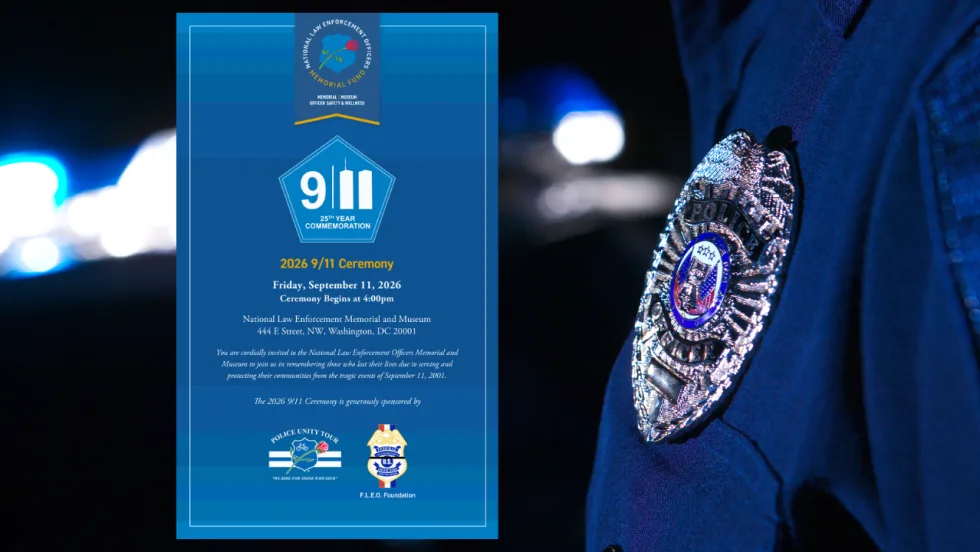
National Law Enforcement Memorial and Museum Hosting 9/11 25th-Year Commemoration Ceremony
The National Law Enforcement Memorial and Museum is hosting a 9/11 25th Year Commemoration Ceremony on Sept. 11 at 4 p.m.
Read More →
National Law Enforcement Officers Memorial Fund Announces June 2026 Officers of the Month
The National Law Enforcement Officers Memorial Fund (NLEOMF) named 15 officers of the Chico Police Department (California) as the Officers of the Month for June 2026 for their roles in responding to an active-shooter incident at a public library.
Read More →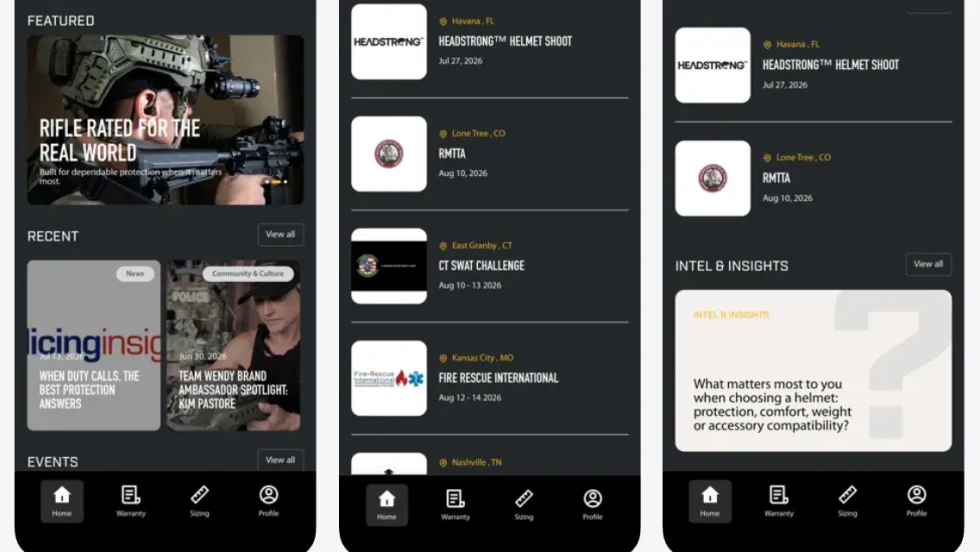
Team Wendy App Creates New Digital Hub for Helmet Owners
The Team Wendy Community App provides one location for warranty registration, size-fit tools, product updates, and community connection. For helmet owners, the new app creates a simpler path to the information and tools that matter most.
Read More →