



Search Warrant Basics
There are good reasons why officers need to become more comfortable with writing search warrant applications, and to delay non-emergency searches until warrants can be obtained.

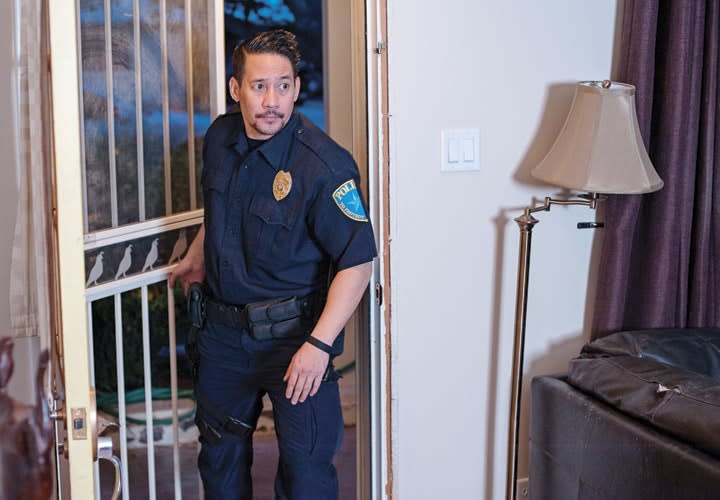
Photo: POLICE File
Whatever the job, it's natural enough to want to take the easy way out. So historically, law enforcement officers have tried to find an exception to the warrant requirement whenever possible, to avoid the time-consuming and often unfamiliar process of applying for and serving a search warrant.
There's nothing wrong with warrantless searches conducted under such recognized exceptions as consent, incident to arrest, "fleeting targets" (probable cause vehicle searches), officer safety, exigent circumstances, and probation or parole conditions. And when a warrantless search is justified by a standard exception, you're not required to get a warrant, just because you could. Such a search "is reasonable and thus consistent with the Fourth Amendment, irrespective of the availability of a warrant." (Fernandez v. California)
But there are good reasons why officers need to become more comfortable with writing search warrant applications, and to delay non-emergency searches until warrants can be obtained.
Warrantless Searches Are Presumed Unreasonable
"Searches conducted outside the judicial process, without prior approval of judge or magistrate, are per se unreasonable under the Fourth Amendment." (Katz v. U.S.) This means whenever you rely on an exception instead of getting a warrant, your prosecutor will have the burden of convincing the court not to suppress resulting evidence.
On the other hand, when you search under a warrant, the defense will have the burden of showing some substantial defect in the warrant, or some mistake in your service of it, before the court could suppress the evidence. This is because the courts have expressed a "preference for police action taken under a warrant as against searches and seizures without one," and have said that "a search under a warrant may be sustainable where one without it would fail." (U.S. v. Ventresca)
Also, even when a Fourth Amendment error occurs, the "good faith" doctrine may save evidence collected under a warrant, while an erroneous warrantless search would generally mean suppression of the evidence, notwithstanding the officer's good faith. "A warrant issued by a magistrate normally suffices to establish that a law enforcement officer has acted in good faith in conducting the search. When an officer acting with objective good faith has obtained a search warrant from a judge or magistrate and acted within its scope, there is no police illegality," and the evidence is therefore not subject to the exclusionary rule. (U.S. v. Leon)
Warrants Provide Greater Protection Against Civil Liability
When you and your agency are being sued in federal court for civil rights damages based on alleged violations of the plaintiff's Fourth Amendment rights, you're entitled to "qualified immunity" from suit if your actions, though unjustifiable, did not violate clearly-established law.
The Supreme Court has said that "Whether an official protected by qualified immunity may be held personally liable for an allegedly unlawful action generally turns on the objective legal reasonableness of the action. Where the alleged Fourth Amendment violation involves a search or seizure pursuant to a warrant, the fact that a neutral magistrate has issued a warrant is the clearest indication that the officers acted in an objectively reasonable manner." (Messerschmidt v. Millender)
And as the Ninth Circuit Court of Appeals summarized the rule, "Under Messerschmidt, approval of a search warrant by superiors, prosecutors and a judge almost guarantees the honest police officer's claim to qualified immunity." (Armstrong v. Asselin)
Detention of Occupants
When you enter and search a house under a search warrant exception (such as consent or probation terms, for example), you don't necessarily have the right to detain everyone who happens to be inside. One of the occupants could simply walk out the door, concealing the very contraband or evidence you were hoping to find.
With a search warrant, however, you get the right to detain everyone present—both residents and non-residents—until the search has been completed. (Michigan v. Summers) Summers and other Supreme Court rulings "have permitted officers executing a search warrant to detain the occupants of the premises while a proper search is conducted." (Bailey v. U.S.)
Warrants Eliminate the Risks of Guesswork
When you act on your own, without getting a search warrant, you take the chance that a reviewing court may disagree with your conclusion that you had a recognized exception for a warrantless search. This could mean suppression of evidence and potential civil liability, whereas as discussed above, a warrant would make such outcomes unlikely. "In choosing to search without a warrant on their own assessment of [exceptional justification], police officers lose the protection [of the good-faith doctrine and "qualified immunity"] that a warrant would provide to them," if a court rules that the exception does not apply. (U.S. v. Ross)
Search Warrants Increasingly Required
The recent trend of U.S. Supreme Court rulings has been to restrict some standard exceptions and require warrants where they previously had not been necessary, including in the following cases.
U.S. v. Jones (2012). In this case, the Supreme Court ruled that warrantless installation and monitoring of a GPS tracker on a suspect's car while parked in a public lot and driven on public streets is a "search" that requires a warrant, unless some exception applies. Before Jones, most jurisdictions did not consider these acts to constitute a Fourth Amendment "search" at all, so neither warrant nor exception had been required.
Florida v. Jardines (2013). Before this case, neither warrant nor exception was generally needed in order to take a drug-sniffing K-9 onto a suspect's front porch to get a "hit" that could support a warrant for the interior. The Supreme Court's ruling changed that, mandating that the K-9 be kept outside the residential curtilage unless a warrant has already been obtained.
Missouri v. McNeely (2013). For nearly half a century, courts had understood the 1966 opinion in Schmerber v. California as authorizing warrantless blood draws in routine DUI/DWI cases, based on the exigency created by the body's natural metabolism and elimination of alcohol from the bloodstream while a warrant was being sought. That changed when the Supreme Court ruled in McNeely that the evanescent nature of BAC evidence does not excuse the need for a search warrant (or valid exception other than search incident to arrest), before a nonconsensual blood draw may occur.
Riley v. California (2014). For the first time, the Supreme Court created a new rule for searches of carried property incident to arrest, based on the nature of the item being searched. Where the item is a cell phone (and by extension of reasoning, a laptop, iPad or similar digital data-storage device), it may no longer be searched incident to the arrest of the person from whom it was recovered. Absent some other applicable exception, a search warrant is now required.
Training Time?
It's pretty clear the Supreme Court is determined to force you out of your comfort zone of warrantless searches and into the habit of seeking judicial warrants. Given the definite advantages search warrants hold for you and your prosecutor, maybe it's time to beef up search warrant training for all officers (patrol, traffic and detectives), and to get comfortable making this your default method of justifying non-emergency searches and seizures.
Devallis Rutledge is a former police officer and veteran prosecutor who currently serves as special counsel to the Los Angeles County district attorney. He is the author of a dozen books.
More Patrol

Adept Armor Introduces Two New Rifle Plates
Adept Armor has launched two new Level IV ballistic plates, the Emperor and the Archon Mark 2, which brings Adept Armor’s new Quatroid ceramic to the high-threat, performance-value center of the range at 5.2 pounds.
Read More →
POLICE Product Test: Benchmade Bailout
The Benchmade Bailout is a slim, lightweight carry knife with a deep-ride pocket clip and comes in a variety of blade steels and scales. Here is a detailed review of the Taiga Green Bailout, released earlier this year.
Read More →
NLEOMF Announces July 2026 Officer of the Month
NLEOMF honored a Michigan deputy sheriff as the July 2026 Officer of the Month for rescuing a trapped driver from a burning vehicle following a Fourth of July crash.
Read More →
Streamlight to Showcase Newest Lighting Products at National Safety Council’s Safety Congress & Expo 2026
Streamlight will showcase its latest lights, including the Portable Scene Light III and the LiteBox 1Million, at the 2026 National Safety Council (NSC) Safety Congress & Expo.
Read More →
The 2027 World Police & Fire Games Set for Perth, Australia
The 2027 World Police & Fire Games (WPFG) will take place in Perth, Western Australia, from Friday, March 12 through Sunday, March 21, 2027.
Read More →
5.11 Partners with National Fallen Firefighters Foundation to Support #ForThe343
5.11 has joined the nationwide movement honoring the 343 New York City Fire Department firefighters lost on Sept. 11, 2001.
Read More →
Team Wendy Announces Title Sponsorship of the Jorge Pastore Foundation
Team Wendy’s 3-year partnership with the Jorge Pastore Foundation expands access to programs that strengthen those who serve.
Read More →
National Law Enforcement Memorial and Museum Hosting 9/11 25th-Year Commemoration Ceremony
The National Law Enforcement Memorial and Museum is hosting a 9/11 25th Year Commemoration Ceremony on Sept. 11 at 4 p.m.
Read More →
National Law Enforcement Officers Memorial Fund Announces June 2026 Officers of the Month
The National Law Enforcement Officers Memorial Fund (NLEOMF) named 15 officers of the Chico Police Department (California) as the Officers of the Month for June 2026 for their roles in responding to an active-shooter incident at a public library.
Read More →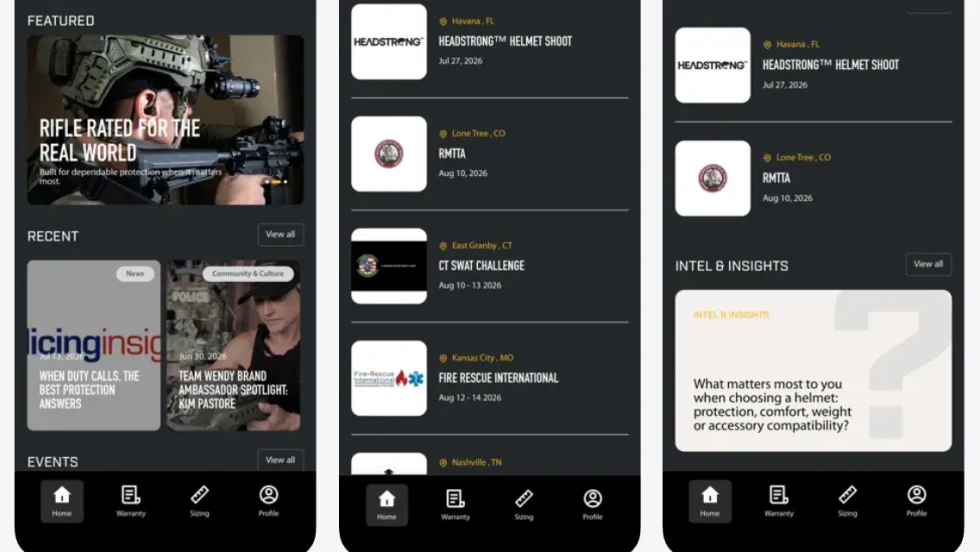
Team Wendy App Creates New Digital Hub for Helmet Owners
The Team Wendy Community App provides one location for warranty registration, size-fit tools, product updates, and community connection. For helmet owners, the new app creates a simpler path to the information and tools that matter most.
Read More →