



Preventing Training Tragedies: Hard Knocks
Today's DT training is much more gritty, more physical, and closer to an approximation of what officers experience in a real street encounter. Unfortunately, it's also much more dangerous.

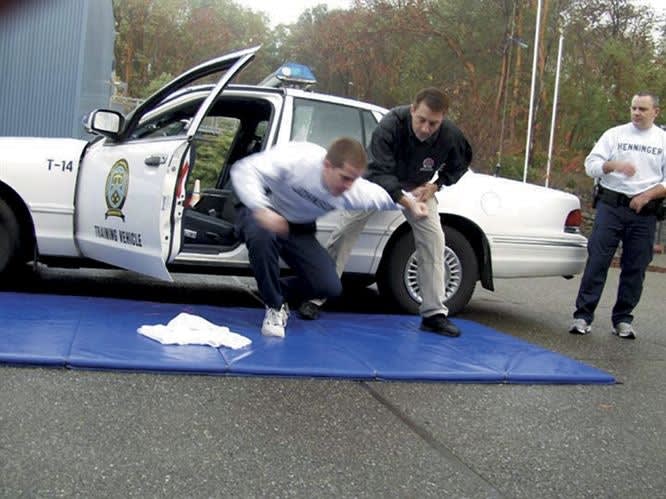
Veteran police trainers talk of the limits of traditional police defensive tactics and use-of-force training with an air of contempt. "It was better than nothing, but not much better," is their consensus. Today's DT training is much more gritty, more physical, and closer to an approximation of what officers experience in a real street encounter. Unfortunately, it's also much more dangerous.
Experts say the potentially perilous nature of contemporary police DT training is why training experts are now taking safety precautions much more seriously than they have in the past. They can't afford to just take it for granted anymore and hope for the best.
Veteran police trainer and retired Milwaukee (Wisc.) Sheriff's Department Capt. Gary T. Klugiewicz marvels at the fact that more police officers weren't seriously injured in training accidents before trainers started adopting rigid and standardized precautions. "Over the years, many of us were unconscious competents," he says. "We did things right, but we didn't really know why it was right, and we couldn't explain it to others."
Now Klugiewicz knows exactly what to tell his students about safety. In his classes and in many other police training programs, the first thing students are asked to do is read the written safety rules and agree to abide by them.
Safety guidelines supplied by several DT trainers cover such concerns as weapons, jewelry, horseplay, keeping the floor clear of tripping hazards, and when to halt the exercise. The guidelines also advise participating officers not to play through pain and to immediately advise the instructors of injuries that do occur.
That last part is very revealing. DT training is obviously no game and accidents will happen. The trick is to minimize both their frequency and their magnitude.
Bob Bragg, director of instructor training at the Washington State Criminal Justice Academy in Seattle, argues the only way to have zero injuries is to have students do nothing but "sit in the classrooms." He says otherwise an acceptable injury rate is 5 percent or less with injuries defined as: "something that lasted more than a few days and had some debilitation associated with it and that may have required the officer or cadet to see a physician." And of course he is not talking about permanently disabling or fatal injuries.
DT trainers also stress that there is a big difference between preventable injuries and those that are pure accidents. For example, training consultant Ed Nowicki notes that if a student has a heretofore unknown congenital defect in his or her wrist bones and suffers an injury during a handcuffing exercise, there's nothing that could have been done to prevent it.
Learning from Mistakes
Once an accident does occur, whether preventable or not, it's the instructor's job to prevent it from happening again. Klugiewicz hammers home this point to other instructors with a riddle: "What's the difference between a tragedy and negligence?" he asks. "The answer is: repetition."
One hazard that Klugiewicz won't repeat in his classes is an incident that happened on a summer day in Iowa nearly a decade ago. Klugiewicz, who is a consultant for the makers of RedMan impact resistant suits, was working out a group of officers in the RedMan gear and the result was perspiration. "It was a very hot day," he explains. "People were out there sweating and fighting, and their sweat was running onto the floor. Someone stepped back, slipped, and twisted his leg. It was a minor injury. But we learned from that. Now we have safety officers who watch the room for safety violations and towel officers who watch the floor for wet spots."
Klugiewicz stresses to his colleagues that instructors have a moral and legal responsibility for the safety of their students. "I got into training to teach officers how to keep themselves safe, and I feel really bad when someone is injured in one of my programs." Fortunately for Klugiewicz and his students, the injuries in his programs have been limited to pulled muscles, twisted knees, and bumps and bruises.[PAGEBREAK]
Kill the Teacher
Ironically, the most bruised and bumped participants in DT training are often the instructors themselves. Bragg conducted a poll at a recent conference of the American Society for Law Enforcement Training (ASLET) and discovered that out of 400 respondees, 30 percent had been injured in a training session.
There are two major reasons why instructors take such a pounding in their classes: they believe they're invulnerable, especially when wearing an impact resistant suit (IRS) like those made by RedMan or FIST and/or they are working with beginning DT students whose reactions can be unpredictable.
Bragg says the IRS systems are great, but instructors need to be aware that they do not turn you into Superman. "Even in the suits, it's pretty darn difficult to protect the head. I could put a motorcycle helmet on you and even if I hit you repeatedly in the head with a padded forearm, you're going to get a concussion because your brain is getting whacked around in your skull."
As for beginning students with little or no training in defensive arts, they are the nightmare of all DT trainers. "I've been hurt more by beginners than in competitive knock-down drag-out things," explains Bragg. "You think something has stopped and you look away to explain the technique to the class and they'll swing while you're talking."
Controlling the Room
Whether they happen to students or themselves, trainers say that injuries in a DT program are ultimately the burden of the lead instructor. "You can delegate authority, but you can't delegate responsibility," Nowicki explains.
San Diego-based police trainer and retired cop Larry Smith adds, "Accidents in training have a lot to do with the instructor. The instructor has to create a safe atmosphere for the exercise, lay down the safety rules, and make sure that the students adhere to them."
For the instructors, preventing injury all comes down to controlling the room. Accordingly, a key concern for many DT instructors is the instructor-to-student ratio. "A lot of training accidents occur because there's not enough instructors to watch everybody and make sure that they are doing the technique correctly," Smith says.
Like a lot of law enforcement trainers, Nowicki has discovered that one of the best tools for controlling the room is a coach's whistle. "If you blow that whistle hard, it'll catch their attention. I let them know that if they hear it, they stop everything. It's much more effective than yelling, 'Stop!'"
Fit for Training
Another major issue for instructors is assessing fitness and overall health of the students before the exercise begins. Many police instructors can tell you horror stories of in-service and even academy programs in which students have died of heart attacks. Less tragic but still a big problem for instructors are students who come to class with existing injuries and don't tell the instructor.
"That's why we stress warm-ups in our training program for instructors," says Bragg. "The warm-up is a warm-up, but it's also a gross injury and function assessment. We train our instructors to look at the students and do some visual evaluation as they go through their warm-up exercises. Then if they see someone who can't do part of the warm-up, they go over and do more of an individual assessment."
Proper equipment is also a concern. Officers are often hurt in training sessions when gear is pushed beyond its limits. And Bragg is quick to add that using improvised equipment to save money is flat-out courting tragedy. "I know budgets are tight, and some agencies can't afford the right gear, but don't try to do realistic training without the right equipment because that will lead to disaster and a sure cessation of training," he says. "You can buy a lot of equipment for the money that you will lay out on one hurt officer."
DT Training Precautions
No weapons allowed in the training area unless required for the scenario and checked thoroughly.
No jewelry.
No horseplay.
Keep gear off the floor.
Know and recognize the release command (pat out, etc.).
Practice techniques slowly at first, then build speed.
Advise your instructor of any condition that may limit your participation.
Notify instructor of any injury that occurs during the training.
More Patrol

Adept Armor Introduces Two New Rifle Plates
Adept Armor has launched two new Level IV ballistic plates, the Emperor and the Archon Mark 2, which brings Adept Armor’s new Quatroid ceramic to the high-threat, performance-value center of the range at 5.2 pounds.
Read More →
POLICE Product Test: Benchmade Bailout
The Benchmade Bailout is a slim, lightweight carry knife with a deep-ride pocket clip and comes in a variety of blade steels and scales. Here is a detailed review of the Taiga Green Bailout, released earlier this year.
Read More →
NLEOMF Announces July 2026 Officer of the Month
NLEOMF honored a Michigan deputy sheriff as the July 2026 Officer of the Month for rescuing a trapped driver from a burning vehicle following a Fourth of July crash.
Read More →
Streamlight to Showcase Newest Lighting Products at National Safety Council’s Safety Congress & Expo 2026
Streamlight will showcase its latest lights, including the Portable Scene Light III and the LiteBox 1Million, at the 2026 National Safety Council (NSC) Safety Congress & Expo.
Read More →
The 2027 World Police & Fire Games Set for Perth, Australia
The 2027 World Police & Fire Games (WPFG) will take place in Perth, Western Australia, from Friday, March 12 through Sunday, March 21, 2027.
Read More →
5.11 Partners with National Fallen Firefighters Foundation to Support #ForThe343
5.11 has joined the nationwide movement honoring the 343 New York City Fire Department firefighters lost on Sept. 11, 2001.
Read More →
Team Wendy Announces Title Sponsorship of the Jorge Pastore Foundation
Team Wendy’s 3-year partnership with the Jorge Pastore Foundation expands access to programs that strengthen those who serve.
Read More →
National Law Enforcement Memorial and Museum Hosting 9/11 25th-Year Commemoration Ceremony
The National Law Enforcement Memorial and Museum is hosting a 9/11 25th Year Commemoration Ceremony on Sept. 11 at 4 p.m.
Read More →
National Law Enforcement Officers Memorial Fund Announces June 2026 Officers of the Month
The National Law Enforcement Officers Memorial Fund (NLEOMF) named 15 officers of the Chico Police Department (California) as the Officers of the Month for June 2026 for their roles in responding to an active-shooter incident at a public library.
Read More →
Team Wendy App Creates New Digital Hub for Helmet Owners
The Team Wendy Community App provides one location for warranty registration, size-fit tools, product updates, and community connection. For helmet owners, the new app creates a simpler path to the information and tools that matter most.
Read More →