



Pre-Attack Indicators
Learn how to tell someone is about to assault you long before they make their first move.

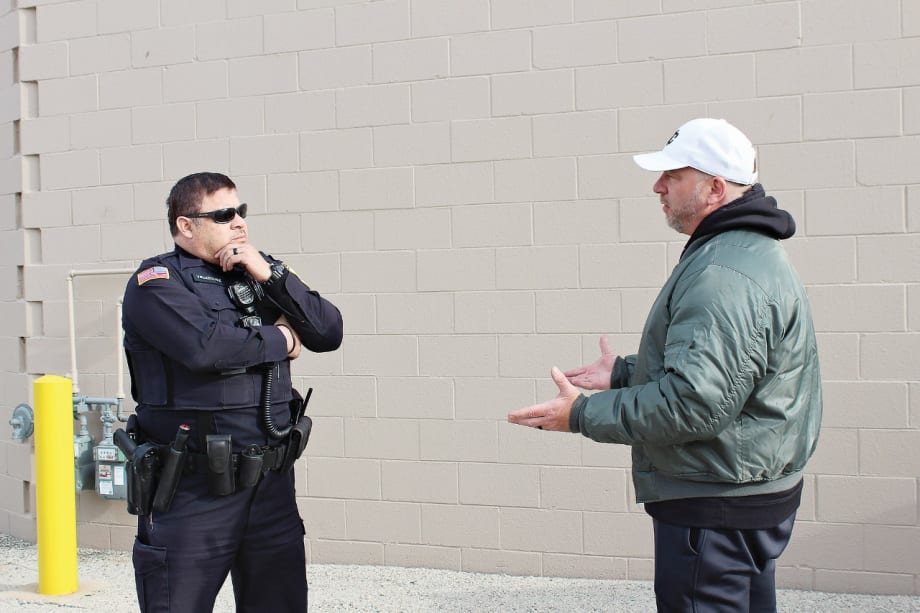
If your hands are down by your side, you're not in the best possible tactical position. A better position is hands up and out in front of you, as in the "tactical thinking stance." This stance projects a professional image and position of advantage. Photo: Dave Young
"No one has started a fight with someone and lost it in their mind first."
How many times have you asked another officer who was involved in a fight what happened and heard that fellow law enforcement professional say, "I don't know, he just punched me?"
Experienced officers know that's not how these confrontations really happen. When you play back the video of almost any physical assault on an officer, you can see the attack coming 30 seconds before the suspect even throws the first punch.
I have been studying human behavior as it pertains to physical encounters for more than 30 years. In the last five years we have highlighted the importance of noting these basic pre-attack indicators during every contact we make. Whether the contact escalates to a physical confrontation or not, these indicators should confirm one or two things: communication between the officer and the suspect has broken down, and/or there is a possible safety violation by the officer.
As someone who has survived several physical encounters and a professional who trains thousands of law enforcement officers yearly on how to read these signs, I have compiled a list of them that you can use in your training.
Making an Assessment
The dictionary definition of "Proxemics" is the study of the nature, degree, and effect of the spatial separation individuals naturally maintain. In our training programs we use this term to identify various levels of officer alertness, awareness of the officer to the distance between them and the subject, body positioning, and hand placement. When we are verbally engaged with others many of us never consider how far we are from another person, until we are hit in the face. To express this, we use a safety rule called "10-5-2."
At 10 feet, you conduct a visual "risk and threat assessment" of your area and people in it. In this assessment, you develop an exit plan, identifying your escape routes (never place yourself in a situation you cannot see yourself getting out of). These escape routes can be other windows in the room, stairs, a ladder, or the door you walked into. All of your escape options need to be both within your physical and emotional limitations.
If you do not feel the area is safe, develop exit strategies. An exit strategy is a way to physically avoid contact with a possible threat or dangerous situation by leaving the immediate area. If there are no immediate escape routes, identify positions of cover, or barriers, you can place between you and a threat, especially when a weapon is present.
The last thing in your "risk assessment" is to identify weapons of opportunity and weapons of availability. Weapons of opportunity are weapons you have on your person, like a concealed firearm, a knife, or even a tactical pen. Weapons of availability are items in your immediate area you can use to physically defend yourself. Always remember if such weapons are present they are available to both you and others.
Getting Closer
At distances of 10 feet, respect for "proxemics" plays a role in safety before you contact someone. As a person approaches you, give the one-handed "halt" sign to alert the person you are aware of their presence and to ask them to respect your boundary.
Of course they won't always honor your command. There are many reasons a person may not respect your boundaries, these include:
Being under the influence
Short-term emotional issues
Brain disorders
Cultural misunderstandings
They wish to be aggressive and/or intimidating
At five feet, your awareness of distance, body positioning, and hand placement play a more vital role in ensuring your physical safety.
The equation that says "hands down equals NOT ready to respond" is very true. Are you standing outside of the five-foot range or inside it? When you are verbally engaging with a person, and their tone intensifies or words become threatening, using proxemics can assist you in improving your communication and increasing your safety without compromising your public image.
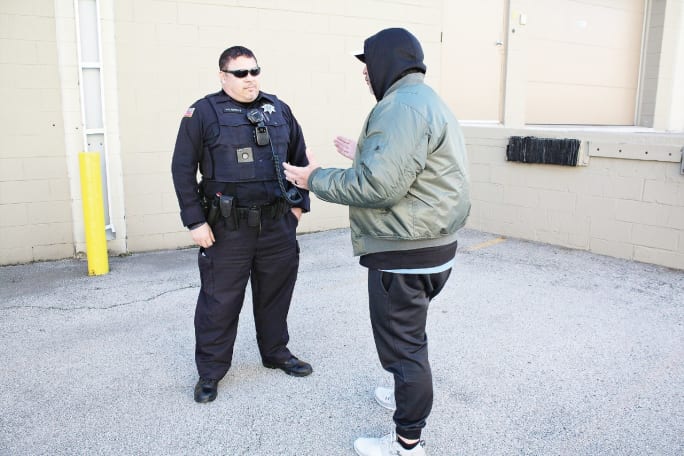
Standing with your thumbs inside your pockets or your hands grabbing your vest during a contact doesn't come across as professional and doesn't give you a position of advantage. Photo: Dave Young
If your hands are down by your side, you're not in the best possible tactical position. A better position is hands up and out in front of you, as in the "tactical thinking stance." Remember, your contact should have the feeling that you are commuicating concern, visually as well as with the tone of your voice.
As you get closer to your contact at distances of two feet, you are typically engaging them with a hand shake, retrieving information from them, handing them something, or engaged in physical contact.
Having your hands up, in front of you using the "emergency time out" position allows you to communicate a message of non-violent intentions and provide you with a position of advantage if you need to respond to a physical attack, especially if someone quickly approaches you from the blind side while you are engaging with another person.
Things to Watch For
In most of our contacts as professionals, we have a positive closure, and situations do not escalate. However, there are times when our contact escalates into conflict, then to a crisis, and then to possible combat. There are very distinct signs or "tells" you need to be aware of when you are in these situations.
Here are five basic prefight indicators you need to know:
1. Distance—The distance a person allows you to maintain during a contact speaks loudly about the level of comfort you are extending to them and the level of safety you feel with them.
2. Positioning—Where a person chooses to stand when verbally engaging you can show either respect or disrespect.
3. Tone of Voice and Word Choice—The tone of a person's voice is closely related to their level of frustration. And the words they choose and/or excessive repetition of the same words will give you a hint about their level of anger.
4. Hand Movements—Hand movements will show a subject's readiness to take action, kind of like a batter warming up in the batting on-deck circle.
5. Eye Focus—Where they are looking and how intently will give you insight into their level of focus. What the eyes focus on is displaying what they are thinking about doing.
Way before the subject is standing in front of you, take note of their approach. I call this the "initial observation of contact."
Watch as they approach you. Be sure to identify the pace at which they are approaching. Speed of approach can indicate level of urgency. Are they gradually walking toward you like they are taking a stroll at the park? Or are they walking steadily in a straight line toward you as if to ask you a question or tell you something important?
Here are a few notes about pace to help you read a subject's intent.
Casual Pace—Walking in a steady but slow speed with no set time or urgency on their arrival, typically looking at what is in front of them not caring too much about what is around them. If eye contact is made, there is usually no facial expression because you might be in their line of sight but not in their mind's eye of purpose or view.
Strolling Pace—Walking in a slight pattern and direction typically with no defined goal or purpose but with a destination or time in mind. This is an uneven pace, like three to five steps forward casually looking at what is around their immediate area but careless of what is directly in front of them. Their steps are in spurts.
Targeting Pace—Walking with a direction and purpose in mind, paying very close attention to what is 10 feet in front of them very clueless as to what isgoing on around them. Their breathing is at a rhythm that matches their attention, but their eyes are focused on a specific location. This can also be referred to as "tunnel vision." Their speed is much faster than a stroll and their eyes are focused directly on you as they walk, possibly bumping into others as they get closer as if they do not see them. This could be a sign they are planning to attack you or they could really need your attention.
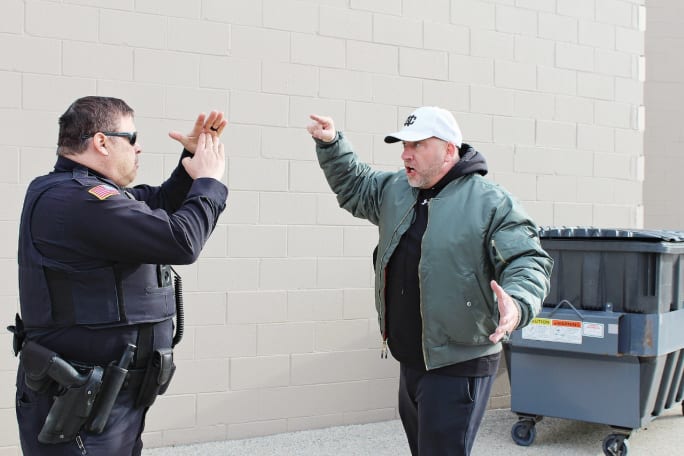
Having your hands up, in front of you using the "emergency time out" position allows you to communicate a message of non-violent intentions without compromising officer safety. Photo: Dave Young
Use Your Ears
The tone of a person's voice is a helpful indicator of that person's state of mind and typically relates to how frustrated the person might be during your contact. The tone of voice a person chooses often can be used to help mask their original feelings or state of mind and focus. Many times when people believe they are not being understood, they will increase the tone of their voice, demonstrating their level of frustration.
Since the words people use are a choice, often the words selected or repetition of a word or words will reveal they are angry. What's critical is to determine if they are angry at you or the situation. Just moments before a physical act, a person's tone and the level of their voice tends to get louder than the person they are talking to and words become more insulting and threatening.
In our training, we discuss four different tones an officer can use to assist a subject in delivering their message.
Search Talk—Normal conversational tone used when asking for identification or gathering information from a contact
Persuasion—A soft, soothing tone used when persuading or negotiating with a person
Light Control Talk—An insistent tone used when there is the need to be professional and serious in communicating with a person and providing direction
Heavy Control Talk—The tone used when issuing ultimatums or giving direct verbal commands
Watch the Hands and Arms
The positions of a person's hands can help confirm their behavior or intended actions before they decide to act. In many cases this can help you in using avoidance and exit strategies during a verbal altercation before it escalates into a physical encounter.
Flexing hands is a way that some people demonstrate their levels of anxiety.
Making a fist during contact may be to release some tension or it could be showing you the image they have inside their mind.
Bending wrists and cracking knuckles during your contact may be used to express their agitation or used to intimidate.
Clapping their hands together, rubbing them as if to wash their hands can show they are reaching the boiling point and may soon act out physically.
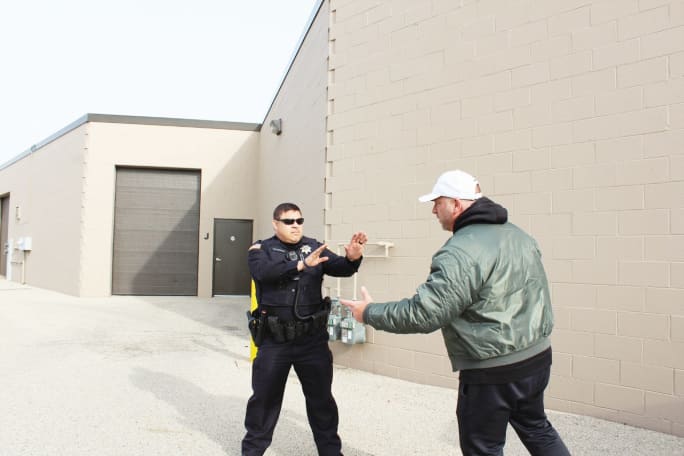
Putting your two hands up as a stop sign is another way to exude a professional image while maintaining officer safety. Photo: Dave Young
Eye Focus
Noting a subject's eye focus typically can help you understand what is on their mind while you are speaking with them. This often can help you gauge their truthfulness and intent during a conversation, especially if this is a verbal altercation that is getting ready to enter a physical confrontation.
Basic examples of this are best illustrated by looking back at your childhood. Just before our parents got mad with us how many of us heard them say, "You better look at me when I talk to you?"
Where should a person's eyes be when you are verbally engaged with them? What about if you are speaking with someone and they are paying more attention to what is happening around them than the words coming out of your mouth? Below are a few types of eye focus you might experience during a contact.
Casual Eyesight—This is looking at someone incidentally in your line of sight. Your eyes see another person. You see their face but only remember their body shape and possibly an item of clothing or hair color. You see what is in front of you without observing what is there in detail.
Normal Eyesight—Someone is in your line of sight and matching a picture you have in your mind of someone you have seen before. Your eyes see another person; you see their face and can give a slightly more detailed description of what you see. You note details like clothing color and fashion, hair color and how it is styled because they match the picture in your mind through a memory of what you have seen before.
Targeting Eyesight—Someone is in your line of sight and you take a long look at them. You are able to fill in more detail as to clothing, hair, eyes, mannerisms, body posture, behavior patterns, type of holster (if they have one), caliber of firearm (if they have one), and any possible injuries or handicaps.
Dave Young is a long-standing member of the POLICE Magazine Advisory Board. He is founder and director of Arma Training and US Fighting Systems, and a co-founder of Vistelar. Young has served as a sworn corrections and law enforcement officer. He is a Marine Corps veteran.
More Training
Registration Underway for Sixth Annual First Responders Relay
The California Police Athletic Federation’s annual First Responder Relay will welcome first responder teams from across the globe to compete along Ventura's scenic coastline on Oct. 11. Registration is underway.
Read More →
Vector Solutions Launches Comprehensive Online Dispatch Training Catalog for Emergency Communications Professionals
Vector Solutions’ new catalog of 35 expert-developed online courses can help emergency communication centers strengthen training, meet certification requirements, and simplify continuing education.
Read More →
Tools for Active Shooter Response Training
What technologies help prepare officers for active shooter response situations? This behind-the-scenes look at law enforcement training explores shot simulators, smart firearms, laser target systems, and the tools used to build safer, more effective training environments.
Read More →
Two-Officer Tactical Doorway Entry Techniques
Entering a room during active-threat situations requires communication, coordination, and disciplined tactical movement. In this video, trainers from the United States Deputy Sheriff’s Association demonstrate critical room entry concepts, including fatal funnel awareness, team coordination, and safe tactical movement.
Read More →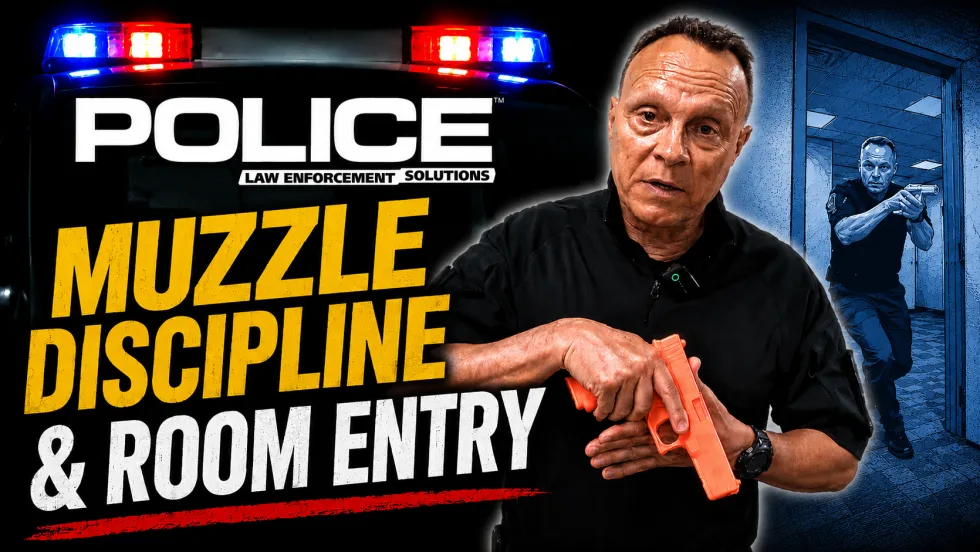
High Compressed Ready Explained | Muzzle Control For Room Entry
In this video, Mike Willis, law enforcement national training and program director for the United States Deputy Sheriffs’ Association, demonstrates the high compressed ready position and discusses muzzle control during room entry.
Read More →
Why Attend the DroneSense Innovation Summit by Versaterm?
Let’s hear from Ryan Bracken, head of product, about why your agency should send someone to the first annual DroneSense Innovation Summit by Versaterm in April.
Read More →
Caswell Live Fire Spins Off from InVeris
Caswell Live Fire has spun off from parent company InVeris, coinciding with the 100th anniversary of Caswell’s founding. Over the past 100 years, Caswell has developed pioneering solutions that support military, law enforcement, and commercial clients worldwide.
Read More →
When Do You Transport a Wounded Officer Instead of Waiting for EMS?
Thumbnail for video series POLICE Topics, Tactics & Tips with a yellow headline that reads When Do You Transport a Wounded Officer Instead of Waiting for EMS?
Read More →
How to Pick Your High-Risk Stop Location for Tactical Advantage
Hear veteran trainer Mike Willis, of the United States Deputy Sheriff’s Association, explain several considerations that can help you wisely pick your best spot to initiate high-risk or felony traffic stops.
Read More →
Coffee Break with Police Experts: Using Your Patrol Vehicle for Cover
In this video, hear from Dustin Mowery, a product specialist at Team Wendy, as he discusses how to best use a patrol vehicle for cover.
Read More →