



Massiah Vs. Miranda
Miranda, Miranda, Miranda. Sometimes, we spend so much time on this one aspect of interrogation law that we tend to forget there are three other constitutional tests of admissibility of a suspect's statement.

Miranda, Miranda, Miranda. Sometimes, we spend so much time on this one aspect of interrogation law that we tend to forget there are three other constitutional tests of admissibility of a suspect's statement.
Statements can be suppressed not only for lack of Miranda compliance (a Fifth Amendment issue), but also when they result from an unreasonable search or seizure (Fourth Amendment), or when their use at trial would infringe the suspect's right to counsel (Sixth Amendment), or when coercive tactics make them involuntary (Fifth or Fourteenth Amendment due process).
If you ever feel confused about the differences between these various constitutional rules for interrogations, don't feel all alone-you have plenty of company. Criminal lawyers and judges also have problems keeping things straight, as the recent U.S. Supreme Court decision in Fellers v. U.S. illustrates.
Older Than Miranda
Miranda v. Arizona went onto the books in 1966. But the Supreme Court had ruled as early as 1897 that prosecutors could not use involuntary statements produced by mistreatment, threats, or coercive promises of leniency. (Bram v. U.S.) In 1963, statements resulting from unlawful arrest were ruled inadmissible. (Wong Sun v. U.S.) And two years before Miranda, in Massiah v. U.S., the court created an exclusionary rule based on the Sixth Amendment right to counsel.
The Sixth Amendment guarantees that after a suspect has become the "accused" in a criminal case, he or she can have the assistance of defense counsel at every meaningful confrontation between the government and the accused. This includes attempts by the police to obtain incriminating statements about that case. Massiah held that once this guarantee kicks in, any statements obtained without the presence of counsel or a valid waiver cannot be used to prove guilt at trial.
Sixth Amendment Attachment
The constitutional right to counsel is limited. It applies only to the specific crime the suspect has been formally "accused" of committing. This does not mean merely that a victim has made an accusation, or even that a prosecutor has charged the suspect by complaint. It means that an "adversary judicial proceeding" has commenced, which will normally happen one of two ways. Either the suspect has been indicted by a grand jury or he has made his first court appearance in the case (typically at an arraignment on a complaint). Once either of these triggering events occurs, the Sixth Amendment right to counsel is said to "attach," and the Massiah rule applies.
Sixth Amendment Assertion
An accused person can "assert" his right to counsel by retaining a private attorney, by requesting counsel, or by accepting the court's appointment of a public defender or other attorney.
Not everyone chooses to be represented by an attorney. Some people decide to act as their own counsel. In those rare cases, no Massiah issue can arise because the defendant's counsel (himself) will always be present during questioning. But unless the defendant has expressly waived his right to counsel, the courts will presume that it is asserted. (Michigan v. Jackson.)
After the Sixth Amendment right to counsel has attached (by indictment or arraignment) and been asserted (by request, retention, or appointment of an attorney), police may no longer obtain a valid waiver of this right from the accused for police-initiated discussions about the case. (Jackson.) Any statement deliberately elicited by police or their agents after this point would be inadmissible in the trial of that case.
Two Rights to Counsel
Because both Miranda and Massiah speak of a "right to counsel," it's easy to get them confused. They're not the same. The Miranda right to an attorney is a court-created means of helping to dispel the coercive atmosphere presumed to exist during custodial interrogations, to protect the Fifth Amendment privilege against compelled self-incrimination. Such interrogations usually occur well before the Sixth Amendment constitutional right to counsel has attached. The Sixth Amendment, on the other hand, is not dependent upon the suspect's custodial status, but only upon indictment or first court appearance.
Sometimes only Miranda applies (custodial suspect is interrogated before indictment or arraignment). Sometimes only Massiah applies (after arraignment and appointment of counsel suspect is released from custody pending trial and is approached by police for questioning). Sometimes, both Miranda and Massiah might apply (as where a defendant remains in custody following indictment or arraignment and is then subjected to police interrogation).
But sometimes, discussions with a suspect fall into a window where the Sixth Amendment has attached (by indictment) but has not yet been asserted (an indicted but unarraigned suspect has neither retained nor requested counsel). The Supreme Court has specifically addressed this kind of situation twice, in the 1988 opinion in Patterson v. Illinois, and in the 2004 opinion in Fellers v. U.S.
Patterson, Elstad, and Fellers
In the Patterson case, the Supreme Court held that when a suspect has been indicted but has not yet asserted his Sixth Amendment right to counsel, it is possible for police (using a standard Miranda advisement) to obtain a valid waiver of the constitutional right to counsel, after which an admissible statement could be obtained.
In the 1985 case of Oregon v. Elstad, involving a Miranda issue, the Supreme Court held that even though initial custodial questioning may have occurred without proper warnings and waiver (responses inadmissible), police could later give the warnings, obtain a waiver, repeat the interrogation, and obtain an admissible second statement. The issue in Fellers was whether officers who elicited statements from an indicted suspect without a waiver could later take a waiver and obtain an admissible second statement.
John Fellers was indicted by a federal grand jury on drug charges. Officers went to his house and arrested him. A few brief statements were elicited without any warnings or waiver. Later at the station, Fellers was Mirandized, waived, and repeated his statements. The issue was whether the second set of statements could be used at trial. The Eighth Federal Circuit Court of Appeals failed to recognize important differences between Miranda and the Sixth Amendment, and so misanalyzed the issue. Their decision was reversed by the Supreme Court.
Practical Guidelines
It's easy to see that some of these issues are too complicated for even federal appellate judges to sort out (although police officers are somehow expected not to make the same mistakes). But a few understandable rules can be taken from the Sixth Amendment cases, and should be kept in mind:
The Sixth Amendment right to counsel only attaches after indictment, arraignment, or other initial court appearance on a case.
After attachment and assertion, only the suspect can initiate discussions with police on that case.
After attachment but before assertion, officers can obtain a Massiah waiver for police-initiated questioning, by using a Miranda admonishment.
The Sixth Amendment right is "offense-specific," meaning that it does not prevent police-initiated questioning on other, uncharged crimes.
Attorney Devallis Rutledge, a former police officer and prosecutor, defends officers and agencies at Manning & Marder, Kass, Ellrod, Ramirez.
More Patrol

Streamlight Portable Scene Light III Wins 2026 OH&S New Product of the Year Award
Streamlight’s Portable Scene Light III has won the 2026 Occupational Health & Safety (OH&S) New Product of the Year Award in the Lighting category.
Read More →
Adept Armor Introduces Two New Rifle Plates
Adept Armor has launched two new Level IV ballistic plates, the Emperor and the Archon Mark 2, which brings Adept Armor’s new Quatroid ceramic to the high-threat, performance-value center of the range at 5.2 pounds.
Read More →
POLICE Product Test: Benchmade Bailout
The Benchmade Bailout is a slim, lightweight carry knife with a deep-ride pocket clip and comes in a variety of blade steels and scales. Here is a detailed review of the Taiga Green Bailout, released earlier this year.
Read More →
NLEOMF Announces July 2026 Officer of the Month
NLEOMF honored a Michigan deputy sheriff as the July 2026 Officer of the Month for rescuing a trapped driver from a burning vehicle following a Fourth of July crash.
Read More →
Streamlight to Showcase Newest Lighting Products at National Safety Council’s Safety Congress & Expo 2026
Streamlight will showcase its latest lights, including the Portable Scene Light III and the LiteBox 1Million, at the 2026 National Safety Council (NSC) Safety Congress & Expo.
Read More →
The 2027 World Police & Fire Games Set for Perth, Australia
The 2027 World Police & Fire Games (WPFG) will take place in Perth, Western Australia, from Friday, March 12 through Sunday, March 21, 2027.
Read More →
5.11 Partners with National Fallen Firefighters Foundation to Support #ForThe343
5.11 has joined the nationwide movement honoring the 343 New York City Fire Department firefighters lost on Sept. 11, 2001.
Read More →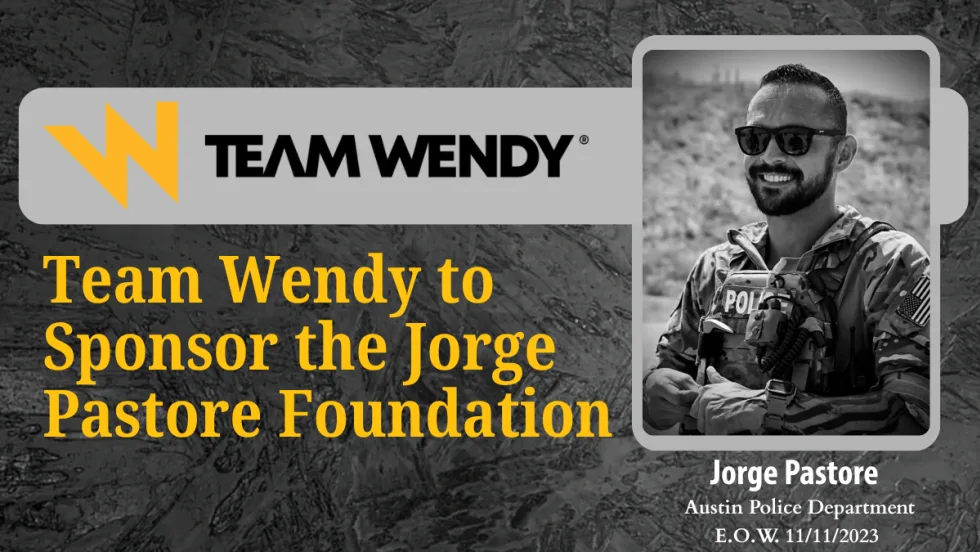
Team Wendy Announces Title Sponsorship of the Jorge Pastore Foundation
Team Wendy’s 3-year partnership with the Jorge Pastore Foundation expands access to programs that strengthen those who serve.
Read More →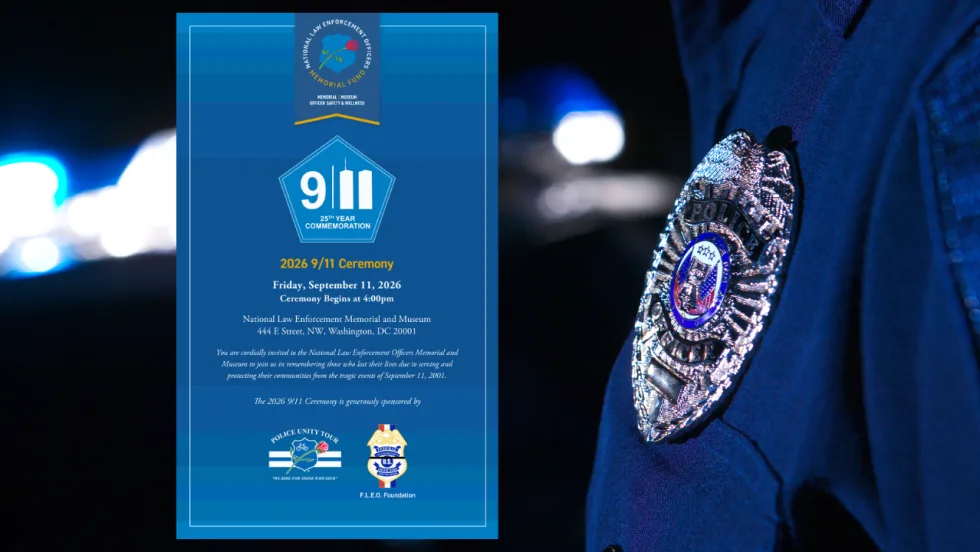
National Law Enforcement Memorial and Museum Hosting 9/11 25th-Year Commemoration Ceremony
The National Law Enforcement Memorial and Museum is hosting a 9/11 25th Year Commemoration Ceremony on Sept. 11 at 4 p.m.
Read More →
National Law Enforcement Officers Memorial Fund Announces June 2026 Officers of the Month
The National Law Enforcement Officers Memorial Fund (NLEOMF) named 15 officers of the Chico Police Department (California) as the Officers of the Month for June 2026 for their roles in responding to an active-shooter incident at a public library.
Read More →