



Legal Issues With Body Cams
Recent events have accelerated law enforcement's timetable for adopting wearable audio-video recording devices. But using this technology has legal ramifications that have to be understood by criminal justice stakeholders.

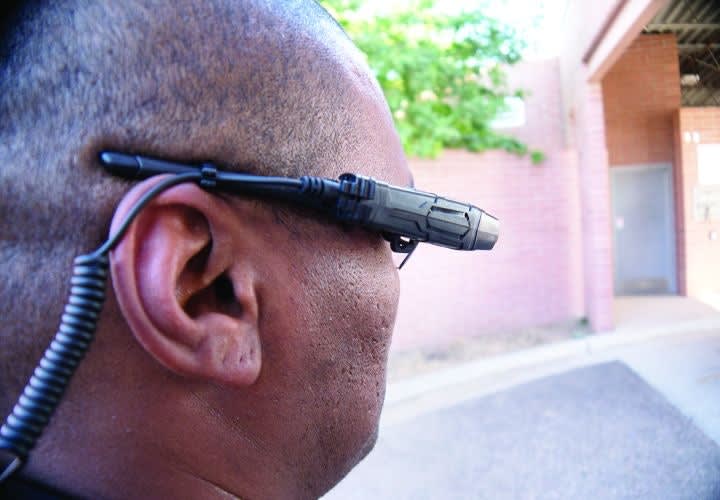
Photo: Mark W. Clark
Recent events have accelerated law enforcement's timetable for adopting pilot programs to test the use of audio-video recording devices worn on the police uniform or accessories. Some early users have reported drops in complaints and use-of-force incidents. Prosecutors and jurors favor the incontestable evidence a recording often provides. Police-accountability activists urge that all officers be required to wear body cams at all times while on duty. There's no denying that this technology has many benefits to offer.
It also has legal ramifications that have to be understood by criminal justice stakeholders. These ramifications make it advisable for departments and their legal advisors to craft protocols for the use of body cams and for the processing of the voluminous recordings they produce. Legislation may be needed to modify certain aspects of laws that were drafted before advances in technology raised issues that present laws don't satisfactorily resolve.
Is It Legal for You to Record?
Police recording of interactions with members of the public may present issues under the Fourth Amendment and under state and federal laws regulating the interception and recording of communications. The U.S. Supreme Court has ruled that law enforcement officers may generally record whatever they can lawfully see and hear, without violating the Fourth Amendment. (Lopez v. U.S.) However, the court has limited this general rule in instances where police used special technology to invade legitimate expectations of privacy in suspects' conversations and activities—for example, a spike mic (Silverman v. U.S.); unauthorized wiretap (Katz v. U.S.); thermal imaging device (Kyllo v. U.S.); and GPS tracker. (U.S. v. Jones)
Federal statutes in Title III of the Omnibus Crime Control and Safe Streets Act, the Electronic Communications Privacy Act, the Stored Communications Act and other federal bills place restrictions on intercepting and recording certain communications. (See, for example, Title 18, United States Code, sections 2510, 2701, and 3121.) Most states also have laws regulating the circumstances under which warrantless electronic surveillance, interception, and recording are permitted.
The Duty to Preserve and Disclose
Constitutional due process mandates that prosecutors disclose to the defense any material exculpatory evidence in the possession of "the prosecution team," which includes the police. (Brady v. Maryland; Kyles v. Whitley) The Supreme Court has held that evidence that has an "apparently exculpatory value" to a defendant that cannot be otherwise obtained by the defense must be preserved by police for disclosure in a criminal prosecution. (California v. Trombetta; Arizona v. Youngblood)
This means that if suspects or witnesses make statements during recorded police encounters that appear to exculpate a suspect, the recording must usually be preserved for disclosure. Since most body cam and dash cam systems automatically upload an entire shift's recordings to a server when the police car and officer return to the station, some procedure is necessary that will enable officers to identify and segregate relevant portions of recordings for review, documentation, retention, and furnishing to the prosecutor for disclosure to the defense.
Failure to implement such protocols has already begun to prove costly in court. In People v. Alvarez, for example, a California Court of Appeal recently reversed the robbery convictions of two defendants because of the failure of police to preserve and disclose their surveillance video. Said the court, "Police and prosecutors are more than willing to avail themselves of technology when it is to their advantage; there must be a level playing field that gives defendants equal access to the same evidence."
Chain of Custody
To be admissible in court, recordings have to be authenticated. How do we establish the date, time, and place of the recording, verify its content and the identities of those recorded, and furnish assurance that the recording has not been edited or overdubbed? If the original recording is kept in a cloud by a commercial vendor, how do we account for the fact that it has not been continuously in official custody, and satisfy the court that the recording introduced in evidence is a true and correct version of the recording made on the indicated date and time?
Public Access
In the federal jurisdiction, the Freedom of Information Act mandates that with specified exceptions, public records must be made available on request to the media and any member of the general public. Most states have similar public records acts. A police recording made on the job is, under controlling definitions, a public record. What provision must a department make for archiving, retrieving, redacting, and duplicating body cam recordings when a proper request is made for those public records?
In some jurisdictions, requests by news media and private individuals for "all recordings made by all officers for the past 5 years" have inundated agencies with obligations they have neither the personnel, resources, nor time to fulfill. If the recordings may contain information that is exempt from disclosure under the acts, it takes assigned reviewers matching periods of real time to review and redact the recordings.
Most public records acts carry short deadlines for compliance. If a department has, say, 20 officers, each making 40 hours of recordings per week, that's 800 hours of recordings per week, or 41,600 per year. A request for 5 years of recordings would consume at least 208,000 hours of someone's time to review, redact, duplicate, and produce. In a jurisdiction where requests have a 30-day compliance limit, for example, that same agency would need an extra 867 full-time screeners to finish the job on time.
What's the solution to such dilemmas? Obviously, public records acts have to be amended. But legislative amendments take time. Meanwhile, how should a law enforcement department plan to cope with requests for copies of all recordings made by body cams worn by its officers in a pilot project?
Invasion of Privacy
Not surprisingly, some of those most vocal in demanding body cams for police accountability and transparency are also the most strident in their insistence that personal privacy be protected. Body cams will often capture people at their worst—drunk, abusive, profane, and at their most personal—during domestic disputes, mental health crises, medical emergencies, etc. Quite understandably, those people would not want recordings turned over to bloggers whose public records requests were intended to provide fodder for a reality television series.
But how should a law enforcement agency balance the public's right to know with the individual's right to privacy and to protection from commercial exploitation of their most personal and embarrassing moments?
Personnel
Should supervisors permit officers to review their own recordings before writing arrest reports, or prior to answering IA questions about a use of force or OIS incident? Some say "Yes," to enhance reliability and avoid creating a "gotcha" atmosphere; some say "No," to encourage candor that is uninfluenced by a review of the recording.
Should recordings from body cams be used to check on officers' work habits, inappropriate language, worker's comp claims, etc.?
Legal Advice
These are just a few of the kinds of legal issues that make it imperative to seek the advice of local prosecutors and civil legal counsel before adopting and implementing a body cam or car cam program. "Shooting (video) first and asking questions later" is rarely the best practice.
Devallis Rutledge is a former police officer and veteran prosecutor who currently serves as special counsel to the Los Angeles County district attorney.
More Technology
Panasonic Connect Launches the Toughbook 34 and Toughbook G3, Fully Rugged 2-in-1 Mobile Computers
Panasonic Connect has launched the Toughbook 34 and Toughbook G3 to facilitate in-vehicle dispatch, records management, and mobile command operations from any location.
Read More →
A police agency's guide to data-driven fleet management
Costs are rising and the public expects more transparency into how their tax dollars are spent. This e-book shows how police agencies can use fleet data to take control of fleet expenses while improving officer safety and demonstrating fiscal responsibility to the communities they serve.
Read More →
AI and analytics for law enforcement: Turning data into insights
Law enforcement agencies are managing more video, sensor data and digital evidence than ever before. Discover how AI and analytics can help turn that data into actionable insights that strengthen situational awareness, accelerate investigations and support more informed decisions.
Read More →
Vasco Electronics Adds Automatic Language Detection to Vasco Translator Q1
Vasco Electronics’ software update introduces hands-free language switching and expanded offline translation across 45 language pairs, empowering law enforcement, healthcare, and front-office enterprise teams
Read More →
North Miami Police Department Deploys Mark43
The North Miami Police Department has deployed Mark43 as part of its Five-Year Strategic Plan that represents its collective vision and goals for a more proactive police department, anchored by a core commitment to leveraging modern technology to enhance efficiency and public safety.
Read More →
Cellebrite Genesis for Enterprise Now Generally Available
Made available to the public sector in June, Cellebrite Genesis is serving a growing mix of national, regional, and local agencies worldwide, including some of the largest regional and metropolitan police departments. It is now available for enterprise organizations.
Read More →
2026 Vision FirstNet Users Summit to Host Emerging Leaders Training on Grassroots Advocacy for Public Safety
“Emerging Leaders Training: Understanding the Importance of Grassroots Advocacy for Public Safety," a session during the 2026 Vision FirstNet Users Summit, will offer a roadmap for unified advocacy at the federal level.
Read More →
Motorola Solutions Completes Acquisition of D-Fend Solutions
Motorola Solutions has acquired D-Fend Solutions, an industry leader in counter-drone technology. This deal provides public safety and enterprise customers with access to advanced counter-unmanned aerial systems.
Read More →
ZeroEyes, Advantech & Camden Police Partner to Bring AI Gun Detection Technology to Delaware School District
ZeroEyes has partnered with Advantech and the Camden Police Department to deploy ZeroEyes’ AI gun detection and intelligent situational awareness platform at Delaware’s Caesar Rodney School District (CRSD).
Read More →
Leonardo U.S. Cyber & Security Solutions Introduces SignalTrace, the Next Evolution in Electronic Signature Detection Technology
SignalTrace reflects years of product refinement and a clearer expression of the technology’s purpose of recognizing and correlating electronic signatures in publicly broadcast wireless signals to reveal patterns, relationships, and trends that might otherwise go undetected.
Read More →