



Investigative Traffic Stops
Most traffic stops are routine. You see a moving or equipment violation, make the stop, and issue a citation or warning. Everything’s over in 10 minutes or so.

Most traffic stops are routine. You see a moving or equipment violation, make the stop, and issue a citation or warning. Everything's over in 10 minutes or so.
But because criminals also commit violations-and since they often have drugs, weapon, or other evidence or contraband inside their vehicles-traffic stops will often provide the opportunity for limited criminal investigations that can result in lawful searches, seizures, and arrests for more serious offenses.
Stop of the Century
The most compelling case-in-point occurred on the morning of April 19, 1995, when Oklahoma Highway Patrol Trooper Charlie Hanger stopped a 1977 Mercury Marquis on northbound Interstate 35 for having no rear license plate.
The driver (sole occupant) got out, and Trooper Hanger asked about the missing plate and requested license and proof of insurance. The driver said he had no insurance, and when he reached toward his rear pocket for his license, Hanger noticed a bulge beneath his jacket, under his left arm.
Finding a semiautomatic pistol loaded with Black Talon rounds, Hanger arrested the driver on weapons and vehicle-related charges. He was booked into the Noble County jail, where FBI agents took custody of him two days later for killing 168 people in the Oklahoma City bombing. The event had occurred little more than one hour before Trooper Hanger made the traffic stop on driver, Timothy McVeigh.
Legal Principles of Investigative Stops
Several important U.S. Supreme Court rulings provide the Fourth Amendment framework for using a criminal suspect's vehicle violations to allow a temporary detention that may permit further investigative steps that could enhance officer safety and produce admissible incriminating evidence.
There are several points to keep in mind when considering the use of a traffic stop to facilitate a criminal investigation:
Full investigative techniques are inappropriate for routine traffic enforcement stops.
Officer/public safety procedures should be observed.
Some states place greater restrictions on police activity than does the Fourth Amendment.
A traffic stop is a detention that must be justified with at least reasonable suspicion of a violation.
Making the Stop
In Whren v. U.S., the Supreme Court held that an officer who suspects a vehicle's occupants of criminal offenses may use an observed traffic violation to stop the vehicle. In Whren, narcotics suspects were stopped for moving violations. Drugs then seized in plain view were admissible because the court ruled that the officers' subjective reason for making the stop-even if a pretext for criminal investigation-did not invalidate the stop.
Ordering Suspects Out
In Pennsylvania v. Mimms, the court considered whether officers could routinely order the driver out at a traffic stop. When Mimms was stopped for expired plates and asked to step out of his car, officers saw a bulge under his jacket, patted him down, and found a gun. Mimms claimed that the order for him to get out of his car violated the Fourth Amendment.
The Supreme Court looked at statistics indicating that 30 percent of police shootings occur when an officer approaches a suspect seated in an automobile and decided that officer safety concerns justified allowing officers to routinely order the driver out. Said the court, "We hold that once a motor vehicle has been lawfully detained for a traffic violation, the police officers may order the driver to get out of the vehicle without violating the Fourth Amendment."
The court extended this holding to all passengers in Maryland v. Wilson. Under these two rulings, you may order the driver and all passengers out of a vehicle at any lawful traffic stop (though you ordinarily would not do so for non-investigative, traffic enforcement stops). Any evidence that comes into your plain view as a result will not be made inadmissible by the Fourth Amendment. (The court has not ruled on whether passengers can be detained without further suspicion.)
Making the Arrest
Some states have statutes that limit an officer's authority to make a custodial arrest of a person for driving and equipment violations, and these limitations should be observed. But for purposes of the Fourth Amendment, which will control federal civil liability issues and admissibility-of-evidence determinations in the federal courts and most state courts, an arrest can be made for even a fine-only traffic infraction, if supported by probable cause.
In Atwater v. City of Lago Vista, Texas, the Supreme Court rejected a civil suit filed by a woman who was arrested for a seatbelt violation, although Texas law limited the punishment to a $50 fine. The court felt the officer exercised "extremely poor judgment" in making a custodial arrest in the circumstances of this case (which is a good reason to confine this option to investigative stops).
But the majority ruled that the arrest was constitutionally permissible, stating, "If an officer has probable cause to believe that an individual has committed even a very minor criminal offense in his presence, he may, without violating the Fourth Amendment, arrest the offender."
The court unanimously reaffirmed its rulings in Atwater and Whren in Arkansas v. Sullivan, which involved an arrest for speeding. An impound inventory of the car yielded methamphetamine. Citing Atwater, the court said, "The Arkansas Supreme Court never questioned Officer Taylor's authority to arrest Sullivan for a fine-only traffic violation (speeding), and rightly so."
And even though the Arkansas court had decided that the traffic arrest had been a "pretext and sham to search" for drugs, the Supreme Court said, "A traffic-violation arrest will not be rendered invalid by the fact that it was a mere pretext for a narcotics search."
Making the Search
In New York v. Belton and Thornton v. U.S., the Supreme Court ruled that a lawful custodial arrest permits a contemporaneous search of the passenger compartment (including containers) of a vehicle recently occupied by the arrestee. And in Rawlings v. Kentucky, the court said that a search incident to arrest could be made once there was probable cause to arrest, even though the person had not yet been arrested. In most jurisdictions, the arrest of the driver allows an impound and a standardized inventory may disclose additional evidence (Colorado v. Bertine).
If the driver is simply issued a citation, no search can then be justified as "incident to arrest" (Knowles v. Iowa).
Using, But Not Abusing, the Law
The dissenting opinion in Atwater succinctly summarized the net effect of these various rulings: "When a police officer has probable cause to believe...a traffic violation, the officer may stop the car, arrest the driver, search the driver, search the entire passenger compartment, including any purse or package inside, and impound the car and inventory all its contents."
The investigative stop can be a very useful tool when used with suspected criminals. But as the majority stressed, its decision was based in part on the absence of proof that officers were abusing their authority to arrest for fine-only offenses. Sound judgment should be used in application.
Checklist for Making Investigative Stops
Watch for moving/equipment violations.
Safety permitting, order occupants out.
Request consent to search.
Arrest the driver for traffic violations (if permitted).
Search the passenger compartment incident to arrest.
Impound and inventory per standardized procedure.
Do not abuse by inappropriate application.
Devallis Rutledge, a former police officer and veteran prosecutor, is Special Counsel to the Los Angeles County District Attorney.
More Patrol

Adept Armor Introduces Two New Rifle Plates
Adept Armor has launched two new Level IV ballistic plates, the Emperor and the Archon Mark 2, which brings Adept Armor’s new Quatroid ceramic to the high-threat, performance-value center of the range at 5.2 pounds.
Read More →
POLICE Product Test: Benchmade Bailout
The Benchmade Bailout is a slim, lightweight carry knife with a deep-ride pocket clip and comes in a variety of blade steels and scales. Here is a detailed review of the Taiga Green Bailout, released earlier this year.
Read More →
NLEOMF Announces July 2026 Officer of the Month
NLEOMF honored a Michigan deputy sheriff as the July 2026 Officer of the Month for rescuing a trapped driver from a burning vehicle following a Fourth of July crash.
Read More →
Streamlight to Showcase Newest Lighting Products at National Safety Council’s Safety Congress & Expo 2026
Streamlight will showcase its latest lights, including the Portable Scene Light III and the LiteBox 1Million, at the 2026 National Safety Council (NSC) Safety Congress & Expo.
Read More →
The 2027 World Police & Fire Games Set for Perth, Australia
The 2027 World Police & Fire Games (WPFG) will take place in Perth, Western Australia, from Friday, March 12 through Sunday, March 21, 2027.
Read More →
5.11 Partners with National Fallen Firefighters Foundation to Support #ForThe343
5.11 has joined the nationwide movement honoring the 343 New York City Fire Department firefighters lost on Sept. 11, 2001.
Read More →
Team Wendy Announces Title Sponsorship of the Jorge Pastore Foundation
Team Wendy’s 3-year partnership with the Jorge Pastore Foundation expands access to programs that strengthen those who serve.
Read More →
National Law Enforcement Memorial and Museum Hosting 9/11 25th-Year Commemoration Ceremony
The National Law Enforcement Memorial and Museum is hosting a 9/11 25th Year Commemoration Ceremony on Sept. 11 at 4 p.m.
Read More →
National Law Enforcement Officers Memorial Fund Announces June 2026 Officers of the Month
The National Law Enforcement Officers Memorial Fund (NLEOMF) named 15 officers of the Chico Police Department (California) as the Officers of the Month for June 2026 for their roles in responding to an active-shooter incident at a public library.
Read More →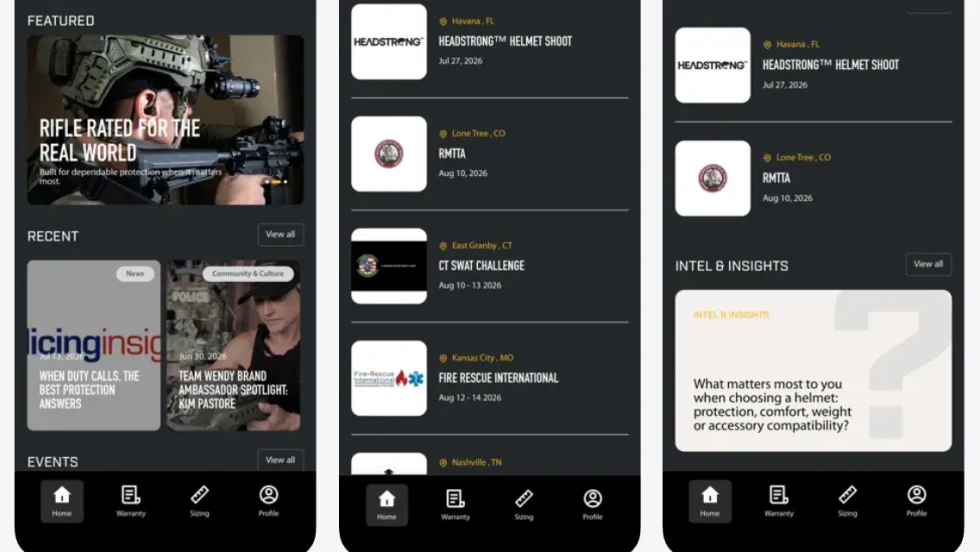
Team Wendy App Creates New Digital Hub for Helmet Owners
The Team Wendy Community App provides one location for warranty registration, size-fit tools, product updates, and community connection. For helmet owners, the new app creates a simpler path to the information and tools that matter most.
Read More →