



Hostage Held in Barricaded House
The victim advises she has been held captive along with her roommate (who is still at the residence) for a week. She tells you she was let out only to buy groceries. She is terrified. You have about 20 minutes before the suspect starts wondering where she is.

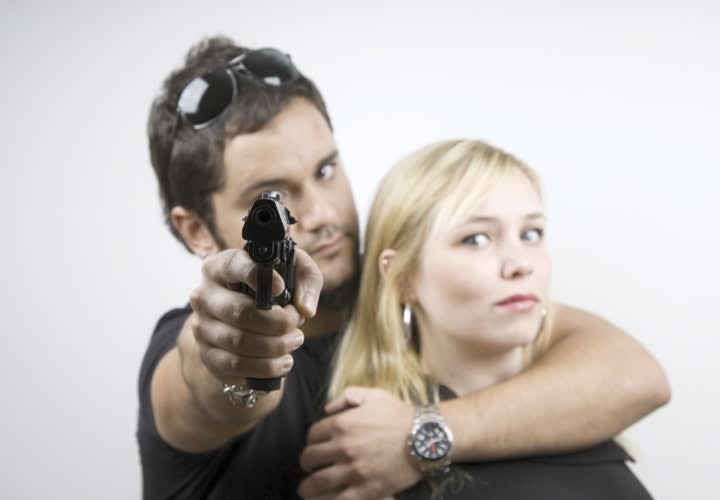
Photo: iStockphoto.com
In every call for service, you should think things through before you begin your response. Each call can be broken down into three phases: pre-response, response, and post response. The following scenario is designed to help you think things through rather than give you a specific way to handle the call.
Situation
Dispatch advises you to meet with a complainant at a gas station just outside a very populated subdivision. The female victim advises she has been held captive along with her roommate (who is still at the residence) for a week. She tells you she was let out only to buy groceries and that the suspect will be expecting her back soon. She is terrified and has several marks and bruises on her body from being beaten. You have about 20 minutes before the suspect starts wondering where she is.
Initial Thoughts
After questioning the victim a bit more, you find out the situation arose from a one-night stand that turned ugly. You know there is at least one other hostage in the house, the victim's roommate. You can't let your victim go back into harm's way, so her going back to the house is out of the question. You already know the suspect is violent so you can assume the roommate is in danger. For now you have the element of surprise on your side if you act quickly. You realize your real enemy here is time. You decide that since your squad includes three former SWAT officers (including yourself) you have enough people available to make entry.
Pre-response
Think It Through Questions:
How much time do I have before the suspect gets suspicious?
Can I place eyes on the target without being seen?
What do I need to do right now to make my situation better and the suspect's worse?
What type of intel can I get from the victim that will help me in my planning?
You ask the victim about her time frame. She tells you the subject will be calling her again to check in and remind her of what he will do to her roommate if she fails to return or contacts the police. You send two officers to observe the front and rear of the victim's home. You ask for a clear channel. You tell the rest of your squad to meet you in the back parking lot of the gas station, which is near the home. You advise the two former SWAT members assisting you to prepare for a hasty entry into the residence using your folding body bunker shield.
You continue to debrief the victim to get the layout of her house. You ask about weapons and she tells you they have been implied but never seen. You're now 15 minutes into the call and the suspect makes his first phone call.
Response
Think It Through Questions:
Can we make our approach without being seen?
Do we take the chance and announce alerting the suspect or just make entry?
Do we have the keys so we don't need to break down the door?
You are lucky in that you have an off-duty officer working nearby. You call him off his post and have him stay at the gas station with the victim. You tell him to let her respond to one more phone call from the subject and make up a story as to why she is running late. She is not to respond to any more phone calls after that. You figure it will confuse him enough to take his attention off the second victim as he tries to call back. You have EMS respond to the gas station and stage. That serves two purposes: check out the victim and be close by in case the suspect gets violent.
Your security element is in place and they have not been seen. You load up in one car to limit the chances of being spotted. The suspect has now tried calling back three consecutive times but has stopped. You assemble your team and start walking up to the door, keys in hand. Before you can put the keys in, the door flies open and the second victim runs out. You make entry and clear the house but find no suspect.
You debrief the second victim and she states the suspect started freaking out when the other victim didn't return his calls. He started looking out all the windows and saw one of your officers in the back of the house. The suspect then ran into a room, giving her the chance to run outside.
You secure the perimeter. You assume that the suspect either went out without being seen or is in the attic section of the house. Your K-9 team gets there, you make your announcements, and you clear the house again. The handler takes the dog around the house but finds no track. You hear a noise coming from the roof section moving toward the garage area.
Your SWAT guys and K-9 want to make entry into the attic area. You decide to take another approach in case the suspect armed himself. You wink at your entry team and whisper to them to go along with whatever you say. You start talking to the suspect and tell him you know he is up there. That you have a K-9. That he has to come down, but if he doesn't, not to worry as you won't be going up after him.
Since this is Florida, it's getting hotter and muggier by the minute. You have decided to wait until he passes out from dehydration or heat exhaustion. To make it more interesting you fake telling one of your officers to order a couple of pizzas and two liters of soda so the squad can have lunch while you wait. A conversation develops as to what toppings to get on the pizza and shortly thereafter, the suspect says he wants to come down.
You secure the garage, tell the suspect any violence on his side will be dealt with accordingly, and you have your K-9 bark a bit for effect. With the help of a neighbor's ladder, the suspect comes down covered in sweat and without incident.
Post-Response
Think It Through Questions:
What do I need from the victims to shore up my case?
What type of evidence do I need to collect from the scene?
I need pictures of the attic and of where he was hiding.
I need supplemental reports from all those involved.
You need to debrief all those involved. You take a few extra minutes and turn it into a training opportunity. You make sure that the victims write thorough statements. Because of the seriousness of the call, you call out your CSI section to process the scene and take good pictures. You also touch base with your Persons Crimes Unit supervisor in case they want to send out a detective. You give the suspect the opportunity to tell his side of the story. You also notify your lieutenant one last time as to the outcome.
Final Thoughts
Choosing to threaten to leave the suspect up in the attic until he passed out and pretend to order pizza was something I did on an actual call. And, as in this example, the suspect did climb down from the attic. The point I am trying to make is to look at all your possible alternatives before you go rushing in to make an extraction, especially from a dangerous space such as an attic.
The more exigent the circumstance, the more quickly you need to act. For example, in an active shooter call there is only one response; move to contact and stop the threat. If there are no exigent circumstances then slow down and use time as a tactic.
Think out of the box and get creative. Create a dialog even if the suspect is not responding. Continue to state his options. Tell the suspect you are not going anywhere and that when your shift is done, another supervisor will take your place. Tell him you get paid the same and you have all day. Tell him you just want to end this as safely as possible. Your goal is to change the suspect's point of view from "Maybe I can escape" to "I can't escape." Also keep in mind that any call can go south quickly, so be prepared to face some type of desperate move from the suspect to avoid capture. Being creative does not mean being unsafe.
There are always multiple possibilities and potential responses. Thinking it through now saves you time later.
Amaury Murgado is a special operations lieutenant with the Osceola County (Fla.) Sheriff's Office, has over 28 years of law enforcement experience, and is an adjunct professor for Valencia College.
More Patrol

Team Wendy Introduces the EXFIL Endurance Ballistic Helmet, Engineered to Reduce the Burden of Extended Wear
Team Wendy has launched its EXFIL Endurance, a new lightweight ballistic helmet engineered to deliver protection, comfort, and fit during demanding, extended operations.
Read More →
The First Responders Children’s Foundation National First Responders Day Roll Call of Heroes Ceremony Returns to Times Square, NYC
First Responders Children’s Foundation (FRCF), in collaboration with T-Mobile, will host the Roll Call of Heroes ceremony in Times Square to commemorate National First Responders Day on Wednesday, Oct. 28. During the event, FRCF will present 18 Hero Awards.
Read More →
Streamlight to Showcase Newest Lighting Products for Law Enforcement Professionals at IACP 2026
Streamlight will showcase its newest lights for law enforcement at the International Association of Chiefs of Police Annual Conference & Expo. Featured lights will include the TLR-3 X, the PolyTac 1X, and more.
Read More →
Streamlight Portable Scene Light III Wins 2026 OH&S New Product of the Year Award
Streamlight’s Portable Scene Light III has won the 2026 Occupational Health & Safety (OH&S) New Product of the Year Award in the Lighting category.
Read More →
Adept Armor Introduces Two New Rifle Plates
Adept Armor has launched two new Level IV ballistic plates, the Emperor and the Archon Mark 2, which brings Adept Armor’s new Quatroid ceramic to the high-threat, performance-value center of the range at 5.2 pounds.
Read More →
POLICE Product Test: Benchmade Bailout
The Benchmade Bailout is a slim, lightweight carry knife with a deep-ride pocket clip and comes in a variety of blade steels and scales. Here is a detailed review of the Taiga Green Bailout, released earlier this year.
Read More →
NLEOMF Announces July 2026 Officer of the Month
NLEOMF honored a Michigan deputy sheriff as the July 2026 Officer of the Month for rescuing a trapped driver from a burning vehicle following a Fourth of July crash.
Read More →
Streamlight to Showcase Newest Lighting Products at National Safety Council’s Safety Congress & Expo 2026
Streamlight will showcase its latest lights, including the Portable Scene Light III and the LiteBox 1Million, at the 2026 National Safety Council (NSC) Safety Congress & Expo.
Read More →
The 2027 World Police & Fire Games Set for Perth, Australia
The 2027 World Police & Fire Games (WPFG) will take place in Perth, Western Australia, from Friday, March 12 through Sunday, March 21, 2027.
Read More →
5.11 Partners with National Fallen Firefighters Foundation to Support #ForThe343
5.11 has joined the nationwide movement honoring the 343 New York City Fire Department firefighters lost on Sept. 11, 2001.
Read More →