



Holding Back Home Occupants
When you go into a suspect’s home to execute a search warrant, it’s not uncommon to find several people present, whether suspects, family members, or others. Sometimes, occupants may outnumber officers on the scene. This can create problems of safety and control, making it more difficult to carry out the search. Realizing this, the Supreme Court has provided guidelines on the ability of officers to detain, handcuff, and question occupants while a search takes place.

When you go into a suspect's home to execute a search warrant, it's not uncommon to find several people present, whether suspects, family members, or others. Sometimes, occupants may outnumber officers on the scene. This can create problems of safety and control, making it more difficult to carry out the search. Realizing this, the Supreme Court has provided guidelines on the ability of officers to detain, handcuff, and question occupants while a search takes place.
Michigan v. Summers
In a 1981 case, the court ruled that officers serving a search warrant for drugs could detain all of the occupants of the premises while searching. Although not all of the occupants would necessarily be suspected of the criminal behavior that was the target of the search, officers would not necessarily know this at the outset.
In Michigan v. Summers, the Supreme Court gave three reasons for allowing the detention of all those present when the search began: (1) "preventing flight in the event incriminating evidence is found," (2) "minimizing the risk of harm to the officers," and (3) facilitating the search, since occupants' "self-interest may induce them to open locked doors or locked containers to avoid the use of force."
To accommodate these three concerns, the court said that police should exercise "unquestioned command" of the search warrant scene. This meant a clear holding was necessary as to the detention of occupants: "We hold that a warrant to search for contraband founded on probable cause carries with it the limited authority to detain the occupants of the premises while a proper search is conducted."
The court did not say in Summers whether detained occupants could be handcuffed, or for how long, nor whether its ruling also applied to searches for evidence, as opposed to contraband. Nor did the court discuss the related issue of questioning such detainees. All of these issues have now been addressed in a 2005 Supreme Court decision.
Muehler v. Mena
Investigating a recent drive-by shooting, police in Simi Valley, Calif., obtained a warrant to search a suspected gang member's house for weapons, ammunition, and gang paraphernalia. Because of the high-risk nature of the case, SWAT made the initial entry. Four occupants, including Iris Mena, were handcuffed at gunpoint and taken into a converted garage, where they were detained for the two or three hours it took to finish searching. The search yielded one handgun and ammunition, other weapons, and gang paraphernalia.
Although none of the seized evidence implicated Mena in any crime, an INS agent who had accompanied the police officers briefly questioned the occupants about their immigration papers, and an officer asked Mena her name, date and place of birth, and immigration status. She was subsequently released.
Mena brought a federal civil rights lawsuit against the police officers and their department, alleging violations of her Fourth Amendment rights. Following trial, a jury awarded her $60,000. The city and the officers appealed, first to the Ninth Circuit Court of Appeals, and ultimately to the Supreme Court.
The Detention Issue
The Ninth Circuit upheld the judgment against the police, ruling that Mena should have been released once it became clear to officers that she was not a suspect. That court ruled that Mena's detention was "objectively unreasonable," as a matter of law.
The Supreme Court unanimously reversed the Ninth Circuit's judgment. On the issue of the detention, the court cited its 1981 precedent in Summers and, making no distinction between searches for contraband and searches for evidence, pointedly disagreed with the Ninth Circuit: "Mena's detention was, under Summers, plainly permissible. An officer's authority to detain incident to a search warrant is categorical" (meaning absolute and unqualified, and not requiring any further justification).[PAGEBREAK]
The Supreme Court rejected the Ninth Circuit view that detention during the full search was impermissible, saying, "Mena's detention for the duration of the search was reasonable under Summers because a warrant existed to search 1363 Patricia Avenue and she was an occupant of that address at the time of the search."
The Handcuffing Issue
The Ninth Circuit also ruled that Mena's Fourth Amendment rights had been violated because her handcuffs were not promptly removed "when it became clear that she posed no immediate threat."
The Supreme Court also reversed this portion of the Ninth Circuit ruling. Recognizing that handcuffing is a use of force for Fourth Amendment purposes, the court said, "Inherent in the authorization to detain an occupant of the place to be searched is the authority to use reasonable force to effectuate the detention."
The court pointed out that the underlying case was a crime of violence, the warrant was based on probable cause to believe that gang members and weapons might be located in the premises, and there were multiple occupants and only a limited number of officers to guard them while others completed the search. These circumstances made the use of cuffs for the full length of the search reasonable, said the court.
Note the difference between the categorical rule that you can always detain the occupants while serving a search warrant, and the more limited rule that you can use handcuffs where the nature of the case and other circumstances make it reasonable to do so. In other words, you can always detain without further justification while the search is completed, but the use of handcuffs will be evaluated on the basis of all the circumstances you confronted, to see if that use of force was justified, and therefore reasonable.
The Questioning Issue
According to the Ninth Circuit, merely asking Mena about her immigration status violated the Fourth Amendment. The circuit court ruled that an officer must have "a particularized reasonable suspicion that an individual is not a citizen to interrogate that individual about his citizenship." The Ninth Circuit therefore held that Mena could be awarded money for simply having questions put to her.
The Supreme Court reversed this error, as well. The court pointed out that simply asking a person questions does not implicate the Fourth Amendment because questioning is neither a "search" nor a "seizure." This is such well-settled law that the Supreme Court chastised the Ninth Circuit for its "faulty" reasoning: "We have repeatedly held that mere police questioning does not constitute a 'seizure.' Hence, the officers did not need reasonable suspicion to ask Mena her name, date and place of birth, or immigration status."
Beyond Mena
Although the Supreme Court reversed the Ninth Circuit ruling on all three of the points raised, the case was remanded for further litigation on the issue of whether Mena could show that she had still been detained after the search was completed. This strongly implies that officers may be held civilly liable for continuing to detain occupants once the search is over. And remember that unless they are named in the warrant, occupants may not be routinely searched. (Ybarra v. Illinois)
To reduce risks of civil liability and suppression of evidence while accommodating officer safety, routine detentions should end once the search is over, and the use of handcuffs should be justified by the particular circumstances of each case. Non-coercive questions may be asked of detainees (subject to Miranda, while they remain handcuffed).
Devallis Rutledge, a former police officer and veteran prosecutor, is Special Counsel to the Los Angeles County District Attorney.
More Patrol

Streamlight Portable Scene Light III Wins 2026 OH&S New Product of the Year Award
Streamlight’s Portable Scene Light III has won the 2026 Occupational Health & Safety (OH&S) New Product of the Year Award in the Lighting category.
Read More →
Adept Armor Introduces Two New Rifle Plates
Adept Armor has launched two new Level IV ballistic plates, the Emperor and the Archon Mark 2, which brings Adept Armor’s new Quatroid ceramic to the high-threat, performance-value center of the range at 5.2 pounds.
Read More →
POLICE Product Test: Benchmade Bailout
The Benchmade Bailout is a slim, lightweight carry knife with a deep-ride pocket clip and comes in a variety of blade steels and scales. Here is a detailed review of the Taiga Green Bailout, released earlier this year.
Read More →
NLEOMF Announces July 2026 Officer of the Month
NLEOMF honored a Michigan deputy sheriff as the July 2026 Officer of the Month for rescuing a trapped driver from a burning vehicle following a Fourth of July crash.
Read More →
Streamlight to Showcase Newest Lighting Products at National Safety Council’s Safety Congress & Expo 2026
Streamlight will showcase its latest lights, including the Portable Scene Light III and the LiteBox 1Million, at the 2026 National Safety Council (NSC) Safety Congress & Expo.
Read More →
The 2027 World Police & Fire Games Set for Perth, Australia
The 2027 World Police & Fire Games (WPFG) will take place in Perth, Western Australia, from Friday, March 12 through Sunday, March 21, 2027.
Read More →
5.11 Partners with National Fallen Firefighters Foundation to Support #ForThe343
5.11 has joined the nationwide movement honoring the 343 New York City Fire Department firefighters lost on Sept. 11, 2001.
Read More →
Team Wendy Announces Title Sponsorship of the Jorge Pastore Foundation
Team Wendy’s 3-year partnership with the Jorge Pastore Foundation expands access to programs that strengthen those who serve.
Read More →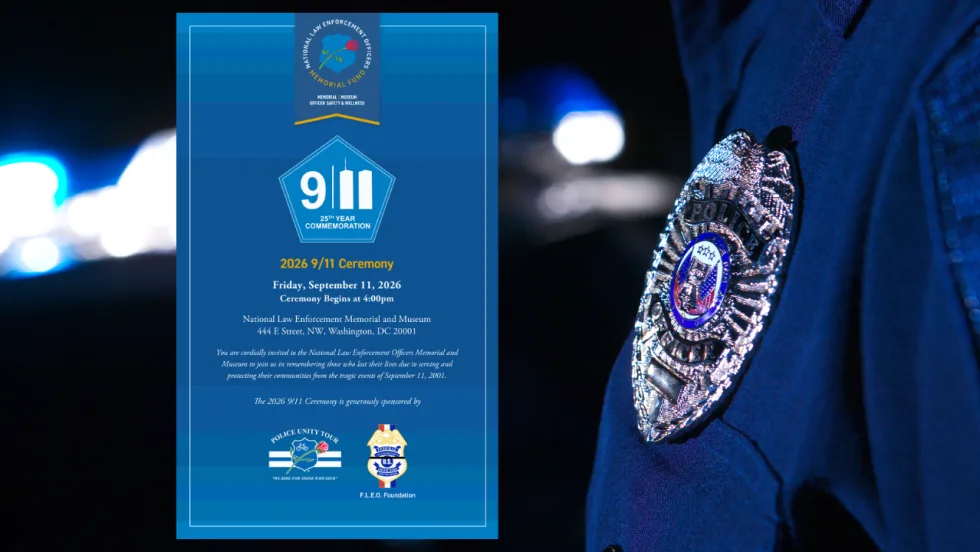
National Law Enforcement Memorial and Museum Hosting 9/11 25th-Year Commemoration Ceremony
The National Law Enforcement Memorial and Museum is hosting a 9/11 25th Year Commemoration Ceremony on Sept. 11 at 4 p.m.
Read More →
National Law Enforcement Officers Memorial Fund Announces June 2026 Officers of the Month
The National Law Enforcement Officers Memorial Fund (NLEOMF) named 15 officers of the Chico Police Department (California) as the Officers of the Month for June 2026 for their roles in responding to an active-shooter incident at a public library.
Read More →