



Handling the Mentally Ill: There Are No Shortcuts for Officers
One study has shown that 32 percent of the homeless, who populate our urban streets, are mentally ill and if you have homeless people in your community, you most certainly have those who are mentally ill among them.

A recent two-part article in the Los Angeles Times addressed the issue of police shootings of the mentally ill. That report focused on 37 people, who had been shot by Los Angeles police since 1994, when they were encountered while exhibiting bizarre behavior. In all of these incidents the reason for the shootings was given as self-defense of the officers or others. The question, that inevitably arises in the aftermath of any such shooting, is: Was it necessary?
The problem of the mentally ill is nationwide in scope and Los Angeles is only an example of what is happening elsewhere as well. One study has shown that 32 percent of the homeless, who populate our urban streets, are mentally ill and if you have homeless people in your community, you most certainly have those who are mentally ill among them.
Furthermore, it is also estimated that 13 percent of the total U.S. population are mentally ill at any given time and 2.8 percent of those people have "severe" mental illnesses-that is a lot of disturbed people out there!
Who is called when a mentally ill person starts exhibiting bizarre behavior in the public? The police, of course, and one out of every 10 calls is estimated to involve a mentally ill person. With 911 and a vast network of cellular phones readily available for instant calling, it is not surprising that the police are being summoned to these incidents with ever increasing frequency.
When a problem of that magnitude faces officers on the street, you would expect to see commensurate training provided, right? Wrong. The fact is that officers generally receive very little training in recognizing and appropriately responding to the mentally ill, whom they are certain to encounter. A common explanation for this lack of training is that "mental illness is not a police problem" and "the police are not social workers." You may recall a similar explanation for not intervening in domestic violence, before it was recognized that the police do have a role. After all, if the police are going to be responding to people who are displaying symptoms of mental illness, and there is no question that they will, does it not follow that they should be trained in how to both effectively and humanely do so?
A recent federal appellate court decision, incidentally, suggests that the Americans with Disabilities Act (ADA) requires such training. In the State of California, which is usually considered a leader in police training, the Peace Officers Standards and Training (POST) Commission's approved curriculum requires only four hours on the whole range of mental disabilities.
Surely, this is insufficient to prepare an officer for an encounter that can escalate into a shooting and is in sharp contrast to the 16 hours of training, on mental illness alone, that is recommended by the Police Executive Research Forum (PERF).
The essential difference between suspect encounter training, that officers traditionally receive, and how to approach the mentally ill is the need to be non-confrontational. Such a requirement to, in effect, shift gears is diametrically opposed to the way officers are routinely expected to control conflict. The same command techniques that are employed to take a criminal suspect into custody can only serve to escalate a contact with the mentally ill into violence.
The National Law Enforcement Policy Center (NLEPC) has developed well-reasoned policy for police contact with the mentally ill and suggests that:
"It is helpful for officers to understand the symptomatic behavior of persons who are afflicted with a form of mental illnesses. In this way, officers are in a better position to formulate appropriate strategies for gaining the individual's compliance."
"Officers should first take time, if possible, to survey the situation in order to gather necessary information and avoid hasty and potentially counterproductive decisions and actions."
"Officers should avoid approaching the subject until a degree of rapport has been developed."
"All attempts should be used to communicate with the person first by allowing him to ventilate."
"The individual should not be threatened with arrest or other enforcement action as this will only add to the subject's fright and stress and may potentially spark aggression."
PERF has long been a leader in advocating better training for the police response to the mentally ill and they similarly suggest:
"Do not rush the person or crowd his personal space. Any attempt to force an issue may quickly backfire in the form of violence."
"He may be waving his fists, or a knife, or yelling. If the situation is secure, and if no one can be accidentally harmed by the individual, you should adopt a non-threatening, non-confrontative stance with the subject."
"Excessively emotional or even violent outburst by the mentally ill are often of short duration. If is better to let the outburst dissipate rather than wrestle with the person who is under extreme emotional stress. Bizarre behavior alone is not reason for physical force."[PAGEBREAK]
"Increased adrenaline (causes) insensitivity to pain."
"What works best and what is most beneficial is patience and communication."
Unfortunately, these concepts are not well understood by street officers and the obvious solution to that critical lack of understanding is relevant training. Some police departments have developed specialty units for responding to the mentally ill and these have been quite successful where and when they are used. A problem, however, is that they are typically not the first responders and it is the initial officers on the scene who have to stabilize the situation. If those who arrive first are not sufficiently trained to achieve stability, the encounter may quickly escalate into a shooting.
Some training that is currently provided to officers may actually exacerbate an encounter with a mentally ill person, particularly if that person has a knife. Since police trainers adopted the so-called "21-foot rule," officers have been taught that anyone within that distance, who is armed with a knife, may be shot in self-defense. Had I been similarly trained, when I was on the street, I might have shot a mentally ill person myself, but fortunately, the outcome was different.
I was dispatched to an apartment where a person was reported to be acting bizarre and when I knocked at the door, it was opened by a woman holding a steak knife. Under today's training scenario I should have immediately drawn my gun and shot her at such close range. Instead, she began using the knife to spread peanut butter on her hair and I responded by asking her what she was doing. She replied that she was making a sandwich and so I next asked her if she was hungry. When she said that she was, I suggested that we go to lunch together and thus became the start of her transport to a mental health facility (in a further violation of today's more dogmatic training, I did not handcuff her either).
It is not unusual for the mentally ill to display a knife or a club, when they fearfully and predictably react to an officer's "command presence," but does that justify shooting them? A better understanding of the dynamics of the mentally ill, through training, can help to resolve such encounters with less violent results.
It is still not well understood by many officers that oleoresin capsicum (OC) aerosol spray does not work well, if at all, on the mentally ill and that its use "may actually exacerbate" resistance. Complete resistance to pain and what is often described as "superhuman" strength are characteristics of the mentally ill. When training has forewarned officers with this knowledge, they will be unlikely to resort to OC and then find themselves in a life-threatening physical struggle that should have been avoided. There are, however, other less-lethal force alternatives that may be appropriately introduced, after a person armed with an edged or impact weapon refuses to submit, and those include:
The Taser electronic restraint device will render a suspect incapacitated without resistance but has a limiting range of only 12 feet (a newly introduced Advanced Taser M26 ad advertises a range of 21 feet);
Stun-bags fired from 12 gauge (or 37-40 mm) shoulder weapons can be delivered with accuracy out to a range of 50 feet and deliver a substantial body blow, not unlike being struck by a baton, from a safe distance.
These weapons can be particularly useful, in resolving attempted "suicide by cop" standoffs, for officers who decline to fulfill the would-be victim's death wish. It must always be remembered, in such cases, that the "mission is to prevent self-destructive behavior" and not escalate the encounter into a "justified" shooting.
A term for exacerbating danger, by failing to utilize "time, talk and tactics," is "officer-created jeopardy." Some researchers have even suggested that "hasty cops who force confrontations with emotionally disturbed persons and who consequently must shoot them to escape uninjured have used unnecessary force." Whether excessive or not, in the final analysis, no reasonable officer should want to use any force, deadly or otherwise, if there is the alternative of taking the time to talk and exercise other options.
It is well accepted, by trained negotiators, that "trying to resolve any problem or crisis too quickly will have negative results." Accordingly, and despite some delay, the ultimate outcome will consume far less time and expense than yet another shooting caused by inadequately trained officers taking too precipitous an action. There are no shortcuts for safely taking the mentally ill into protective custody.
D.P. Van Blaricom is a retired chief of police, a nationally known police practices expert and an occasional contributor to POLICE.
More Patrol

Adept Armor Introduces Two New Rifle Plates
Adept Armor has launched two new Level IV ballistic plates, the Emperor and the Archon Mark 2, which brings Adept Armor’s new Quatroid ceramic to the high-threat, performance-value center of the range at 5.2 pounds.
Read More →
POLICE Product Test: Benchmade Bailout
The Benchmade Bailout is a slim, lightweight carry knife with a deep-ride pocket clip and comes in a variety of blade steels and scales. Here is a detailed review of the Taiga Green Bailout, released earlier this year.
Read More →
NLEOMF Announces July 2026 Officer of the Month
NLEOMF honored a Michigan deputy sheriff as the July 2026 Officer of the Month for rescuing a trapped driver from a burning vehicle following a Fourth of July crash.
Read More →
Streamlight to Showcase Newest Lighting Products at National Safety Council’s Safety Congress & Expo 2026
Streamlight will showcase its latest lights, including the Portable Scene Light III and the LiteBox 1Million, at the 2026 National Safety Council (NSC) Safety Congress & Expo.
Read More →
The 2027 World Police & Fire Games Set for Perth, Australia
The 2027 World Police & Fire Games (WPFG) will take place in Perth, Western Australia, from Friday, March 12 through Sunday, March 21, 2027.
Read More →
5.11 Partners with National Fallen Firefighters Foundation to Support #ForThe343
5.11 has joined the nationwide movement honoring the 343 New York City Fire Department firefighters lost on Sept. 11, 2001.
Read More →
Team Wendy Announces Title Sponsorship of the Jorge Pastore Foundation
Team Wendy’s 3-year partnership with the Jorge Pastore Foundation expands access to programs that strengthen those who serve.
Read More →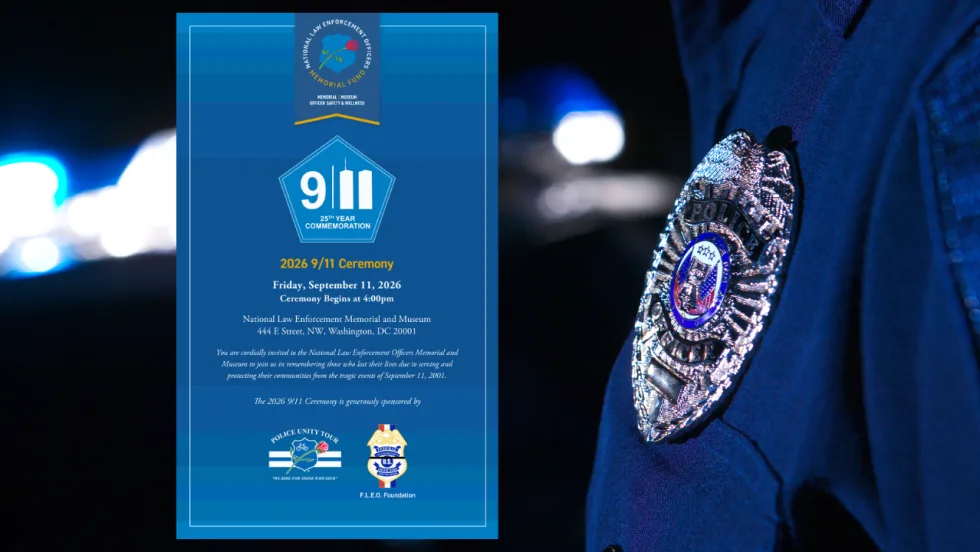
National Law Enforcement Memorial and Museum Hosting 9/11 25th-Year Commemoration Ceremony
The National Law Enforcement Memorial and Museum is hosting a 9/11 25th Year Commemoration Ceremony on Sept. 11 at 4 p.m.
Read More →
National Law Enforcement Officers Memorial Fund Announces June 2026 Officers of the Month
The National Law Enforcement Officers Memorial Fund (NLEOMF) named 15 officers of the Chico Police Department (California) as the Officers of the Month for June 2026 for their roles in responding to an active-shooter incident at a public library.
Read More →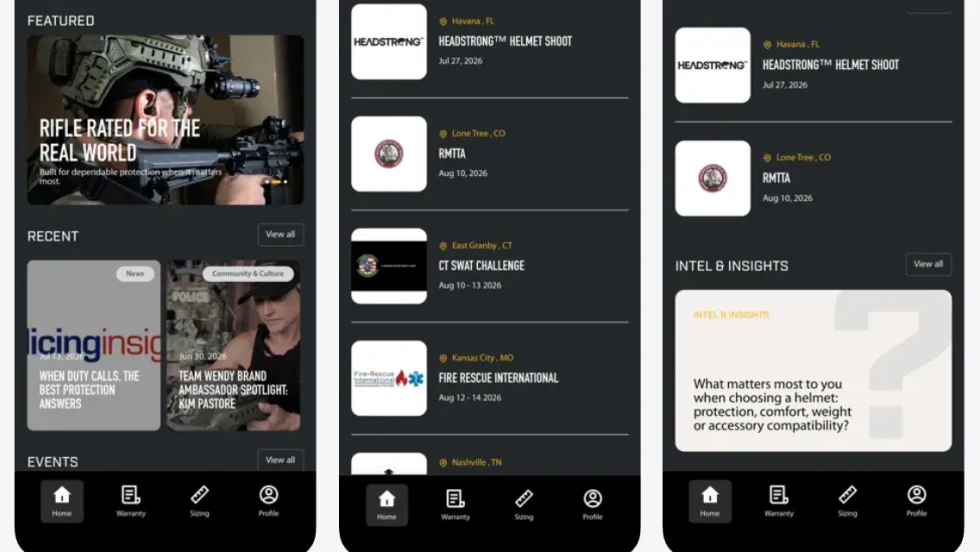
Team Wendy App Creates New Digital Hub for Helmet Owners
The Team Wendy Community App provides one location for warranty registration, size-fit tools, product updates, and community connection. For helmet owners, the new app creates a simpler path to the information and tools that matter most.
Read More →