



Exigent Entry
Warrantless entries are limited to those authorized by consent, probation or parole search conditions, or "exigent circumstances" involving some sort of emergency requiring immediate action. One category of exigency that may justify warrantless entry is the need to prevent the imminent destruction of evidence.

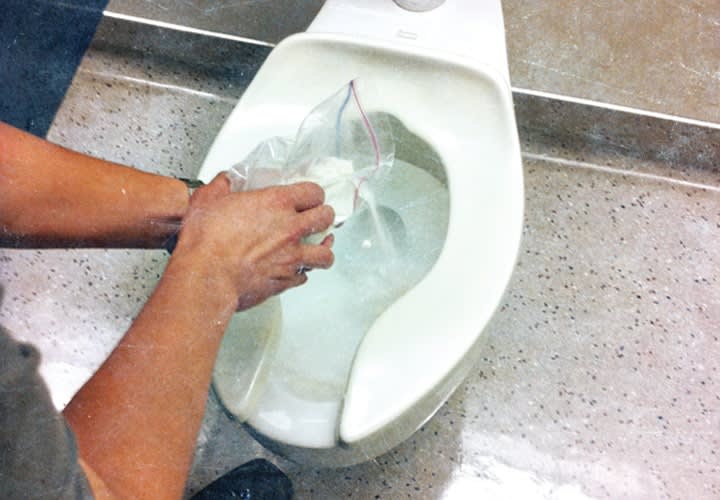
Photo: LaMar Norman.
The general rule for police entry into private premises is that a search or arrest warrant is required. Warrantless entries are limited to those authorized by consent, probation or parole search conditions, or "exigent circumstances" involving some sort of emergency requiring immediate action. (Payton v. New York) One category of exigency that may justify warrantless entry is the need to prevent the imminent destruction of evidence. (Welsh v. Wisconsin) Permissible entry under this particular exigency was affirmed in a 1963 decision of the U.S. Supreme Court, and was the subject of another decision in 2011.
Ker v. California
Narcotics investigators were following several marijuana dealers and saw them meet for a possible exchange, after which they drove away separately. Officers followed suspect George Ker's car but lost him during counter-surveillance maneuvers, so they drove directly to his residence, where they saw his car parked outside. Believing that Ker was now alerted to their suspicions and might try to dispose of marijuana before they could obtain a search warrant and return, officers made entry and seized contraband, which Ker later sought to suppress.
The U.S. Supreme Court ruled that police entry to prevent the imminent destruction of evidence is reasonable under the Fourth Amendment where officers reasonably suspect that destructible evidence is inside premises and that occupants of the premises are likely to remove or destroy the evidence if immediate entry is not made.
The court said this:
"Suspects have no constitutional right to destroy or dispose of evidence. In addition to the officers' belief that Ker was in possession of narcotics, which could be quickly and easily destroyed, Ker's furtive conduct in eluding them shortly before the arrest was ground for the belief that he might well have been expecting the police. Time clearly was of the essence. The officers had reason to act quickly because of Ker's furtive conduct and the likelihood that the marijuana would be distributed or hidden before a warrant could be obtained. We therefore hold that under the particular circumstances of this case, the officers' method of entry was not unreasonable under the standards of the Fourth Amendment." (Ker v. California)
Lower Courts and the "Police-Created" Doctrine
In the years since the 1963 ruling in Ker, many state and federal appellate courts have created an exception to the rule that the risk of imminent destruction of evidence justifies warrantless entry. These courts have said that when police, by their own conduct, create the risk of destruction of evidence, the exception does not apply. Courts have referred to this as a "do-it-yourself exigency," or as a "manufactured" or "police-created" exigency, under which warrantless entry would not be allowable.
For example, in People v. Shuey, the California Supreme Court adopted the "police-created" doctrine and ruled that if police alert occupants to their presence and give the occupants the incentive to destroy evidence, officers may not rely on the exigency they themselves created, in order to "circumvent" the warrant requirement. Similar rulings have been adopted in other states and in several circuits of the U.S. Court of Appeals. (U.S. v. Coles, 3rd Circuit; U.S. v. Mowatt, 4th Circuit; U.S. v. Gould, 5th Circuit; U.S. v. Chambers, 6th Circuit.) This restrictive "police-created" doctrine has now been rejected by the U.S. Supreme Court.[PAGEBREAK]
Kentucky v. King
Police officers in Lexington, Ky., were watching a suspected drug dealer when he disappeared into the breezeway of an apartment building. They heard a door shut, but as they approached, the officers saw that there were two apartments, and they could not tell which one the suspect had entered.
A strong odor of burnt marijuana emanated from one of the apartments, so the officers knocked loudly on that door and announced, "This is the police." Noises inside the apartment led the officers to conclude that occupants were attempting to destroy narcotics, so they forced entry and seized drugs and other evidence in plain view. Occupant Hollis Deshaun King later moved to suppress the evidence when it was offered against him in court.
The trial court denied the suppression motion and ruled that the circumstances encountered by the officers amounted to exigent circumstances due to the threat of the imminent destruction of evidence. However, the Kentucky Supreme Court reversed this ruling and held instead that police could not rely on this particular exigency because once officers knocked at the door and identified themselves, "it was reasonably foreseeable that the investigative tactics employed by the police would create the exigent circumstances."
The U.S. Supreme Court reversed. The court pointed out the obvious: "In the vast majority of cases in which evidence is destroyed by persons who are engaged in illegal conduct, the reason for the destruction is fear that the evidence will fall into the hands of law enforcement. Persons in possession of valuable drugs are unlikely to destroy them unless they fear discovery by the police. Consequently, a rule that precludes the police from making a warrantless entry to prevent the destruction of evidence whenever their conduct causes the exigency would unreasonably shrink the reach of this well-established exception to the warrant requirement."
In rejecting the "police-created" doctrine, the Supreme Court said that as long as police have not violated the Fourth Amendment before the exigency arises, there is no ground for denying exigent entry merely because occupants react to a police knock at the door by trying to dispose of the evidence of their wrongdoing.
The court said this:
"Where the police did not create the exigency by engaging or threatening to engage in conduct that violates the Fourth Amendment, warrantless entry to prevent the imminent destruction of evidence is reasonable and thus allowed. When law enforcement officers who are not armed with a warrant knock on a door, they do no more than any private citizen might do. Occupants who elect to attempt to destroy evidence have only themselves to blame for the warrantless exigent-circumstances search that may ensue." (Kentucky v. King)
Precaution
The Supreme Courtsaid in a footnote that if the officers had demanded entry or had threatened to break down the door before the exigency arose, this exception might not apply. Officers may simply knock and identify themselves without demanding admittance and without any threats. Afterward, if noises indicate evidence is about to be destroyed, officers could then demand entry, threaten to force entry, and make forcible entry if the door is not opened.
When detailing the facts supporting application of this exception, you should describe the nature of the evidence to show that it is of kind that is easily destroyed, should explain why you believed there were occupants inside who could carry out the destruction, and should give reasons for believing that those occupants were aware of police presence and were about to destroy the evidence.
For purposes of the federal exclusionary rule, it is not necessary to say why a search warrant was not sought. "There are many entirely proper reasons why police may not want to seek a search warrant. Faulting the police for failing to apply for a search warrant imposes a duty that is nowhere to be found in the Constitution." (Kentucky v. King)
Devallis Rutledge is a former police officer and veteran prosecutor who currently serves as Special Counsel to the Los Angeles County District Attorney. He is the author of 12 books, including "Investigative Constitutional Law."
More Patrol

Streamlight Portable Scene Light III Wins 2026 OH&S New Product of the Year Award
Streamlight’s Portable Scene Light III has won the 2026 Occupational Health & Safety (OH&S) New Product of the Year Award in the Lighting category.
Read More →
Adept Armor Introduces Two New Rifle Plates
Adept Armor has launched two new Level IV ballistic plates, the Emperor and the Archon Mark 2, which brings Adept Armor’s new Quatroid ceramic to the high-threat, performance-value center of the range at 5.2 pounds.
Read More →
POLICE Product Test: Benchmade Bailout
The Benchmade Bailout is a slim, lightweight carry knife with a deep-ride pocket clip and comes in a variety of blade steels and scales. Here is a detailed review of the Taiga Green Bailout, released earlier this year.
Read More →
NLEOMF Announces July 2026 Officer of the Month
NLEOMF honored a Michigan deputy sheriff as the July 2026 Officer of the Month for rescuing a trapped driver from a burning vehicle following a Fourth of July crash.
Read More →
Streamlight to Showcase Newest Lighting Products at National Safety Council’s Safety Congress & Expo 2026
Streamlight will showcase its latest lights, including the Portable Scene Light III and the LiteBox 1Million, at the 2026 National Safety Council (NSC) Safety Congress & Expo.
Read More →
The 2027 World Police & Fire Games Set for Perth, Australia
The 2027 World Police & Fire Games (WPFG) will take place in Perth, Western Australia, from Friday, March 12 through Sunday, March 21, 2027.
Read More →
5.11 Partners with National Fallen Firefighters Foundation to Support #ForThe343
5.11 has joined the nationwide movement honoring the 343 New York City Fire Department firefighters lost on Sept. 11, 2001.
Read More →
Team Wendy Announces Title Sponsorship of the Jorge Pastore Foundation
Team Wendy’s 3-year partnership with the Jorge Pastore Foundation expands access to programs that strengthen those who serve.
Read More →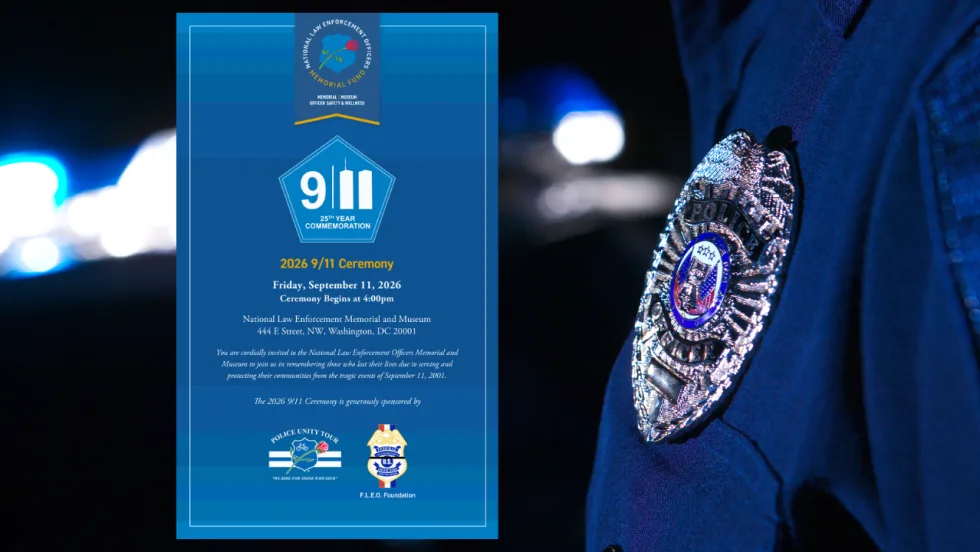
National Law Enforcement Memorial and Museum Hosting 9/11 25th-Year Commemoration Ceremony
The National Law Enforcement Memorial and Museum is hosting a 9/11 25th Year Commemoration Ceremony on Sept. 11 at 4 p.m.
Read More →
National Law Enforcement Officers Memorial Fund Announces June 2026 Officers of the Month
The National Law Enforcement Officers Memorial Fund (NLEOMF) named 15 officers of the Chico Police Department (California) as the Officers of the Month for June 2026 for their roles in responding to an active-shooter incident at a public library.
Read More →