



Canines Bring Comfort to Victims
The goal whenever a comfort dog is used during a crisis is to "calm people down then push them off to the resources they need. We also do a lot of work with first responders, especially in debriefings."

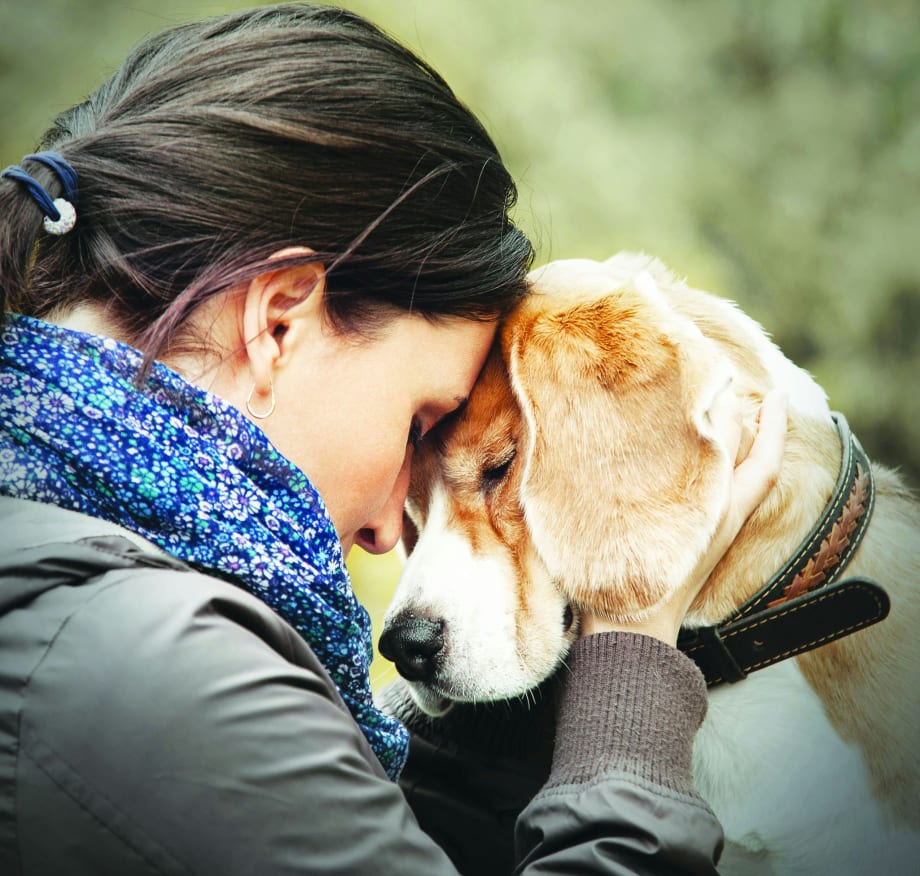
Photo: Getty Images
It's said that in every cloud lies a silver lining. The Greenfield (MA) Police Department has found its silver lining in a Comfort Dog program. For this program came about after a negative incident darkened an officer's life, and this officer turned his own life storm into a shining outcome.
In 2011, when Greenfield Lt. William Gordon began suffering from Post-traumatic Stress Disorder (PTSD) after a work-related incident, he started receiving treatment from On-Site Academy, a Westminster, MA, nonprofit association serving emergency service workers suffering from job-related stress.
As Gordon navigated through treatment, he kept hearing he needed to "find things that brought him joy." He says, "My dogs were what brought me joy."
To foster his own healing, Gordon began training his dog, Clarence, a lumbering Saint Bernard full of personality and affection, to be a service dog. He began bringing his dog with him everywhere—even to treatment, and he quickly learned Clarence wasn't only aiding in his recovery, he was helping others with theirs.
He adds, "I was recovering quite nicely from PTSD and needed the dog less and less, but I noticed the more I brought him around, the happier the people who were also getting treatment began to be."
Word got around about Gordon's efforts, and this led to outreach from a priest, who suggested he bring Clarence to a rehab section formed after the Sandy Hook mass school shooting, where 20 children and six adults lost their lives.
"It was two to three days after the shooting, and the community was still recovering, as were the first responders," Gordon recalls. "The dogs brought joy to these people. Even if it was only for five minutes, it gave them something to smile about and took their thoughts off this horrific incident."
Clarence's presence also helped the first responders on scene. "In one case, there was an officer typing his report and petting the dog at the same time," he recalls. "The dog was helping him type things in his report that he never wanted to have to record. The dog helped him through that."
Gordon and his wife, also a police officer, eventually began working their dogs with a newly formed nonprofit called K9 First Responders of Milford, CT, which was launched after Sandy Hook to help individuals in crisis.
This partnership led to Clarence and Gordon aiding victims after the Boston Marathon bombing, helping first responders after the mass shooting at the Mandalay Bay Resort & Casino in Las Vegas, and assisting EMTs who responded to the Parkland, FL, school shooting.
"As we responded to these things, we kept in touch with the chief and he really liked how the dogs were being used to help people with anxiety during stressful situations," he says. "The chief asked me to bring this to our department to help children who were victims of crimes and anxious about talking to police."
In June, Greenfield PD became one of the first police departments in the nation to start a comfort dog program. Front and center of this new program are two Saint Bernards, Clarence and Donut. Clarence is the older, veteran comfort dog, who is one year shy of retirement, while Donut is just a few months old.
Gordon says Donut will take over as the department's main comfort dog next year—after Clarence trains him.
How Comfort Dogs Are Used
According to Greenfield PD's Comfort Dog Policy, the function of the comfort dog is to "provide interaction during investigations involving children or adults to reduce anxiety and increase communication between the adult or child victim/witness and investigators; to provide comfort for people during times of crisis; and to provide aid and comfort to individuals, groups and communities impacted by violence, tragedy or traumatic events."
The policy also stresses the dog is a "valuable tool in fostering dialog and communications between the police department and the community we serve." As such, the comfort dog can be "used in the department's community policing efforts with its community policing team."
The goal whenever a comfort dog is used during a crisis is to "calm people down then push them off to the resources they need. We also do a lot of work with first responders, especially in debriefings," says Gordon. "The first responders talk about what happened, and the dog is there. They look at the dog as they share their experiences. They don't want to look at their team members."
Greenfield has used its dogs in a variety of ways. In one situation, there was a house fire and the only people who survived were the father and his daughter; the mother and other children perished in the fire. Gordon brought the dog to visit with surviving family members and Clarence helped this young girl throughout the wake and funeral, and upon her re-entry to school.
"She could talk to people about the dog rather than the incident. It distracted her from the horrific situation she was going through," he says. "She did the same thing when I went to the school. How do you talk to someone who has been through a tragedy like this? What's the first words you say? In this case, the first words were about the dog and it broke the tension."
He adds he also brought Clarence to the school a few days before her return to talk to her classmates and teachers. "He helped the entire community through this tragedy, and the donations rolled in to help the family," he says.
In another case, the dogs assisted during a hotel fire. The fire involved homeless families who were living in the hotel. They were sitting in a bus watching their home burn down. "We brought the dogs onto the bus, and they distracted everyone on the bus. They played with the dogs rather than watch the hotel burn down," he says.
Several years after the Sandy Hook tragedy, Gordon recalls meeting a first responder who had been there. "He brought up the dogs and said he remembered meeting them, and that it was a pleasant, happy experience," he says. "Years later, he can remember that one positive thing that happened there.
He adds, "That's kind of how the dogs help. Yes, you have gone through something bad, but the dogs are like a ray of sunshine breaking through the clouds on a dark and stormy day. It's a small beautiful moment. Then, the clouds roll back in and the storm returns, but you still remember the ray of sunshine. That's what we're trying to bring to these situations that are dark and full of anxiety."
More Than Meets the Eye
There's more to a comfort dog than meets the eye, however. Gordon explains that although comfort dogs are not targeting criminals and investigating crimes, they do play an important role, and as such, this program requires the right dog, the right handler, the right training, and the right policy.
The first step is finding the right dog. Though many dog breeds are well suited to comforting others, Saint Bernards top Gordon's list of possibilities. He explains they are calm, large, and lumbersome. "They have a sad face that just seems to look at someone and understand what they are going through," he says.
That's not to say other breeds won't work, he adds. The top qualification of a comfort K-9 is loving people. A dog that voluntarily approaches strangers, makes eye contact, and welcomes attention is a good choice as opposed to one that shies away from attention.
Being physically and emotionally calm is also a consideration. A super-excitable K-9 that jumps up on people and wiggles a lot is not a good fit for a dog that is there to help people in a state of heightened anxiety.
"These dogs have to be able to help us calm victims down so they focus their energies on recovering from tragedy," he says. "A Saint Bernard's calm demeanor helps people with their anxiety."
He notes that Saint Bernards were originally dispatched to find and help people trapped in avalanches. Gordon says, "If they can help people in avalanches, they can help victims of crime, who are caught in an avalanche of anxiety. They can bring their attention off something bad and into something good."
Who will handle the dog is also a key consideration, says Gordon, who notes only he and his wife work Greenfield's dogs. "I'm a lieutenant; she's a bicycle officer. The dogs mainly stay with me, but she uses them for community policing and events. It really opens the door for her to communicate with people in a way they may not have communicated with her before," he says.
Police K-9 handlers must be honest, courteous, respectful, dependable, and in good physical shape, but they also must have a genuine interest in being part of the comfort dog program. It's not about being a cop with a cool dog; it's about providing comfort to victims, Gordon reminds. Greenfield PD requires handlers to have a minimum of one year with the department; adequate space at their home to house the dog; and a minimum of five years' prior experience working, training, and caring for dogs.
"My wife and I have been working with dogs in this capacity for about 10 years, so we know what we're doing," he says.
According to Gordon, the key to a program's success will be picking the right officers. "You've got to have officers who are willing to work one-on-one with people, where the dog becomes another tool to help with the conversation," he says. "It's a great fit for community policing officers who are going to do this type of work anyway."
It's important, he adds, to remember a comfort dog is a "tool," not something to attract attention. "It's a tool, just like any other police K-9, to help you do work you were going to do anyway," he says. "If I didn't have my dogs, I'd still be working in the community."
Costs of a Comfort Dog Program
The Gordons donated the dogs and the cost of their care to the police department, so for Greenfield PD the program's expenses have been nominal.
But typically, a program like this would entail purchasing a dog, which for a Saint Bernard is approximately $2,000. Training the dog, which takes up to a year and runs from general obedience training all the way to therapy dog training, adds up to approximately $600-1,000. Then, there is the cost of about one hour a week of overtime for the handler to train the dog and the cost of the dog's food and veterinary care.
"The biggest cost would be transportation," he says. "You can't just throw a Saint Bernard in the back of a police cruiser. You have to kennel it just like you would with any other K-9 officer."
Gordon states while there may be some upfront expenses for a department, he predicts donations will cover most expenses once the public is aware of the program and its benefits. He explains, "We had many people call in and offer us money for the program, but we weren't set up to receive any yet, so we had to turn them away. In the future, we will be accepting donations to help us continue this work and pass the program on to the next officers."
Ronnie Wendt is a freelance writer based in Wisconsin. She has been writing about law enforcement for over 20 years.
More Patrol

Streamlight Portable Scene Light III Wins 2026 OH&S New Product of the Year Award
Streamlight’s Portable Scene Light III has won the 2026 Occupational Health & Safety (OH&S) New Product of the Year Award in the Lighting category.
Read More →
Adept Armor Introduces Two New Rifle Plates
Adept Armor has launched two new Level IV ballistic plates, the Emperor and the Archon Mark 2, which brings Adept Armor’s new Quatroid ceramic to the high-threat, performance-value center of the range at 5.2 pounds.
Read More →
POLICE Product Test: Benchmade Bailout
The Benchmade Bailout is a slim, lightweight carry knife with a deep-ride pocket clip and comes in a variety of blade steels and scales. Here is a detailed review of the Taiga Green Bailout, released earlier this year.
Read More →
NLEOMF Announces July 2026 Officer of the Month
NLEOMF honored a Michigan deputy sheriff as the July 2026 Officer of the Month for rescuing a trapped driver from a burning vehicle following a Fourth of July crash.
Read More →
Streamlight to Showcase Newest Lighting Products at National Safety Council’s Safety Congress & Expo 2026
Streamlight will showcase its latest lights, including the Portable Scene Light III and the LiteBox 1Million, at the 2026 National Safety Council (NSC) Safety Congress & Expo.
Read More →
The 2027 World Police & Fire Games Set for Perth, Australia
The 2027 World Police & Fire Games (WPFG) will take place in Perth, Western Australia, from Friday, March 12 through Sunday, March 21, 2027.
Read More →
5.11 Partners with National Fallen Firefighters Foundation to Support #ForThe343
5.11 has joined the nationwide movement honoring the 343 New York City Fire Department firefighters lost on Sept. 11, 2001.
Read More →
Team Wendy Announces Title Sponsorship of the Jorge Pastore Foundation
Team Wendy’s 3-year partnership with the Jorge Pastore Foundation expands access to programs that strengthen those who serve.
Read More →
National Law Enforcement Memorial and Museum Hosting 9/11 25th-Year Commemoration Ceremony
The National Law Enforcement Memorial and Museum is hosting a 9/11 25th Year Commemoration Ceremony on Sept. 11 at 4 p.m.
Read More →
National Law Enforcement Officers Memorial Fund Announces June 2026 Officers of the Month
The National Law Enforcement Officers Memorial Fund (NLEOMF) named 15 officers of the Chico Police Department (California) as the Officers of the Month for June 2026 for their roles in responding to an active-shooter incident at a public library.
Read More →