



California Law on Youth Informants Not Needed
A few weeks ago, the Golden State passed what may be the only law of its kind in the nation. Approved as a so-called "urgency measure," the statute "prohibits the use of children age 12 and under as informants" in police investigations.

A few weeks ago, the Golden State passed what may be the only law of its kind in the nation. Approved as a so-called "urgency measure," the statute "prohibits the use of children age 12 and under as informants" in police investigations. Youths age 13 through 17 can be used as informants, but only after police get permission from a court.
What's going on you ask?
Probably a "knee-jerk reaction," said Dave Spaulding, a POLICE Advisory Board member and commander of the Montgomery County (Ohio) Sheriff's Office Organized Crime Unit. Spaulding had heard of the case prior to my call, having been faxed a copy of a Los Angeles Times report on the law by a colleague.
Here's what happened: Earlier this year, a 17-year-old methamphetamine user was tortured and murdered after visiting a drug house in a Los Angeles suburb. He had been arrested a few months before and had been flipped by an area police agency, agreeing to work as an informant in exchange for some assistance with his legal problems. According to the department in question, he made one drug buy for officers but was dropped form the program after being arrested a second time.
He subsequently made his fatal trip to another drug house which his family claimed was made under pressure and under the belief he was or could still be working for the police.
Needless to say, a media circus mushroomed over the case with volleys being hurled back and forth between the boy's family and police.
What resulted, was the introduction of a measure by a Republican assemblyman who said in support of his bill: "There's absolutely no need to fight the war on drugs with children."
Said California's Governor Pete Wilson in classic grandstanding style with a prepared statement after signing the measure: "Solving crimes is the responsibility law enforcement officials and other qualified adults, not of children."
No kidding.
The law may appease ACLU types but my guess is it isn't likely to win favor with law officers. It certainly doesn't with me.
The incoming president of the International Narcotics Officers Association (INOA), for one, was not impressed, adding he was not aware of any similar law anywhere in the country." A law like this will hamper a lot of investigations," said Capt. Jim O'Hara, Bethel (Conn.) PD. He told me that the time potentially required to obtain a judge's OK to use an under-age informant could jeopardize important time elements in a case.
Furthermore, said O'Hara, "our concerns are the same for someone who is 18 or 19 as it is with a younger individual."
O'Hara assumes INOA's top post in January 1999.
Commander Spaulding, who supervises an aggressive unit combating illegal drugs in his county, told me that his agency has a policy similar to the California law wherein "we're not allowed to use juveniles without a magistrate's approval.
"Generally I can walk into a magistrate's office in the afternoon and get it done."
But Spaulding emphasized teens are not liberally used as informants by his department ("sometimes") and in any case, "the whole thing comes down to a good dose of common sense."
Another approach-and I suspect, one that is representative of other departments around the nation-is the most unofficial policy of the New York State Police toward juveniles as informants. "We have no law or policy on this but the liability factor is so great, we will err on the side of caution," an undercover NYSP investigator told me. "There are rare cases when we will use a juvenile but always with the parents' knowledge and consent.
"There are other ways to get information," he added.
All valid points to be sure.
The California law, however well-intentioned, may not be what America needs, however. For one thing, it suggests to me that the governor and lawmakers there, believe that officers are not capable of making sound judgments.
Commander Spaulding points out that youths need extra protection—"you can't just have carte blanche use of kids; you'll get someone hurt or killed." Bit what would seem more appropriate than new laws, however, are clear and reasonable individual agency policies on the matter and a dose of that "common sense" the good commander refers to.
Dennis Hall is the executive editor of POLICE and a former police officer.
More Patrol

Streamlight Portable Scene Light III Wins 2026 OH&S New Product of the Year Award
Streamlight’s Portable Scene Light III has won the 2026 Occupational Health & Safety (OH&S) New Product of the Year Award in the Lighting category.
Read More →
Adept Armor Introduces Two New Rifle Plates
Adept Armor has launched two new Level IV ballistic plates, the Emperor and the Archon Mark 2, which brings Adept Armor’s new Quatroid ceramic to the high-threat, performance-value center of the range at 5.2 pounds.
Read More →
POLICE Product Test: Benchmade Bailout
The Benchmade Bailout is a slim, lightweight carry knife with a deep-ride pocket clip and comes in a variety of blade steels and scales. Here is a detailed review of the Taiga Green Bailout, released earlier this year.
Read More →
NLEOMF Announces July 2026 Officer of the Month
NLEOMF honored a Michigan deputy sheriff as the July 2026 Officer of the Month for rescuing a trapped driver from a burning vehicle following a Fourth of July crash.
Read More →
Streamlight to Showcase Newest Lighting Products at National Safety Council’s Safety Congress & Expo 2026
Streamlight will showcase its latest lights, including the Portable Scene Light III and the LiteBox 1Million, at the 2026 National Safety Council (NSC) Safety Congress & Expo.
Read More →
The 2027 World Police & Fire Games Set for Perth, Australia
The 2027 World Police & Fire Games (WPFG) will take place in Perth, Western Australia, from Friday, March 12 through Sunday, March 21, 2027.
Read More →
5.11 Partners with National Fallen Firefighters Foundation to Support #ForThe343
5.11 has joined the nationwide movement honoring the 343 New York City Fire Department firefighters lost on Sept. 11, 2001.
Read More →
Team Wendy Announces Title Sponsorship of the Jorge Pastore Foundation
Team Wendy’s 3-year partnership with the Jorge Pastore Foundation expands access to programs that strengthen those who serve.
Read More →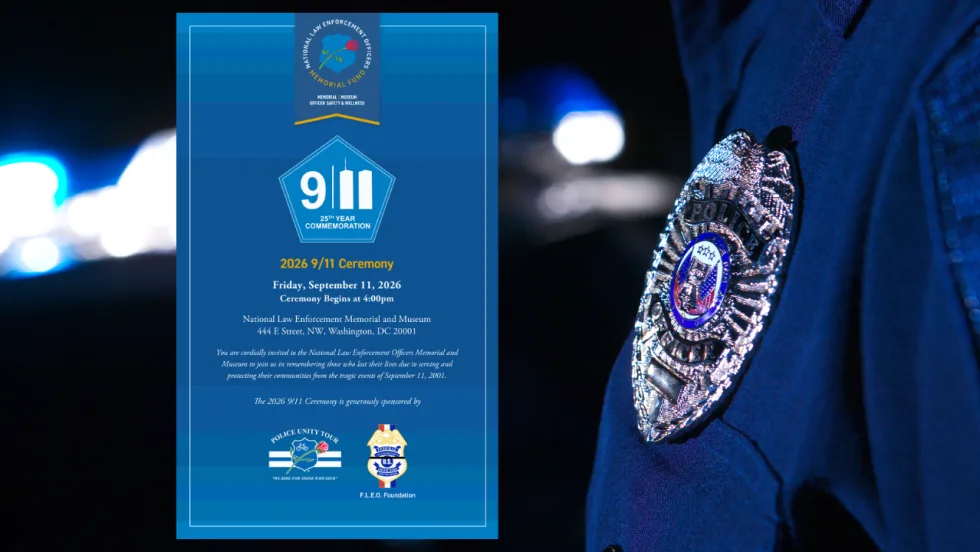
National Law Enforcement Memorial and Museum Hosting 9/11 25th-Year Commemoration Ceremony
The National Law Enforcement Memorial and Museum is hosting a 9/11 25th Year Commemoration Ceremony on Sept. 11 at 4 p.m.
Read More →
National Law Enforcement Officers Memorial Fund Announces June 2026 Officers of the Month
The National Law Enforcement Officers Memorial Fund (NLEOMF) named 15 officers of the Chico Police Department (California) as the Officers of the Month for June 2026 for their roles in responding to an active-shooter incident at a public library.
Read More →