



Asking the Right Questions
Quickly gaining rapport and eliciting information from individuals is one of the most valuable tools in law enforcement. Obtaining admissions from suspects solves more cases than all the forensic evidence techniques combined.

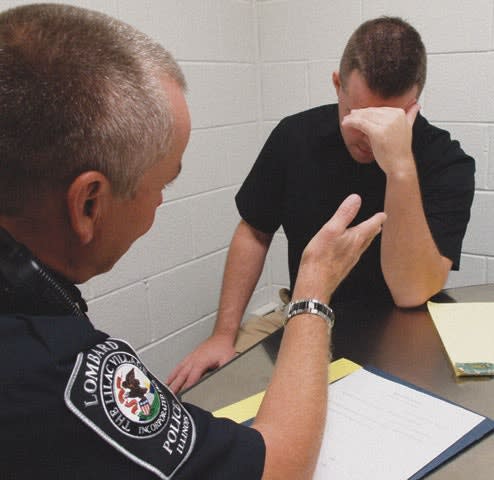
Regardless of your assignment, as an American law enforcement officer you need to know how and when to ask the right questions of criminal suspects.
Quickly gaining rapport and eliciting information from individuals is one of the most valuable tools in law enforcement. Obtaining admissions from suspects solves more cases than all the forensic evidence techniques combined.
Let's begin by briefly distinguishing between interviewing and interrogations, although this article will address both:
An interview is a broad-based inquiry using open-ended questions to obtain facts, sequence of events, or alibis, which may or may not be true.
An interrogation is an attempt to obtain a statement or admission against the individual's interest when it is believed he is withholding information. It is to be conducted without the use of threats or promises.
OK, let's talk about how you can gain the advantage when conducting an interview or an interrogation.
Setting the Stage
Finding the ideal room setting requires many considerations and can get very specific, but the main idea is to keep the room simple and free of distractions. The room should be smaller, such as 10 feet by 10 feet, and away from outside distractions. If there is a window, the suspect should be seated to face away from it.
Remove any excess furniture, phones, wall clocks, or reading material. There should be no barriers such as a desk or table between the interviewer and the subject. Eliminating barriers between the officer and the suspect creates a more neutral environment and allows a clear observation of the subject.
Also, limit the number of people in the room. Ideally, it should just be two or three people including the subject. It is easier for a suspect to say something negative about himself in front of one person vs. an audience. If there must be another person present, have him blend into the woodwork—seated further back and off to the side so as not cause a distraction.
Tip: Avoid distractions in your interrogation room—keep it as empty as possible, remove unnecessary furniture and people. Use a "Do Not Disturb" sign on the door.
Establishing a Baseline
The easiest way to interpret a suspect's behavior is to first establish a behavioral norm for that particular suspect.
Verbal and nonverbal behaviors are very individualized and, although generalizations can be made about behavior, individuals can be unique when trying to deceive. Observing the subject while gathering background information and during the rapport-building phase will give you an average behavior baseline that you can use as a reference point for comparison. This comparison will be made when you later discuss the crime.
Be aware that any situation that is unusual or threatening may cause the suspect's stress level to rise. For example, consider the reaction of most people when stopped for a traffic violation. Simply being in an interrogation situation will cause some behavioral changes.
The goal of the observant investigator is to recognize that people who are being interviewed may be nervous; this nervousness may have nothing whatsoever to do with deception. It may be simply caused by the situation. Evaluate the suspect's behavior in light of his behavioral norm, the population's average response, and the context of the situation.
Behavioral Clusters
The behavior observed during the course of an interview/interrogation is more likely to be valid when clusters of different types of behavior occur together.
For example, in a deceptive individual, you could observe a lack of eye contact, closed body posture, and grooming gestures. At the same time, there may be deceptive verbal behavior with delays in the speech pattern. The clustering of similar behaviors when evaluated globally assists you in determining whether the individual is truthful or deceptive.
Rarely is a single behavior to be interpreted as the truth or deception. The accuracy of the decision is enhanced when the behavior can be read in clusters that support each other, leading to the conclusion of truthfulness. Much like deception, truthful behavior can be read using clusters of behavior such as direct spontaneous responses, good eye contact, open posture, and related fluid movements.
Cautions in Evaluating Behavior
In addition to keeping in mind any environmental distractions, you must consider any personal biases against the suspect, which can allow you to overlook information and behavior indicative of guilt or innocence. People remind us either positively or negatively of someone we know and you must be aware of these biases.
Also be aware that cultural, ethnic, and geographic differences can cause behavior variations in people. In some Asian cultures, eye contact may be significantly less than among other populations because it may be inappropriate to make eye contact with an authority figure. Gestures and behaviors may also be typical for specific cultures and very appropriate for their ethnic group.
You must also take into account the attitude of the suspect when assessing behavior. When you are dealing with someone who does not like law enforcement, you will receive negative feedback from that individual.
[PAGEBREAK]
None of us likes to be disliked and individuals tend to treat others the way others treat them. Thus, when we are dealing with a person who doesn't like us, we are more likely to judge the person to be deceptive based on behavior owing to the bias we have against the suspect. Recognizing these biases will prevent you from inaccurately evaluating the suspect's behavior.
Tip: Realize that no behavior symptoms happen by chance. All behavior is meaningful. In many cases, suspects are not even aware that they are reacting and providing you with behavioral clues.
Non-Accusatory Questions
Structuring an interview based on behavior-provoking, non-accusatory questions to elicit interpretable behavior symptoms is a typical way you may determine innocence or guilt. You should understand that although a meeting with the suspect may be non-accusatory for the purpose of eliciting alibis or explanations, it can turn into an interrogation at any time.
A professional, yet friendly, approach to the person being interviewed is the most effective way to establish rapport. A quick way to do this is by finding some common ground or interest, since people tend to like people who have similar interests and personalities.
By reading the suspect's personality, you can establish rapport by changing topics to discuss points of interest common to both of you. Try to connect with the suspect on one of the many similarities most people have. For example, common ground might be found in weather, family, work frustrations, bills, children, etc.
You will be judged by your appearance during the first few seconds. So consider removing handcuffs, weapons, or radios, which might create a sense of unease. Words such as witness, victim, court, and testimony, or slang terms used by police can also create an unacceptable image. Avoid any words that trigger negative responses or recreate the seriousness of the crime.
Once rapport has been established, cooperation is essential. By making general benefits statements, cooperation can be encouraged. Use benefits statements to convey the benefits of cooperation to the witness. The second part of the benefits statement strategy is providing the benefit that addresses the need. To provide the benefit, explain the building of a case and development of information and discuss how the witness might benefit from his cooperation.
Handling Denials
Regardless of whether you are interviewing or interrogating there are five basic types of lies you may have to deal with.
Direct Denial: This is a simple "I didn't do it" and it creates an emotional sense of disquiet called dissonance, which people try to avoid.
Lie of Omission: This is the most common type of lie because it allows an individual to tell the truth while omitting details that could create potential trouble. Down the road, when revisiting the same information, individuals tend to say they simply forgot if confronted with the omission.
Lie of Fabrication: This is the most difficult lie to tell because the suspect must be a quick thinker with good memory. The suspect must be able to create information without contradicting himself or herself to make the deception confident and ring of truth.
Lie of Minimization: This lie downplays significance, which the suspect hopes will satisfy the interviewer and limit further questions. This is like the first offer in a negotiation. There will likely be more to come.
Lie of Exaggeration: Many exaggerated claims can be tested by looking for inconsistencies in the story. Con men and swindlers often make contradictory claims because of their flamboyant personalities.
The suspect's level of cooperation will determine whether you want to challenge his or her truthfulness. The decision to confront might be directly related to the investigative strategy. Regardless, a plan for re-interviewing should be prepared with time to investigate the fact surrounding the subject's story.
At some point, the subject must be confronted with his or her deceptions and involvement in the crime. There will be a transition from the interview where the suspect does most of the talking to the interrogation where most of the talking will be done by you, the
[PAGEBREAK]
investigator. During the interrogation, the suspect may attempt to deny his or her involvement in the crime and the interrogator will have to deal with this tactic by using the following techniques:
Anticipate the denial by observing behavior. There will be observable behavior preceding the suspect's denial. If you observe and react to this behavior, you will be able to stop the denial before it is voiced.
Use the suspect's first name. When people hear their names, they stop what they were about to do or say and pay attention to the speaker. You can use this to gain the suspect's attention or momentarily cause him to stop what he is doing.
Discuss important areas. The suspect's desire to know the amount of information that has been developed can get him or her to listen. Tell the suspect that the information you are going to present is important because the suspect is going to have to make an important decision. The suspect interprets this to mean that he or she will be discussing specific evidence that proves his or her involvement but, in actuality, you have no intention of discussing specifics but rather return to providing rationalizations.
Tell the suspect that he or she will have a chance to talk. This typically pushes a suspect into maintaining silence while you talk. The silence allows the rationalization to chip away at the suspect's resistance, moving the suspect closer to submission.
Interrupt the suspect and state the denial for him. This keeps you in control of the dialogue and establishes rapport but does not cause the suspect to feel like he or she has to protect a position.
Create curiosity. By offering a statement designed to create curiosity, the suspect will wait to get all of the information that you promised.
Use behavior to control the interrogation. Using gestures and conversational reactions to tell the suspect not to speak can control the suspect's denials. For example, raising a hand in conjunction with breaking eye contact can stop the denial.
Use an enticement question. The enticement question presents either real or fake evidence that causes the suspect to change his or her story. This works best when the suspect is only weakly denying involvement. As denials stop, the suspect begins to accept his fate and becomes withdrawn emotionally and quieter. In this submissive phase, he or she is searching for a way out and will often begin the admission process.
Tip: The most common mistake is failing to stop a denial from occurring. Use the above tips to handle denials.
Interrogation
When it comes to obtaining a confession, there are several ways to make it easier for the suspect to admit the truth:
Creating the belief his guilt is known: In this case, the suspect confesses because he believes that he is caught. He wants to save face and relieve his own guilt.
Offering a face-saving option: By minimizing the seriousness of the crime, the interrogator can focus on the resolution and the future. Using appropriate rationalizations allows the suspect to save and offer a more acceptable reason for committing the crime without losing the elements of intent or mental state needed to convict the suspect.
Avoiding denials: The interrogator should avoid direct statements of accusation, which will cause denials. Instead, use third-person rationalizations to gain acceptance by and allow the suspect to minimize the seriousness of the incident.
Using assumptive questions: The use of assumptive questions leapfrogs the final defensive barrier a suspect has erected to oppose the confession. An assumptive question assumes that the suspect committed the crime and asks for an admission regarding some aspect of the crime.
There are two types of assumptive questions: Soft accusation and the choice question.
A soft accusation asks for an admission about some aspect of the crime and is a one-sided question broad enough to cover a number of issues. Examples include: What would be the greatest amount of money that you took from the company in any one day? When was the first time you considered buying the gun? When did you begin to plan this out?
A choice question incorporates a good and bad choice. Selection of either is the suspect's first admission of involvement. Examples include: Did you use the money for bills or was it for drugs? Did you plan this out or did you do it on the spur of the moment without thinking? Was this your idea or someone else's?
Once the suspect has acknowledged involvement in the situation, it is essential to develop the admission, which includes the elements of the crime, the suspect's mental state, evidence, and the details of the crime.
Interview and interrogation are by far the most effective tools in the law enforcement arsenal to resolve crimes. Remember, obtaining admissions from suspects solves more cases than all the forensic evidence techniques combined.
Shane G. Sturman, CFI, is the president of Wicklander-Zulawski & Associates Inc. He is a nationally recognized speaker on interview and interrogation techniques and has presented hundreds of seminars on the topic to federal agencies, law enforcement, and the private sector. As an investigator, Sturman has personally conducted thousands of interviews and interrogations for both private and public agencies.
Wicklander-Zulawski & Associates Inc. is dedicated to assisting public and private sector professionals in improving their interviewing ability to obtain the truth through legally acceptable techniques. More information on training courses and seminars can be found at www.w-z.com.
More Patrol

Streamlight to Showcase Newest Lighting Products for Law Enforcement Professionals at IACP 2026
Streamlight will showcase its newest lights for law enforcement at the International Association of Chiefs of Police Annual Conference & Expo. Featured lights will include the TLR-3 X, the PolyTac 1X, and more.
Read More →
Streamlight Portable Scene Light III Wins 2026 OH&S New Product of the Year Award
Streamlight’s Portable Scene Light III has won the 2026 Occupational Health & Safety (OH&S) New Product of the Year Award in the Lighting category.
Read More →
Adept Armor Introduces Two New Rifle Plates
Adept Armor has launched two new Level IV ballistic plates, the Emperor and the Archon Mark 2, which brings Adept Armor’s new Quatroid ceramic to the high-threat, performance-value center of the range at 5.2 pounds.
Read More →
POLICE Product Test: Benchmade Bailout
The Benchmade Bailout is a slim, lightweight carry knife with a deep-ride pocket clip and comes in a variety of blade steels and scales. Here is a detailed review of the Taiga Green Bailout, released earlier this year.
Read More →
NLEOMF Announces July 2026 Officer of the Month
NLEOMF honored a Michigan deputy sheriff as the July 2026 Officer of the Month for rescuing a trapped driver from a burning vehicle following a Fourth of July crash.
Read More →
Streamlight to Showcase Newest Lighting Products at National Safety Council’s Safety Congress & Expo 2026
Streamlight will showcase its latest lights, including the Portable Scene Light III and the LiteBox 1Million, at the 2026 National Safety Council (NSC) Safety Congress & Expo.
Read More →
The 2027 World Police & Fire Games Set for Perth, Australia
The 2027 World Police & Fire Games (WPFG) will take place in Perth, Western Australia, from Friday, March 12 through Sunday, March 21, 2027.
Read More →
5.11 Partners with National Fallen Firefighters Foundation to Support #ForThe343
5.11 has joined the nationwide movement honoring the 343 New York City Fire Department firefighters lost on Sept. 11, 2001.
Read More →
Team Wendy Announces Title Sponsorship of the Jorge Pastore Foundation
Team Wendy’s 3-year partnership with the Jorge Pastore Foundation expands access to programs that strengthen those who serve.
Read More →
National Law Enforcement Memorial and Museum Hosting 9/11 25th-Year Commemoration Ceremony
The National Law Enforcement Memorial and Museum is hosting a 9/11 25th Year Commemoration Ceremony on Sept. 11 at 4 p.m.
Read More →