



Understanding Graham v. Connor
The 1989 case of Graham v. Connor is an example of how the actions of one officer can start a process that establishes law. Using the Graham standard, an officer must apply constitutionally appropriate levels of force based on the unique circumstances.

Findings from Graham v. Connor determine the legality of every use-of-force decision an officer makes.
POLICE
No law enforcement officer starts his or her shift saying, "I want to make some case law here today." But there are those rare occasions where an officer's observations and actions get reviewed, scrutinized, and solidified as case law in the highest courts of the land. The 1989 case of Graham v. Connor is an example of how the actions of one officer can start a process that establishes law.
Findings from Graham v. Connor determine the legality of every use-of-force decision an officer makes. And they will certainly be considered in the deadly use-of-force decision made by Ferguson, Missouri, police officer Darren Wilson when using deadly force on Michael Brown. Which is why every American law enforcement officer should have a sound understanding of the Graham case and what it means.
Using the Graham standard, an officer must apply constitutionally appropriate levels of force, based on the unique circumstances of each case. The officer's force should be applied in the same basic way that an "objectively reasonable" officer would in the same circumstances. The Supreme Court has repeatedly said that the most important factor to consider in applying force is the threat faced by the officer or others at the scene.
Orange Juice
1984, On Nov. 12, 1984, Dethorne Graham, a North Carolina Department of Transportation maintenance worker and diabetic, sensed the onset of a diabetic reaction and needed sugar to offset the insulin. He asked a friend to drive him to a convenience store so he could purchase orange juice to counteract the insulin reaction.
As he entered the store, Graham took note of the police car parked across from the store, but didn't give it a second thought. He needed sucrose and couldn't wait. Upon entering the store and seeing the number of people ahead of him, Graham hurried out of the store and asked his friend to drive him elsewhere for his sugar. Officer Connor of the Charlotte Police Department, sitting in the car across the street, saw Graham enter the store, then quickly run from the store, a textbook move for a thief or robber.
Officers are trained to look for suspicious activity and Connor, along with any other "objectionably reasonable" officer, would think that Graham's actions were suspicious and worth investigating further.
According to well-publicized facts of the case, Connor followed the car Graham got into and stopped it down the street. The driver of the car, William Berry, told the officer that Graham was a diabetic, but the officer ordered the pair to wait while he found out what had happened in the store.
When Connor returned to his patrol car to call for backup, Graham got out of the car, ran around it twice, and finally sat down on the curb, where he passed out briefly.
A number of Charlotte police officers arrived as backup on the scene. One of the officers rolled Graham over on the sidewalk and cuffed his hands tightly behind his back, as Berry pleaded with the officers to get Graham some sugar. Several officers then lifted Graham up from behind, carried him over to Berry's car, and placed him face down on its hood.
Regaining consciousness, Graham asked the officers to check in his wallet for a diabetic decal that he carried. In response, one of the officers told him to "shut up" and shoved his face down against the hood of the car. Four officers grabbed Graham and put him head first into the police car.
A friend of Graham's brought some orange juice to the car, but the officers refused to let him have it. Finally, Officer Connor received a report that Graham had done nothing wrong at the convenience store, and the officers drove him home and released him.
At some point during his encounter with the police, Graham sustained a broken foot, cuts on his wrists, a bruised forehead, and an injured shoulder; he also claims to have developed a loud ringing in his right ear that continues to this day.
Graham secured counsel and filed a federal lawsuit under 42 U.S.C. § 1983—a section of U.S. Code that covers the violation of someone's civil rights by a law enforcement officer—against the individual officers involved in the incident. The case wound its way through the appellate process all the way to the U.S. Supreme Court, which established the rulings in Graham v. Connor as the law of the land in 1989.
Graham and Ferguson
On closer inspection of the Graham v. Connor ruling, there are some important thoughts expressed by the court that are salient to the Ferguson shooting case.
Devallis Rutledge is special counsel to the Los Angeles County District Attorney's Office, a use-of-force subject matter expert, and author of numerous books and POLICE Magazine's monthly "Point of Law" column. He says that the most important quotes from the written opinion of the Supreme Court in the Graham decision are in the three paragraphs talking about the reasonableness test of the Fourth Amendment.
These paragraphs say: Any use of force by law enforcement officers needs to take into account "severity of the crime at issue, whether the suspect poses an immediate threat to the safety of the officers or others, and whether he is actively resisting arrest or attempting to evade arrest by flight."
"The 'reasonableness' of a particular use of force must be judged from the perspective of a reasonable officer on the scene, rather than with the 20/20 vision of hindsight."
"The calculus of reasonableness must embody allowance for the fact that police officers are often forced to make split-second judgments—in circumstances that are tense, uncertain, and rapidly evolving—about the amount of force that is necessary in a particular situation."
So considering the facts that are known in the Ferguson case, of which there are very few in the public domain at this time, the officer's state of mind will play an important role in considering if the shooting was excessive. What level of threat did the officer perceive? What is his training and background? What are the physical size differences between officer and offender? What options could be reasonable considered short of deadly force?
It is safe to say that the situation in Ferguson was "tense, uncertain, and rapidly evolving," as the incident was reportedly a prolonged violent confrontation that went from a police car to a confrontation on the street. Would a reasonable officer, faced with the exact same circumstances, with the same training and physical conditioning, make the same decision to use force in the same manner? These are the questions to be answered by the investigators.
We don't know what will happen with Officer Darren Wilson of the Ferguson Police Department. But we can be certain that officials charged with evaluating the facts of his shooting will consider Graham when deciding if it was objectively reasonable and constitutional.
Write It Up
Officers working the street and applying the principles of Graham v. Connor every day may or may not know they are doing it. A generation of officers has been trained in the case's practical meaning and has spent decades applying it to every use-of-force decision. So, it has become part of law enforcement DNA, often unnoticed as it works in the background to determine our actions. But now the events in Ferguson give us a rare opportunity to put the application of the Graham standards in everyday policing and in-service training under the microscope and study them.
What are the relevant points for a police officer in a situation of deciding the right level of force to use to effect an arrest? Focus on the main questions to be asked: Was the force "objectively reasonable" based on the facts and circumstances faced by the officer? What was the seriousness of the crime? What was the threat to the officer or other people? Was the suspect resisting and/or attempting to flee?
According to retired LAPD Capt. Greg Meyer, a POLICE Advisory Board member and noted use-of-force expert, the officer's assessment of the suspect becomes very important in a Graham analysis. Height and weight? Weapons? Demeanor? Verbal threats? Intoxication? Prior knowledge of suspect's history? These are among the many factors that you should remember to include in the reporting.
"When you focus on the Graham factors, your police report will be better," Meyer says. "Your report should be specific about what the suspect was doing that caused you to use force."
It's not enough to give a generalized statement about levels of resistance and levels of force, Meyer says. It's far better to specifically write what happened. Meyer provides the following example of specifics for a police report on a TASER deployment.
"The suspect started looking around to his left and his right. I used my radio to request a backup unit. He flexed his arm muscles and clenched his fists. I drew my TASER and stated, ‘Sir, if you don't calm down, I will use the TASER on you, and it will hurt a lot.' Then he yelled at me, ‘I am not going to jail again!' I calmly repeated my instruction, ‘Sir, I know you're upset, but you are under arrest. Please cooperate. Put your hands behind your head, and turn around so that I can handcuff you. Do it now!' At that time, the suspect looked around to his left and right again. He bent forward at the waist and began to take a step forward in my direction. At that time, I believed that he was about to attack me. I deployed TASER probes, and he fell to the ground. At that time I handcuffed him."
Writing specific accounts of why you used force during an incident will go a long way toward getting any potential jury inside your head and understanding what you were thinking. You have to say what the exact threat was that you perceived. You may not be thinking about making case law at the time, but you may be doing just that.
The Decision
The words of Chief Justice William Rehnquist can still be heard loud and clear today, 25 years after the Graham v. Connor decision. And every American law enforcement officer should know them well.
"The reasonableness of a particular use of force must be judged from the perspective of a reasonable officer on the scene, rather than with the 20/20 vision of hindsight. The calculus of reasonableness must embody allowance for the fact that police officers are often forced to make split-second judgments—in circumstances that are tense, uncertain and rapidly evolving—about the amount of force that is necessary in a particular situation. The test of reasonableness is not capable of precise definition or mechanical application."
Our society would benefit from listening to Rehnquist's opinion rather than listening to community activists, protesters, or ill-informed politicians who see issues in black and white instead of seeing the issues from the standpoint of objective reasonableness. After the dust settles in Ferguson, we may have new case law or we may have affirmation of a 25-year-old decision that started with a quest for a bottle of orange juice.
Mark Clark is a 27-year veteran police sergeant. He has served as PIO, training officer, and as supervisor for various squads.
Learn More: 10 Tips for Reviewing Use-of-Force Reports
More Patrol

Adept Armor Introduces Two New Rifle Plates
Adept Armor has launched two new Level IV ballistic plates, the Emperor and the Archon Mark 2, which brings Adept Armor’s new Quatroid ceramic to the high-threat, performance-value center of the range at 5.2 pounds.
Read More →
POLICE Product Test: Benchmade Bailout
The Benchmade Bailout is a slim, lightweight carry knife with a deep-ride pocket clip and comes in a variety of blade steels and scales. Here is a detailed review of the Taiga Green Bailout, released earlier this year.
Read More →
NLEOMF Announces July 2026 Officer of the Month
NLEOMF honored a Michigan deputy sheriff as the July 2026 Officer of the Month for rescuing a trapped driver from a burning vehicle following a Fourth of July crash.
Read More →
Streamlight to Showcase Newest Lighting Products at National Safety Council’s Safety Congress & Expo 2026
Streamlight will showcase its latest lights, including the Portable Scene Light III and the LiteBox 1Million, at the 2026 National Safety Council (NSC) Safety Congress & Expo.
Read More →
The 2027 World Police & Fire Games Set for Perth, Australia
The 2027 World Police & Fire Games (WPFG) will take place in Perth, Western Australia, from Friday, March 12 through Sunday, March 21, 2027.
Read More →
5.11 Partners with National Fallen Firefighters Foundation to Support #ForThe343
5.11 has joined the nationwide movement honoring the 343 New York City Fire Department firefighters lost on Sept. 11, 2001.
Read More →
Team Wendy Announces Title Sponsorship of the Jorge Pastore Foundation
Team Wendy’s 3-year partnership with the Jorge Pastore Foundation expands access to programs that strengthen those who serve.
Read More →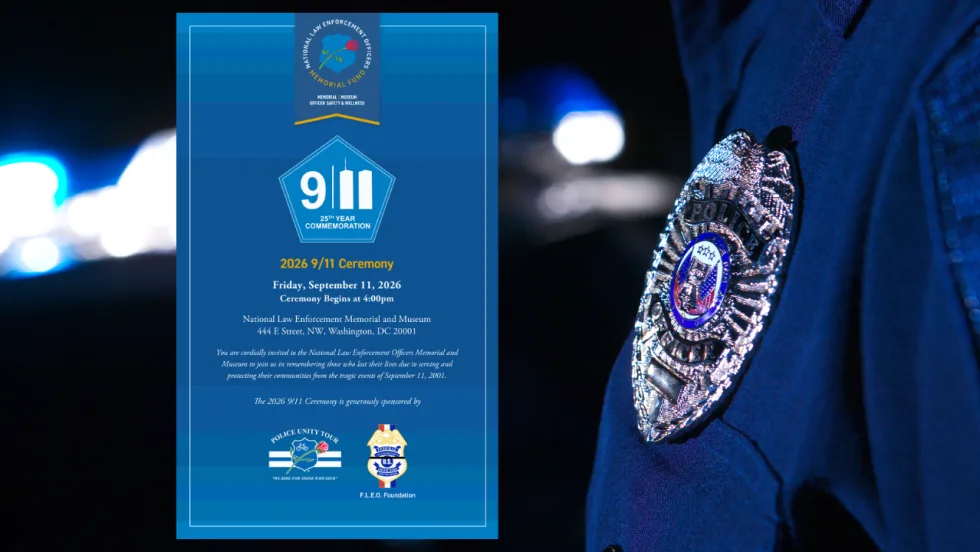
National Law Enforcement Memorial and Museum Hosting 9/11 25th-Year Commemoration Ceremony
The National Law Enforcement Memorial and Museum is hosting a 9/11 25th Year Commemoration Ceremony on Sept. 11 at 4 p.m.
Read More →
National Law Enforcement Officers Memorial Fund Announces June 2026 Officers of the Month
The National Law Enforcement Officers Memorial Fund (NLEOMF) named 15 officers of the Chico Police Department (California) as the Officers of the Month for June 2026 for their roles in responding to an active-shooter incident at a public library.
Read More →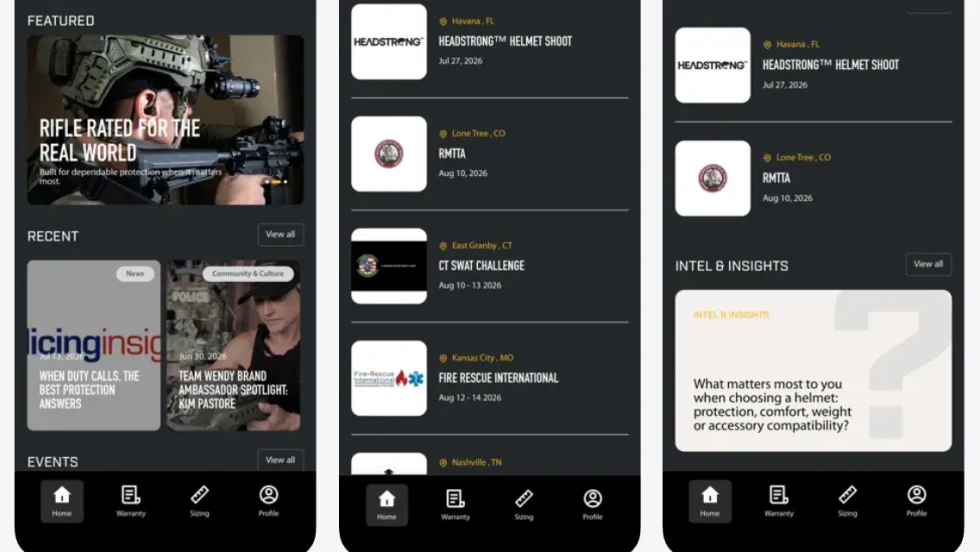
Team Wendy App Creates New Digital Hub for Helmet Owners
The Team Wendy Community App provides one location for warranty registration, size-fit tools, product updates, and community connection. For helmet owners, the new app creates a simpler path to the information and tools that matter most.
Read More →