



LAPD Honors Pioneering Female Officer Alice Stebbins Wells
Wells was one of the first female officers in the country with arrest powers. Her first duties included the "suppression of unwholesome billboard displays, searches for missing persons, and the maintenance of a general information bureau for women seeking advice on matters within the scope of police departments."

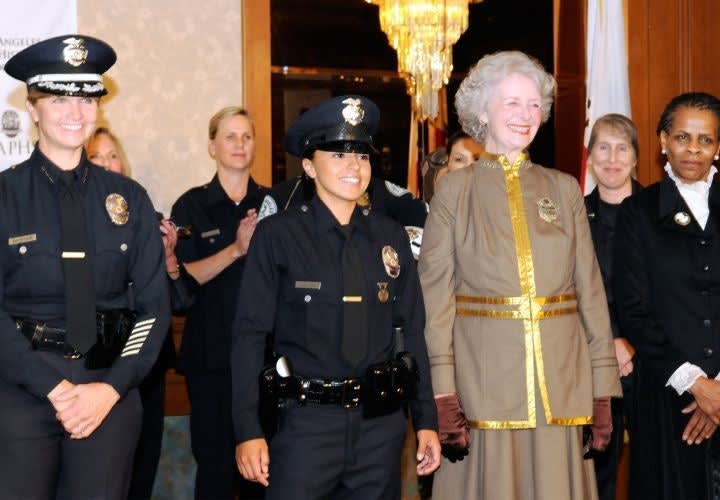
The LAPD's newest female officer (center) is flanked by Asst. Chief Sandy Jo MacArthur (left) and a retired officer wearing the original uniform of Alice Stebbins Wells, who became an LAPD officer in 1910. Photo courtesy of the Los Angeles Police Historical Society.
On the centennial of her hiring as one of the nation's first working policewomen, Alice Stebbins Wells received a tribute from the Los Angeles Police Department.
Wells was one of the first female officers in the country with arrest powers when she joined the department on Sept. 12, 1910. On Monday, the LAPD paid tribute to Wells during the 17th Annual Jack Webb Awards Night that is co-hosted with the Los Angeles Police Historical Society.
"A lot of them were being brought in to deal with women and children to handle the problems that women were raising in the community and to try to keep them on the straight and narrow," Assistant Chief Sandy Jo MacArthur tells POLICE Magazine. "Many of them had to design their role in policing."
Wells' grandson made an appearance at the luncheon, along with 14 active and retired LAPD policewomen, who wore the uniforms female officers wore between 1910 and the present.
Prior to Wells entering the force, in 1909, she had petitioned Mayor George Alexander and the City Council to establish a Los Angeles policewoman. On the first day of her appointment, Wells was issued a telephone call box key, a book of rules, a first-aid book, and a policeman's badge.
"When Alice came on she had full police powers but not a gun," MacArthur said. "Talk about blazing a trail, but not being given the tools. Nor did she have partners. She was out there on her own blazing through uncharted territory."
Wells was eventually issued Policewoman's Badge Number One. Her first duties included the "suppression of unwholesome billboard displays, searches for missing persons, and the maintenance of a general information bureau for women seeking advice on matters within the scope of police departments," according to the LAPD website.
While Wells paved the way for more female officers in the LAPD, there were other barriers. In the 1950s, the City Council intervened, appointing several female officers as sergeants.
Today, females make up 19 percent of the department.
Recruiting female officers can be a challenge for the deparment, according to MacArthur, due to the physical aspects of police work. Yet, the department has hosted several recruiting events for women that have been well attended. Female officers explain their work to dispell the mystique of the job.
Wells' start with the department was well chronicled in the local newspapers at the time, the Los Angeles Times reports.
Related:
PHOTO GALLERY: "Pioneering Women of the LAPD"
More Patrol

Team Wendy Introduces the EXFIL Endurance Ballistic Helmet, Engineered to Reduce the Burden of Extended Wear
Team Wendy has launched its EXFIL Endurance, a new lightweight ballistic helmet engineered to deliver protection, comfort, and fit during demanding, extended operations.
Read More →
The First Responders Children’s Foundation National First Responders Day Roll Call of Heroes Ceremony Returns to Times Square, NYC
First Responders Children’s Foundation (FRCF), in collaboration with T-Mobile, will host the Roll Call of Heroes ceremony in Times Square to commemorate National First Responders Day on Wednesday, Oct. 28. During the event, FRCF will present 18 Hero Awards.
Read More →
Streamlight to Showcase Newest Lighting Products for Law Enforcement Professionals at IACP 2026
Streamlight will showcase its newest lights for law enforcement at the International Association of Chiefs of Police Annual Conference & Expo. Featured lights will include the TLR-3 X, the PolyTac 1X, and more.
Read More →
Streamlight Portable Scene Light III Wins 2026 OH&S New Product of the Year Award
Streamlight’s Portable Scene Light III has won the 2026 Occupational Health & Safety (OH&S) New Product of the Year Award in the Lighting category.
Read More →
Adept Armor Introduces Two New Rifle Plates
Adept Armor has launched two new Level IV ballistic plates, the Emperor and the Archon Mark 2, which brings Adept Armor’s new Quatroid ceramic to the high-threat, performance-value center of the range at 5.2 pounds.
Read More →
POLICE Product Test: Benchmade Bailout
The Benchmade Bailout is a slim, lightweight carry knife with a deep-ride pocket clip and comes in a variety of blade steels and scales. Here is a detailed review of the Taiga Green Bailout, released earlier this year.
Read More →
NLEOMF Announces July 2026 Officer of the Month
NLEOMF honored a Michigan deputy sheriff as the July 2026 Officer of the Month for rescuing a trapped driver from a burning vehicle following a Fourth of July crash.
Read More →
Streamlight to Showcase Newest Lighting Products at National Safety Council’s Safety Congress & Expo 2026
Streamlight will showcase its latest lights, including the Portable Scene Light III and the LiteBox 1Million, at the 2026 National Safety Council (NSC) Safety Congress & Expo.
Read More →
The 2027 World Police & Fire Games Set for Perth, Australia
The 2027 World Police & Fire Games (WPFG) will take place in Perth, Western Australia, from Friday, March 12 through Sunday, March 21, 2027.
Read More →
5.11 Partners with National Fallen Firefighters Foundation to Support #ForThe343
5.11 has joined the nationwide movement honoring the 343 New York City Fire Department firefighters lost on Sept. 11, 2001.
Read More →