



Getting You to Pull the Trigger
Despite the officer's repeated pleas for him to drop the weapon, Pergament continues to advance. Faced with the prospect his own impending death, the officer fires three times, killing Pergament. Only later does the officer learn the brutal truth: the weapon wielded by the suspect is nothing more than a toy gun.

November 1997: Nineteen-year-old Moshe Pergament is spotted driving erratically by a Nassua County, N.Y., police officer who pulls over the college student's car. As the officer exits his patrol vehicle, Pergament gets out of his car and approaches the police officer with what appears to be a firearm. Despite the officer's repeated pleas for him to drop the weapon, Pergament continues to advance. Faced with the prospect his own impending death, the officer fires three times, killing Pergament. Only later does the officer learn the brutal truth: the weapon wielded by the suspect is nothing more than a toy gun.
January 1998: A 36-year-old man walks into a central Tuscon, Ariz., convenience store. Slamming a gun on the counter, he demands that the clerk call police to come kill him. An hour later, he lies dying in an empty lot with two bullets in his body: one in the chest from a police officer's gun; the other, a self-inflicted head wound.
May 1998: Daring a Belleville, Ill. officer to shoot him, a 21-year-old man lunges at the officer with a 10-inch hunting knife. The officer fires. The suspect falls, a bullet in his chest.
Each of these incidents was an attempt by the suspect to have himself killed at the hands of a police officer. In two of the three cases, the suspect succeeded. Taken together, these incidents are representative of a national phenomenon referred to as "suicide by cop."
While the term "suicide by cop" has joined media-friendly phrases like "road rage" and "going postal" in an ever-growing American lexicon, Los Angeles County Sheriff's Department Homicide Sgt. John Yarbrough doesn't feel it's an accurate description. "Throughout history, there have been numerous instances of agency-assisted suicide: medical, judicial, etc.," Yarbrough told POLICE.
"Basically, it's a means of getting someone else to do it for you," said Yarbrough about "suicide by cop."
But he feels that "suicide by cop" is a disingenuous misnomer at best, and a dangerous one, at worse. "It's a means of passing the buck on behalf of the victim. It tries to make the officer accountable for the person's death; when in fact, it is the suicidal individual who is responsible. The perpetrator has the death wish, not the officer, who is merely reacting to a situation."
Because of this, Yarbrough-who participated in perhaps the only known detailed study of the phenomenon-prefers to call such incidents as "police-assisted suicides."
An Emerging Concern for Police
By any name, the incidence of a suicidal person confronting police officers in a manner likely to provoke a defensive reaction, is a growing concern for law enforcement agencies. Police agencies have historically shied away from discussing the phenomenon for the very realistic fear that publicity might generate copycat episodes.
A "suicide by cop" study that Yarbrough worked on, included researchers from Harvard and USC and profiled a number of officer-involved shootings that occurred in Los Angeles County between 1987-1996. Each case study had to fit established criteria, among them that before, during, or after the incident, the suspect made it explicitly known that he wanted to be shot by officers.
Of the 384 cases studied, at least 10 percent were determined to fit the "suicide by cop" phenomenon. Some commonalities emerged in the Los Angeles County study. In almost all instances, the victims were male; an overwhelming majority were whites or Latino. There were also high incidences of prior domestic violence, alcohol or chemical abuse, and prior suicide attempts.
The most easily recognized catalyst was the dissolution of a relationship: a break-up with a girlfriend or a divorce. Feeling helpless and hopeless, the suspects came to believe the only way out was death. Unable to commit suicide themselves, they looked to cops to emancipate them from their pain and set out to execute some plan that would culminate in their being killed.
The motives for orchestrating such a scenario are myriad. Whereas suicide is deemed an act of honor in Japan, it still carries a negative stigma in the United States. Thus, the victim may be opting to skirt the sociological stigma that suicide is weak. Or he may be trying to reconcile the desire to kill himself with the theological belief that suicide is a sin; so he somehow distances himself from the act by being shot by another. Whatever his motive, the suspect will set out to precipitate a shooting by preying on an officer's defensive responsiveness.
Sgt. Yarbrough describes this step as "the outrageous event": an action taken by the suspect that will guarantee police presence. This may be a sudden act of property damage such as vandalism or arson or an assault against another. It may be the random brandishing of a firearm against fellow pedestrians or passing motorists. In any instance, it will find an informant and possibly the suspect himself calling police to advise them of a crime in progress.
This "outrageous event" usually follows a period of anxious vacillation by the suspect. But once he's committed to having himself killed, the suspect may actually experience a period wherein he acts in a calm and methodical manner. No longer distracted by the probable consequences of his actions, the suspect can constructively commit his attentions and energies toward orchestrating events so that responding officers will find themselves in the position of defending their lives or the lives of others.
Moment of Truth
Once the event has arrived, the suspect is generally keyed for a "GO" signal, a sign for him to take some final action and realize his goal. In "suicide by cop" situations, this signal may be the arrival of police or any sign of proactive police intervention that might follow an officer's arrival. But once the "GO" signal is perceived, the suspect's final assault is imminent. The suspect's actions are often very aggressive, for this is his bid for annihilation and he does not want to be wounded. This perhaps explains why many suspects will continue hopeless acts of aggression even after they've been incapacitated by gunfire.
As James Gilligan, author of the book, Violence notes, "For many, the only means capable of expressing, in a final catharsis, the rage that is within them, is the fantasy of dying in a shootout with the police in which they would at least take as many people as possible into death with them before they die-an acting our of the Bonnie and Clyde myth, the Gotterdammerung myth. Every year in this country, hundreds of violent criminals go to their deaths in exactly that way.
Their implements may vary. Suspects have been known to wield remote controls, blunt instruments, and water pistols with equal efficacy. But despite what some might believe, the vast majority of the time the suspects are well armed: The knives are real; the guns, loaded. Because of this, Sgt. Yarbrough cautions against the arbitrary use of less lethal weapons as their deployment may serve as the "GO" signal.
Indeed, in one Southern California shooting, officers attempted to disarm an elderly man who was wielding a revolver. Firing shotgun-projected bean bags, they only succeeded in provoking the man to fire several shots, one which wounded an officer. Another collateral concern is the possible presence of booby-traps on or about the subject's person or property.[PAGEBREAK]
Inevitable Occurrence
Virtually every cop at one time or another will encounter the loud and belligerent drunk who challenges the cop to shoot him. Often, theses are drunks, confrontation junkies out to play "chicken" with a cop.
Often, they are only attempting to get a rise out of cops and see if they can scare them. But some are more adept than others at the enterprise, and succeed beyond their dreams in escalating situations to points where the reasonable cop has no option other than to shoot him. Such instances confuse the issue and cloud the already murky waters of officer-involved shootings.
Because of this uncertainty, Constable Rick Parent of the Delta Municipal Police Department, British Columbia, is cautious to delineate between the "victim-precipitated suicide" and those cases where the suspect may have other, more ambiguous motives. Because many of the decedents of such incidents have a history of suicide attempts, Parent encourages the street cop to familiarize himself with the ideation of suicidal individuals. Parent, an expert in the phenomenon, notes that "for cops who work the field, the more they know about suicide, the more they know about police work.
"For the dynamic of dealing with a suicidal person is quite different than dealing with a suspect wanted for a bungled robbery or burglary. In the latter instances, the suspects are hoping to evade capture with their lives, even if it means jeopardizing the lives of others. In these cases, they're begging us to kill them, even if it means taking others with them."
Trying to discern the true motive can sometimes be difficult. When the suspect succeeds in getting himself killed, such questions are often left unresolved. Sgt. Yarbrough's examination has led him to the conclusion that at least 10 percent of all officer-involved shootings are police-assisted suicide.
The Choices
So when the choice comes down to one of taking them in, or taking them out, what should we do? Some may opt for neither. What if they had a shooting, and nobody came?
Suspect Creates Incident
August, 1998: Deputies from the Los Angeles County Antelope Valley Station respond to a campground to find a distraught 28-year-old man pointing a rifle at his head and threatening to kill himself. After the deployment of shotgun projected bean bags and hours of negotiations fail to coerce the subject's surrender, the deputies simply leave. No one is seriously injured.
This incident is perhaps a best-case scenario, and while some argument may be made later for the suspect posing a threat to others, officers can only deal with what they are faced with at any given moment, all the while reconciling their tactical decisions with the reverence for human life. In this particular situation, the decision to leave the scene was feasible, given the isolated area, the fact that the subject posed no threat to other persons, and deputies had done all they could to coerce a surrender.
But no matter how patient we are or how well-trained we may be to deal with a distraught individual, there will be instances wherein the officer will have to fire that shot. And while these incidences are certainly tragic, it is imperative to remember that it is the suspect who invariably sets the series of events in motion. That they should choose officers to help them in this endeavor should be of no surprise.
At all times, we are responding to their actions: It's what they're counting on. Officers have historically been well-armed, and suspects generally believe officers will fire until a threat is removed. And in every instance, the suspect gives little consideration to the officer who is placed in the role of judge, jury, and executioner. Nor will the decedent dictate the spin the local news media may put on the outcome of such a situation.
"It's a very selfish act on the part of the person doing it," explains Kevin Danaher, a veteran of the Tuscon (Ariz.) Police Department SWAT team. "He (suspect) never considers the impact on the officer. He only envisions the positive impact on him. He can become a martyr, with his name and picture in the paper. He is letting his girlfriend know that if 'I can't have you, I'll have you know I died a victim.'
And if he survives, he can always sue the officers involved. For him, it's a win-win situation."
Obviously, the likelihood of minimizing the odds that we'll have to kill a suicidal man depends largely on the suspect's determination, his weapons, and the direct threat he poses to those who about him. As Danaher notes, "The most effective thing we've ever used is negotiation. These are the toughest situations to deal with. You're dealing with a person who's at the end of his rope and, quite possibly, at the end of the line.
"Officers are confronting a different dynamic than the inadvertent hostage situation that evolves out of a bungled robbery. These people want to die. How are you about to change their minds?"
The Fallout
The taking of another's life can become psychologically debilitating for the involved officers. Denotatively, "suicide by cop" means a cop who killed himself; connotatively, it refers to an individual who has himself killed by an officer. Sometimes, it can mean both.
Tuscon P.D.'s Danaher is familiar with one officer whose excessive interest in suicide obsession stemmed from an incident in which he'd killed a man bent on committing suicide. The officer's growing fascination found him going out of his way to roll to morbid situations, and culminated with a particularly traumatic episode where a subject shot himself in the head as the officer was talking with him. Within 18 months of taking the life of another, the officer took his own life as well.
Danaher notes that those who are able to objectively reconcile their involvement in such incidents are less likely to come to such drastic ends. A common appraisal among such officers is the following: "I showed up to help. I can live with having to kill him; I made sure that he didn't take anybody with him." The psychological fallout in the aftermath of such a tactical situation can be far-reaching. Incident commanders who have ordered someone to take a shot may have as difficult a time dealing with the trauma as if they were actively involved-perhaps more so.
Obviously, there are those who, despite doing everything they can, may be faced with the prospect of taking a human life, and until the day comes when we can set phasers to stun, we'll have to fight fire with fire. Moe Pergament, the collegian, realized this and in a final written note appealed to the shooting officer to forgive him for what he'd forced the officer to do.
Inside his car was a note addressed: "To the officer who shot me." Inside the envelope was a Hallmark card with a personal inscription:
"Officer, "It was a plan. I'm sorry to get you involved. I just needed to die. Please remember that this was all my doing. You had no way of knowing...Moe Pergament."
Sgt. Dean Scoville is a patrol supervisor with the Los Angeles County Sheriff's Department and a regular contributor to POLICE. He can be reached via e-mail at comicdet@concentric.net. His web page can be found at www.concentric.net/~comicdet.
More Patrol

Adept Armor Introduces Two New Rifle Plates
Adept Armor has launched two new Level IV ballistic plates, the Emperor and the Archon Mark 2, which brings Adept Armor’s new Quatroid ceramic to the high-threat, performance-value center of the range at 5.2 pounds.
Read More →
POLICE Product Test: Benchmade Bailout
The Benchmade Bailout is a slim, lightweight carry knife with a deep-ride pocket clip and comes in a variety of blade steels and scales. Here is a detailed review of the Taiga Green Bailout, released earlier this year.
Read More →
NLEOMF Announces July 2026 Officer of the Month
NLEOMF honored a Michigan deputy sheriff as the July 2026 Officer of the Month for rescuing a trapped driver from a burning vehicle following a Fourth of July crash.
Read More →
Streamlight to Showcase Newest Lighting Products at National Safety Council’s Safety Congress & Expo 2026
Streamlight will showcase its latest lights, including the Portable Scene Light III and the LiteBox 1Million, at the 2026 National Safety Council (NSC) Safety Congress & Expo.
Read More →
The 2027 World Police & Fire Games Set for Perth, Australia
The 2027 World Police & Fire Games (WPFG) will take place in Perth, Western Australia, from Friday, March 12 through Sunday, March 21, 2027.
Read More →
5.11 Partners with National Fallen Firefighters Foundation to Support #ForThe343
5.11 has joined the nationwide movement honoring the 343 New York City Fire Department firefighters lost on Sept. 11, 2001.
Read More →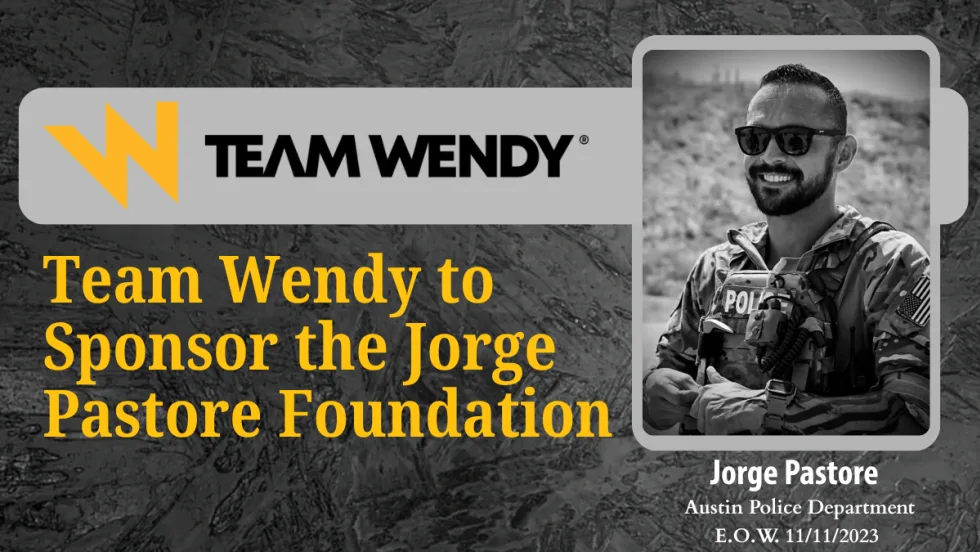
Team Wendy Announces Title Sponsorship of the Jorge Pastore Foundation
Team Wendy’s 3-year partnership with the Jorge Pastore Foundation expands access to programs that strengthen those who serve.
Read More →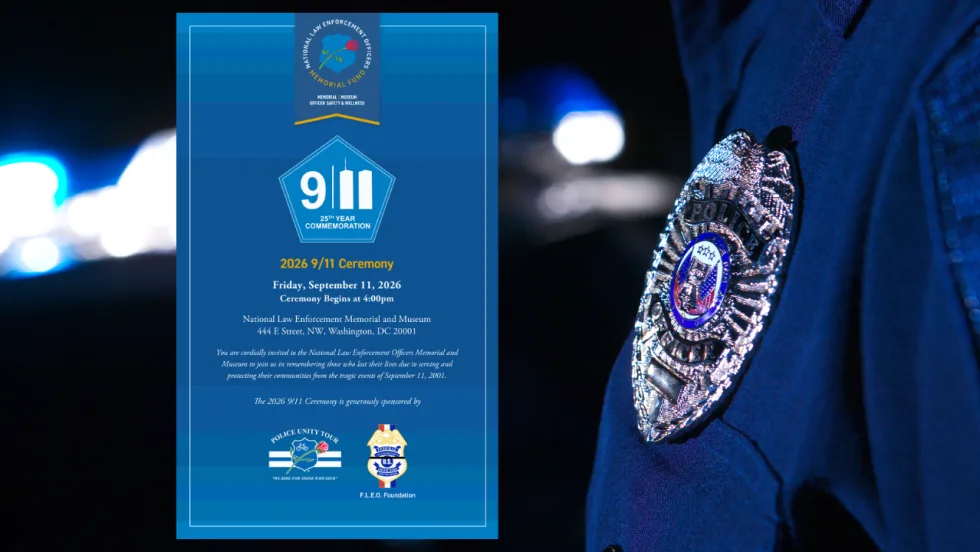
National Law Enforcement Memorial and Museum Hosting 9/11 25th-Year Commemoration Ceremony
The National Law Enforcement Memorial and Museum is hosting a 9/11 25th Year Commemoration Ceremony on Sept. 11 at 4 p.m.
Read More →
National Law Enforcement Officers Memorial Fund Announces June 2026 Officers of the Month
The National Law Enforcement Officers Memorial Fund (NLEOMF) named 15 officers of the Chico Police Department (California) as the Officers of the Month for June 2026 for their roles in responding to an active-shooter incident at a public library.
Read More →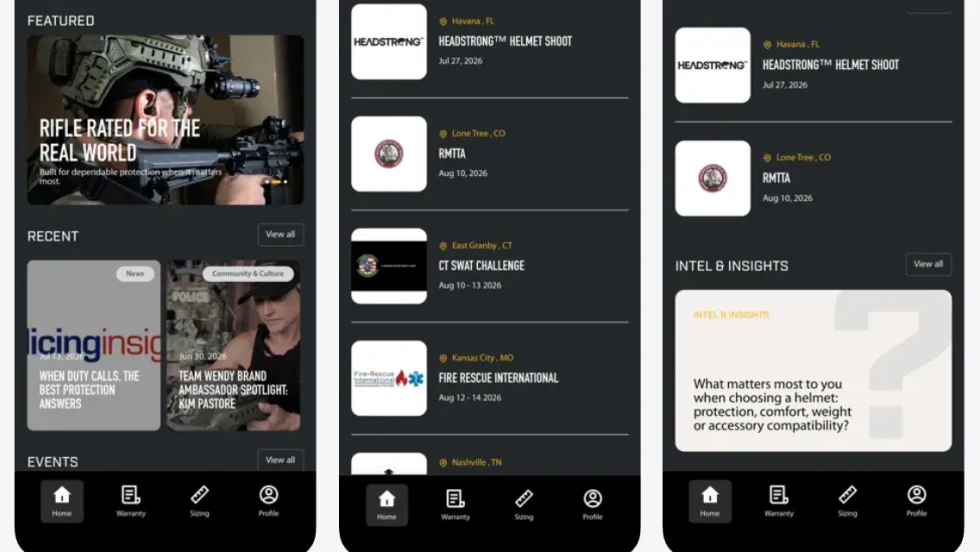
Team Wendy App Creates New Digital Hub for Helmet Owners
The Team Wendy Community App provides one location for warranty registration, size-fit tools, product updates, and community connection. For helmet owners, the new app creates a simpler path to the information and tools that matter most.
Read More →