



Davis Rules
In a fairly common scenario, you obtain a valid Miranda waiver from a suspect in custody and begin interrogation. Part-way through your questioning, the suspect begins to feel uneasy about going forward and says something about remaining silent or talking to a lawyer.

In a fairly common scenario, you obtain a valid Miranda waiver from a suspect in custody and begin interrogation. Part-way through your questioning, the suspect begins to feel uneasy about going forward and says something about remaining silent or talking to a lawyer. What then? Must you stop interrogating? Do you need to clarify his wishes? Or can you keep talking? The U.S. Supreme Court gave the answers in Davis v. U.S.
The Davis Facts
At the Charleston Naval Base, Robert Davis had an argument with another sailor over a pool game. The other sailor was later found behind the commissary, beaten to death with a pool cue. Naval Investigative Service agents developed probable cause to arrest Davis, and took him into custody. They read him his rights and obtained a valid waiver.
About an hour and a half into the interrogation, Davis said, "Maybe I should talk to a lawyer." The agents questioned him about his wishes, and Davis then said, "No, I don't want a lawyer." The interrogation continued for another hour, with Davis making incriminating statements.
At his court-martial, Davis sought to exclude the statements he made after the first mention of a lawyer. In support, he cited state and federal court cases that had held that any mention of counsel, however ambiguous, should be sufficient to require that all questioning cease. After his suppression motion was denied, he was convicted of murder and sentenced to life in prison and a dishonorable discharge. He appealed to the U.S. Supreme Court.
The Davis Rule
The Supreme Court acknowledged its earlier ruling in Edwards v. Arizona that a statement obtained through police custodial interrogation will not be admitted to prove guilt at trial if it resulted from questioning that continued after the suspect's request for an attorney. But where it is not necessarily clear that a suspect who has already waived his rights is asking for an attorney, the court declined to place the burden of resolving the ambiguity on the police.
"If a suspect makes a reference to an attorney that is ambiguous or equivocal in that a reasonable officer in light of the circumstances would have understood only that the suspect might be invoking the right to counsel, our precedents do not require the cessation of questioning.
"Rather, the suspect must unambiguously request counsel. He must articulate his desire to have counsel present sufficiently clearly that a reasonable police officer in the circumstances would understand the statement to be a request for an attorney.
"We therefore hold that, after a knowing and voluntary waiver of the Miranda rights, law enforcement officers may continue questioning until and unless the suspect clearly requests an attorney."
Finding that the statement, "Maybe I should talk to a lawyer," was not an unequivocal, unambiguous invocation of the right to counsel, the court upheld admission of Davis's statements and unanimously affirmed his conviction and sentence.
Although Davis involved an issue of an ambiguous reference to the right to counsel, lower courts have also applied the same approach to references to the right to silence (James v. Marshall; U.S. v. Mills).
Clarifying Ambiguities after Waiver
Although all nine justices voted to affirm the judgment in Davis, four of them wrote a separate opinion to stress that they believed officers should stop and clarify the suspect's wishes before going forward with an interrogation, once mention of counsel has been made.
But in the lead opinion, a five-member majority rejected this view and held that it is not necessary for officers to stop an interrogation when the suspect makes an ambiguous reference to invoking his rights:
"We decline to adopt a rule requiring officers to ask clarifying questions. If the suspect's statement is not an unambiguous or unequivocal request for counsel, the officers have no obligation to stop questioning him."
How Ambiguous is "Ambiguous?"
There are no magic words that a suspect has to use to constitute a clear and unambiguous invocation of Miranda rights. An unqualified statement such as "No more questions," or "I want a lawyer now," would be unambiguous. But although eventually a reviewing court will decide whether a suspect's words were clear enough to invalidate further questioning, at the time of the interrogation "it is police officers who must actually decide whether or not they can question a suspect" (Davis v. U.S.).
A number of federal appellate court cases have provided some guidance as to the level of clarity required to make a statement an unambiguous assertion of rights. In each of the following cases, the quoted language was held to not require that questioning stop, in the context and circumstances of each case:
Burket v. Angelone-"I just don't think that I should say anything."
U.S. v. Banks-"I don't got nothing to say."
Diaz v. Senkowski-"Do you think I need a lawyer?"
Dormire v. Wilkinson-"Could I call my lawyer?"
Clark v. Murphy-"I think I would like to talk to a lawyer."
Mincey v. Head-"Go ahead and run the lawyers."
Wishy-washy qualifications such as "I think..." or "Maybe I should..." or "If this is going to go much further..." would normally be ambiguous enough to come within the Davis rule that there is no need to clarify the suspect's wishes and no need to stop questioning. As a tactical matter, however, when a suspect makes a statement that shows his uneasiness, it might be a good time to switch the questions to something less incriminating for awhile, and return to the crime elements later as the interrogation goes forward.
Clarify Responses to Warnings
It's important to note that the Davis rule only applies where the suspect initially gave a clear, unambiguous waiver when he was given his pre-interrogation Miranda warning. Once he has waived, the burden shifts to him to clearly, unambiguously assert his rights if he wants questioning to cease.
However, since the prosecution has the burden of establishing a waiver whenever Miranda applies, it is necessary for you to clarify any initial ambiguity before beginning interrogation. For example, if the suspect responds to the Miranda admonishment by saying something like, "I think maybe I should get a lawyer," you should not proceed without clarifying whether or not you have an invocation of counsel. It's only after a clean waiver has been obtained that the Davis rule kicks in to require the suspect to clearly, unambiguously assert his right to counsel or silence if he wishes to cut off questioning.
Local Rules May Vary
Not all states follow the U.S. Supreme Court rulings on exclusionary issues. States are free to interpret their own constitutions as providing greater protection to criminals than the U.S. Constitution provides. Some states do so.
For example, in State v. Hoey, the Hawaii Supreme Court rejected the Davis rule and held that the state's constitution provides greater protection for criminal suspects than the federal constitution, requiring officers to clarify a suspect's ambiguous statements, or stop interrogating when an ambiguous statement is made. Officers should verify with local prosecutors whether the Davis rule is followed in each of their local jurisdictions.
Devallis Rutledge, a former police officer and veteran prosecutor, is Special Counsel to the Los Angeles County District Attorney.
More Patrol

Streamlight Portable Scene Light III Wins 2026 OH&S New Product of the Year Award
Streamlight’s Portable Scene Light III has won the 2026 Occupational Health & Safety (OH&S) New Product of the Year Award in the Lighting category.
Read More →
Adept Armor Introduces Two New Rifle Plates
Adept Armor has launched two new Level IV ballistic plates, the Emperor and the Archon Mark 2, which brings Adept Armor’s new Quatroid ceramic to the high-threat, performance-value center of the range at 5.2 pounds.
Read More →
POLICE Product Test: Benchmade Bailout
The Benchmade Bailout is a slim, lightweight carry knife with a deep-ride pocket clip and comes in a variety of blade steels and scales. Here is a detailed review of the Taiga Green Bailout, released earlier this year.
Read More →
NLEOMF Announces July 2026 Officer of the Month
NLEOMF honored a Michigan deputy sheriff as the July 2026 Officer of the Month for rescuing a trapped driver from a burning vehicle following a Fourth of July crash.
Read More →
Streamlight to Showcase Newest Lighting Products at National Safety Council’s Safety Congress & Expo 2026
Streamlight will showcase its latest lights, including the Portable Scene Light III and the LiteBox 1Million, at the 2026 National Safety Council (NSC) Safety Congress & Expo.
Read More →
The 2027 World Police & Fire Games Set for Perth, Australia
The 2027 World Police & Fire Games (WPFG) will take place in Perth, Western Australia, from Friday, March 12 through Sunday, March 21, 2027.
Read More →
5.11 Partners with National Fallen Firefighters Foundation to Support #ForThe343
5.11 has joined the nationwide movement honoring the 343 New York City Fire Department firefighters lost on Sept. 11, 2001.
Read More →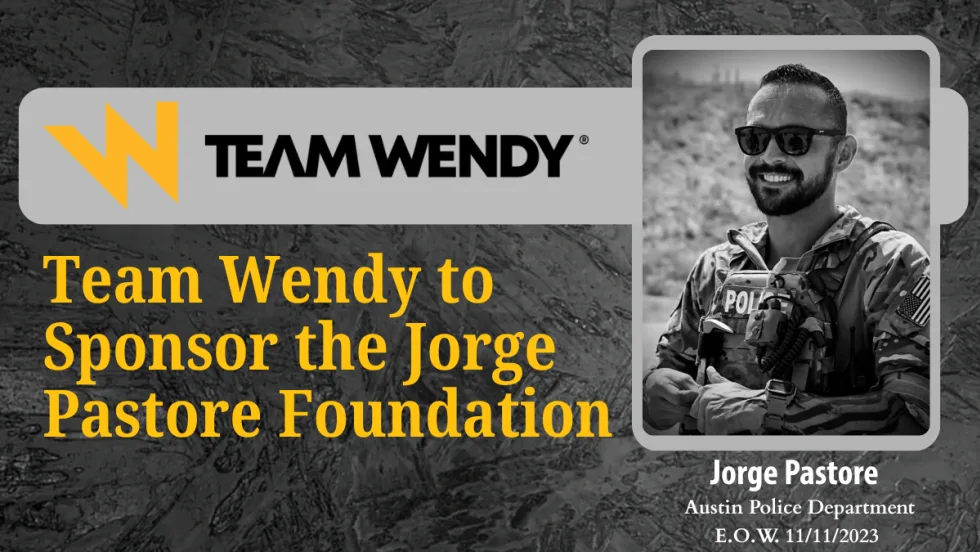
Team Wendy Announces Title Sponsorship of the Jorge Pastore Foundation
Team Wendy’s 3-year partnership with the Jorge Pastore Foundation expands access to programs that strengthen those who serve.
Read More →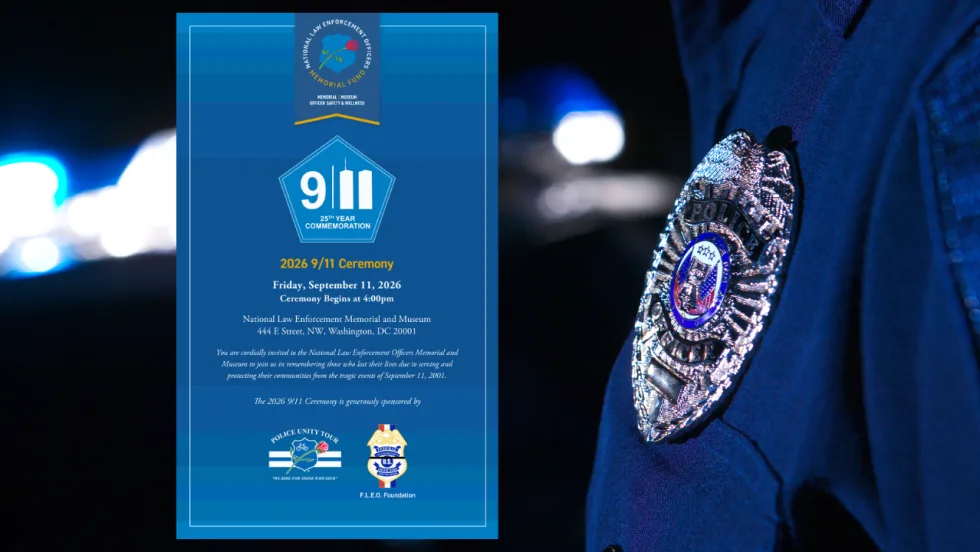
National Law Enforcement Memorial and Museum Hosting 9/11 25th-Year Commemoration Ceremony
The National Law Enforcement Memorial and Museum is hosting a 9/11 25th Year Commemoration Ceremony on Sept. 11 at 4 p.m.
Read More →
National Law Enforcement Officers Memorial Fund Announces June 2026 Officers of the Month
The National Law Enforcement Officers Memorial Fund (NLEOMF) named 15 officers of the Chico Police Department (California) as the Officers of the Month for June 2026 for their roles in responding to an active-shooter incident at a public library.
Read More →