



Right to Counsel
Law enforcement officers are quite familiar with the court-created "right" to counsel established by the Miranda opinion, to protect the Fifth Amendment trial privilege against compelled self-incrimination. But it applies only during police custodial interrogation.

Law enforcement officers are quite familiar with the court-created "right" to counsel established by the Miranda opinion, to protect the Fifth Amendment trial privilege against compelled self-incrimination. But it applies only during police custodial interrogation.
A separate, independent right to counsel is provided by the Sixth Amendment to the Constitution itself. This one guarantees an "accused" person the assistance of counsel for his defense in a criminal prosecution. It differs from the Miranda rule in several important ways. You should be aware of the Sixth Amendment basics affecting criminal investigations and the admissibility of evidence.
The Massiah and Wade-Gilbert Rules
Two years before Miranda, the Supreme Court ruled that a suspect's statement could not be used to prove his guilt at trial if it was "deliberately elicited" from an indicted defendant after he had retained counsel while counsel was not present. (Massiah v. U.S.) This rule became known as the "Massiah exclusionary rule."
In two subsequent decisions, U.S. v. Wade and Gilbert v. California, the court created a similar rule with respect to the admissibility of pretrial identifications. After a suspect has been indicted and has obtained counsel, he has a right to have counsel present during a lineup; if the lineup is conducted without counsel's presence, evidence of any ID made there cannot be used in court. This is the "Wade-Gilbert rule."
Attachment of the Right to Counsel
Not all states use a grand jury indictment to charge defendants. Some use a criminal complaint or other means. To cover the various procedures that might trigger the Sixth Amendment right to counsel, the court eventually declared that the right to counsel would attach by any process (including "formal charge, preliminary hearing, indictment, information, or arraignment") that might be used to initiate "adversary judicial proceedings" (Kirby v. Illinois). This means that in most jurisdictions, the Sixth Amendment right to counsel will arise either at the time of indictment or of the first court appearance after formal charges, whichever comes first.
"Offense Specific"
Because the constitutional right to counsel exists to provide a lawyer's assistance for an accused layman both at trial and during "critical stages" of pretrial procedures, this right only applies to cases where adversary judicial proceedings have begun. In the past, some courts tried to expand this protection to cover any "closely related" cases as well.
For example, suppose a robbery suspect has not yet been charged with robbery, but has been indicted for unlawful possession of the weapon used during the robbery. In the jurisdictions that followed the old "closely related" doctrine, the attachment of the Sixth Amendment to the weapons charge would have prevented officers from obtaining an admissible statement or lineup ID on either case without counsel. In Texas v. Cobb, however, the Supreme Court rejected the closely related doctrine and ruled that the constitutional right to counsel is "offense specific," meaning that it only applies to the specific charges for which the defendant has been indicted or arraigned.
Cobb burglarized a residence and killed the woman and infant he found inside. Because he buried their bodies in the woods, these victims had not been found when he was arrested, charged, and given counsel on the burglary charge. Without his attorney's presence, police questioned Cobb about the disappearance of the mother and child, and obtained incriminating statements. At Cobb's subsequent murder trial, he moved to suppress his statements on Massiah grounds. The state court, applying the theory that the charged burglary and the uncharged murder were so closely related that attachment on one meant attachment on the other, suppressed his statements.
Reversing the Texas court, the Supreme Court ruled that the closely related doctrine has no application to Sixth Amendment issues. The court held that Massiah does not prohibit prosecutorial use of statements on cases as to which no adversary judicial proceedings have begun.
Unless a state gives criminals greater protection under its state constitution than they have under the Sixth Amendment, the Cobb ruling means that the Massiah and Wade-Gilbert rules will only apply to the specific crimes the defendant has been indicted or arraigned on (or other first appearance made), and will not prohibit lineup ID or questioning as to other crimes, even though they are related to the charged case.
Assertion and Waiver
In some situations, you can obtain a valid waiver of the Sixth Amendment right to counsel for both questioning and lineups. If the right has attached (such as by indictment or arraignment), but the defendant has neither retained nor requested an attorney nor had an attorney appointed to represent him, a Miranda warning and waiver will suffice to make subsequent statements or ID admissible over Sixth Amendment challenges (Patterson v. Illinois).
On the other hand, once adversary judicial proceedings have been initiated on a case and the defendant has either hired a lawyer, or asked for one or accepted appointment of one, you cannot obtain a valid waiver for police-initiated questioning or lineup on that case without the attorney's presence (Michigan v. Jackson). Therefore, if you wish to try to get an admissible statement or lineup after indictment, you must secure a waiver of counsel before your suspect requests or obtains an attorney.
Informants and Undercover Officers
Once the Sixth Amendment right to counsel has attached, any statements elicited by your agents, even undercover, cannot be admitted to prove guilt on the charged crime (U.S. v. Henry). However, you can ask informants to report any volunteered statements the defendant makes on his own, provided you do not instruct the informant to provoke discussions and do not give him or her any incentive to do so.
The informant must behave strictly as a "passive listening post," passing along what he or she overhears without any guidance or reward from you (Kuhlmann v. Wilson).
Use of Statements for Impeachment
Statements that are inadmissible in the prosecutor's case-in-chief under Miranda may be used to impeach the defendant if he testifies to a different story. Statements that are inadmissible under Massiah may also be admitted for impeachment (Michigan v. Harvey).
The Supreme Court has said in both instances that court-created exclusionary rules cannot be used as a shield to commit perjury. This makes it important for you to report all statements you obtain from the suspect, even though you may believe they are inadmissible. Allow the prosecutor the opportunity to evaluate their admissibility, and perhaps to preserve them for possible impeachment evidence.
Miranda and Massiah Distinguished
There are some basic differences between Miranda and Massiah, and the two should not be confused. It is entirely possible that a particular statement might be admissible under Miranda, but inadmissible under Massiah, and vice versa.
Miranda applies only if the suspect is in custody; Massiah applies either in or out of custody.
Miranda custody arises at arrest or equivalent physical restraint; Massiah attaches by indictment or first court appearance.
Miranda does not prohibit undercover questioning; Massiah allows passive listening, but no active undercover questioning.
Remember, if you plan a lineup or questioning of someone who is already facing adversary judicial proceedings on the case you're investigating, it's best to review the Wade-Gilbert and Massiah principles with your local prosecutor beforehand.
Devallis Rutledge, a former police officer and veteran prosecutor, is Special Counsel to the Los Angeles County District Attorney.
More Patrol

Streamlight Portable Scene Light III Wins 2026 OH&S New Product of the Year Award
Streamlight’s Portable Scene Light III has won the 2026 Occupational Health & Safety (OH&S) New Product of the Year Award in the Lighting category.
Read More →
Adept Armor Introduces Two New Rifle Plates
Adept Armor has launched two new Level IV ballistic plates, the Emperor and the Archon Mark 2, which brings Adept Armor’s new Quatroid ceramic to the high-threat, performance-value center of the range at 5.2 pounds.
Read More →
POLICE Product Test: Benchmade Bailout
The Benchmade Bailout is a slim, lightweight carry knife with a deep-ride pocket clip and comes in a variety of blade steels and scales. Here is a detailed review of the Taiga Green Bailout, released earlier this year.
Read More →
NLEOMF Announces July 2026 Officer of the Month
NLEOMF honored a Michigan deputy sheriff as the July 2026 Officer of the Month for rescuing a trapped driver from a burning vehicle following a Fourth of July crash.
Read More →
Streamlight to Showcase Newest Lighting Products at National Safety Council’s Safety Congress & Expo 2026
Streamlight will showcase its latest lights, including the Portable Scene Light III and the LiteBox 1Million, at the 2026 National Safety Council (NSC) Safety Congress & Expo.
Read More →
The 2027 World Police & Fire Games Set for Perth, Australia
The 2027 World Police & Fire Games (WPFG) will take place in Perth, Western Australia, from Friday, March 12 through Sunday, March 21, 2027.
Read More →
5.11 Partners with National Fallen Firefighters Foundation to Support #ForThe343
5.11 has joined the nationwide movement honoring the 343 New York City Fire Department firefighters lost on Sept. 11, 2001.
Read More →
Team Wendy Announces Title Sponsorship of the Jorge Pastore Foundation
Team Wendy’s 3-year partnership with the Jorge Pastore Foundation expands access to programs that strengthen those who serve.
Read More →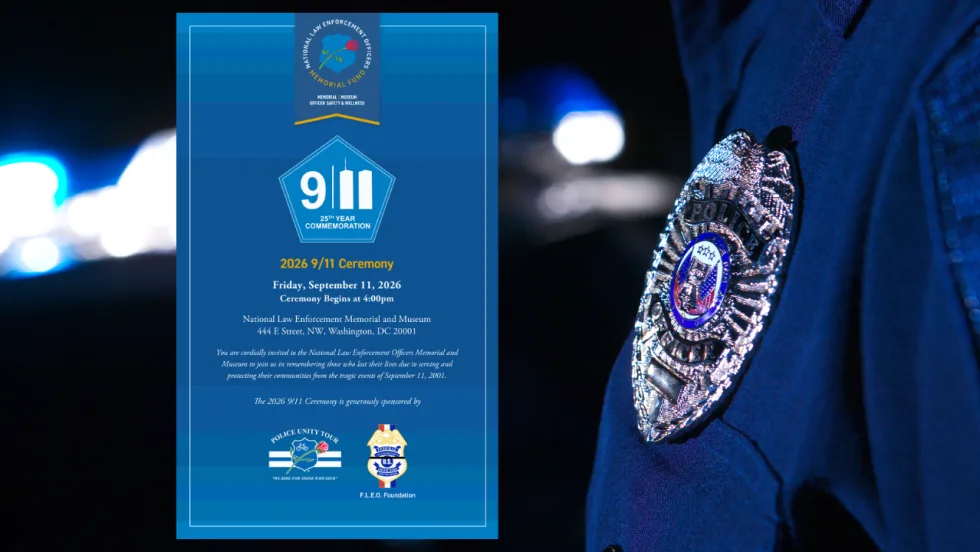
National Law Enforcement Memorial and Museum Hosting 9/11 25th-Year Commemoration Ceremony
The National Law Enforcement Memorial and Museum is hosting a 9/11 25th Year Commemoration Ceremony on Sept. 11 at 4 p.m.
Read More →
National Law Enforcement Officers Memorial Fund Announces June 2026 Officers of the Month
The National Law Enforcement Officers Memorial Fund (NLEOMF) named 15 officers of the Chico Police Department (California) as the Officers of the Month for June 2026 for their roles in responding to an active-shooter incident at a public library.
Read More →