



Know Their Flight Plans
When it comes to apprehending fleeing suspects, understanding the tactics being used by those suspects is as important as understanding the tactics practiced by law enforcement. The criminal element has learned how law enforcement operates and criminals have adjusted their tactics.

When it comes to apprehending fleeing suspects, understanding the tactics being used by those suspects is as important as understanding the tactics practiced by law enforcement. The criminal element has learned how law enforcement operates and criminals have adjusted their tactics.
Many suspects running from officers are captured every day; however, a greater number get away. All of these suspects can immediately share their stories with fellow criminals either in a jail setting, if they were caught, or at home with friends if they escaped capture. These stories of success and failure certainly travel quickly through the criminal population.
You can also bet that criminals watch shows like “Cops,” “LAPD: Life on the Beat,” and numerous documentaries on specialized police units. All of these shows were designed to educate and entertain the law-abiding public on what it’s really like to be a cop in the United States, but criminals also watch these shows to educate themselves on police tactics.
The result is that when an “educated” criminal sees a patrol car in the rearview mirror, he has tactics in mind to avoid capture and is ready to put those tactics in motion if confronted.
Law enforcement must meet the challenge of “educated criminals” head on by continuing to modernize equipment and developing new tactics. In other words, the best way to counter the bad guys’ attempts to foil our tactics is to study their tactics and share what we learn with our fellow officers.
When it comes to discussing suspect tactics nothing is written in stone. Every suspect and every chase is unique, but trends do emerge.
None of the suspect tactics about to be discussed is guaranteed to occur when an officer chases his or her next suspect, but they have been used numerous times in the past by suspects all over America.
During foot pursuits 20 years ago, it was very common for suspects to run a short distance and grab the first good hiding place. Search teams quickly located many of these suspects hiding inside sheds, under houses, and behind bushes. Today this still occurs on occasion, but it has become the exception to the rule. More and more suspects are being located a great distance from where they were last observed by officers and many are hiding in close proximity to an officer assisting with a containment.
Running Until Confronted
This trend clearly indicates that most suspects are no longer content to grab the first hiding spot and wait for K-9 or SWAT to come and get them. They are running as fast and as far as possible until they are forced to grab a hiding spot. They are running until confronted by law enforcement.
In this case, “confronted” does not necessarily mean an officer with gun drawn standing in front of the suspect. The confrontation is the perception in the mind of the suspect that the police are about to catch him. It may be the sound of approaching police sirens, or the reflection of emergency lights on a building, or a police helicopter arriving overhead, or a patrol car screeching to a stop at the corner that causes the suspect to now find a place to hide.
More and more suspects are found hiding at the far edge of even large containments, many times within feet of a patrol car. Some of these suspects have stated that the only reason they stopped running was the sight of the patrol car at the corner. The officers in their patrol cars never observed the suspects, but the officers’ mere presence deterred a suspect from crossing a street and running out of the containment area.
Finding suspects hiding in the last bush of the last yard of the last block of a containment area is a common occurrence. This suspect tactic alone should keep officers working a perimeter on their toes at all times. The suspect could be hiding in close proximity to the location of an officer and may be watching the officer’s every move.
The Path of Least Resistance
Studies have been completed in an attempt to place a probability on what direction a suspect who is fleeing the police will turn. These studies are interesting and I am sure they have some scientific merit, but only in a world without obstacles.
In the real world of fences, walls, gates, dogs, razor wire, trees, brush, vehicles, and any other obstacle you can think of, suspects most often take the path of least resistance.
This path has the fewest and easiest obstacles to deal with while running from the police.
Consider a suspect who is running from officers. She runs down a driveway into the backyard of an urban residential neighborhood. She observes a five-foot fence with a dog behind it to the right, a seven-foot chain link fence with razor wire straight ahead, and a three-foot fence to the left. Even at a sprint, her choice is simple: Go left over the easiest obstacle.
Do some suspects still go straight into the razor wire or right over the fence with the dog? Absolutely. But very few will do that. Most suspects who choose to take a more difficult route have a particular location they are attempting to get to. Understanding this tactic can make a difference in capturing a suspect.
Running Through the Block
Suspects have learned that if they move quickly through a block, cross the street, and enter the next block it is very challenging for officers to stay a step ahead. Even agencies that are very good at setting up quick containments will be challenged by the suspect who does this.
A suspect with average speed and agility can run through the width of a block in approximately 20 seconds. That is with a couple of fences. Twenty seconds is not a long time to get an officer to block the path of the suspect. Take away the fences and you can cut five to 10 seconds off that time.
It is very important for responding units to think of this tactic when deciding exactly where to respond to contain the suspect. Think about how long it took to get to the scene and what kinds of obstacles there are inside the block. A decision to contain two blocks instead of one is a good one in many cases, especially if the suspect is a serious felon.
[PAGEBREAK]
Doubling Back
This popular tactic has been documented numerous times and is one that causes problems for officers on a regular basis. Understanding this tactic will make it clear to officers that they shouldn’t assume that a suspect last seen in a certain direction will continue in that direction.
Many suspects begin running one way and quickly go the opposite direction after officers have lost sight of them. This is a very conscious decision by the suspect, and it is one escape tactic that has been used successfully many times.
There are two very common examples of this tactic. The first involves any block with an alley. The suspect is being chased by officers down a sidewalk. At some point, the suspect turns into the block running between the houses. When the suspect reaches the alley, he or she turns and runs down the alley. The officer observes this turn and assumes that the suspect will continue running down the alley in the same direction he turned. The suspect does continue in that direction, but only for a short distance. Then he or she enters a rear yard on the opposite side of the block and turns back in the opposite direction, moving quickly through yards out of the officers’ view. The suspect then continues running out of the block or hide.
The second example is identical in the path taken, but without the alley. It has been used to return to a vehicle that the suspect just bailed out of moments before. The suspect appears to be making a turn in a particular direction while still in view of the officers, and then he or she doubles back. The officers must show discipline and not be fooled by this action. By containing the entire block and not making any assumptions, you cover all the options. Of course, some suspects make that turn and keep running in that direction as far as they can. Containing the block controls that possibility as well.
Into an Alley
In addition to the use of an alley for a double-back, the alley itself raises a significant concern for an officer chasing a suspect. Once a suspect reaches an alley, he can run without any obstacles for a considerable distance. The time it takes to get out of that block is cut down dramatically for obvious reasons. Many suspects choose to bail out of vehicles in alleys for that very reason. They are able to put distance between themselves and the officers very quickly.
One tactic that has been used is for the suspect to drive into an alley only a few yards before bailing out and running down the alley. The car that the suspect just bailed out of is now blocking officers from chasing the suspect with their patrol cars and they are forced to chase on foot, which is to the suspect’s advantage in the majority of cases.
Officers need to think a step ahead when they see that the suspect is about to run into a block with an alley and consider their options.
Crossing Highways
Desperation on the part of the suspect causes actions that are not reasonable at times. Running across any heavily traveled highway has great risk but can be beneficial to a suspect.
A suspect who runs without hesitation across a highway during a foot pursuit achieves the same result as a suspect in a vehicle pursuit who runs through mid-phase red traffic lights without slowing down; he puts distance between himself and the pursuing officers. Suspects know that officers will slow down and even stop before crossing the highway or going through the red light, and that creates space and time for the suspect. Once the suspect reaches the far side, he or she has time to move without an officer right on their heels.
If the officer is not prepared and does not respond quickly to this tactic, the suspect will probably not be captured. Officers must think a step ahead when they see this possibility in front of them and immediately advise responding units that the suspect may cross a highway and some units should respond to that side of the highway without delay.
Drainage Pipes
Many cities and towns have drainage pipes that are large enough to run through without even ducking to avoid hitting your head. I am not sure if this is a rapidly growing trend or a tactic that’s always been used by criminals and we are just catching on, but it is now very common.
Suspects are entering these pipes, moving a considerable distance through darkness, and then popping up through manhole covers blocks from where they were last seen by officers. If the officer observes the suspect enter the pipe, immediate action must be taken by responding units.
The primary officer should contain the opening, look at the direction of the pipe, and advise units to contain an area in that direction, reminding them to watch the manhole covers for several blocks.
The most common response to this tactic is for all of the responding officers to go to the opening of the pipe. Generally, this doesn’t work. While the officers are standing there formulating a plan to enter the pipe and capture the suspect, the suspect is two blocks away, walking away after coming out of a manhole. Clearing the pipe with a search team may be required at some point, but containing the surrounding manhole covers and escape routes should be the priority.
What about going right into the pipe after the suspect? This may not be a good idea. If the suspect is known to be armed, entering that pipe in most cases has much greater risk than benefit. Being inside a concrete or steel pipe when shots are fired is not a good thing. In addition, communication may be inhibited or nonexistent inside of the pipe, so you may be cut off from backup.
There are two final factors that affect officer safety in this scenario. Most pipes are very slippery and very dark. Even having a flashlight will not help your footing inside of the pipe. All of these things can affect officer safety and should be considered prior to entering any drainage pipe in pursuit of a suspect.
Jack H. Schonely is the author of “Apprehending Fleeing Suspects.” He has 24 years of experience in law enforcement, including more than 20 years with the Los Angeles Police Department. His duties have included patrol, vice, K-9, and air support.
This article was excerpted from “Apprehending Fleeing Suspects: Suspect Tactics and Perimeter Containment” by Jack H. Schonely. The book is available from Charles C. Thomas Publisher Ltd., www.ccthomas.com, and from Amazon.com.
More Patrol

Adept Armor Introduces Two New Rifle Plates
Adept Armor has launched two new Level IV ballistic plates, the Emperor and the Archon Mark 2, which brings Adept Armor’s new Quatroid ceramic to the high-threat, performance-value center of the range at 5.2 pounds.
Read More →
POLICE Product Test: Benchmade Bailout
The Benchmade Bailout is a slim, lightweight carry knife with a deep-ride pocket clip and comes in a variety of blade steels and scales. Here is a detailed review of the Taiga Green Bailout, released earlier this year.
Read More →
NLEOMF Announces July 2026 Officer of the Month
NLEOMF honored a Michigan deputy sheriff as the July 2026 Officer of the Month for rescuing a trapped driver from a burning vehicle following a Fourth of July crash.
Read More →
Streamlight to Showcase Newest Lighting Products at National Safety Council’s Safety Congress & Expo 2026
Streamlight will showcase its latest lights, including the Portable Scene Light III and the LiteBox 1Million, at the 2026 National Safety Council (NSC) Safety Congress & Expo.
Read More →
The 2027 World Police & Fire Games Set for Perth, Australia
The 2027 World Police & Fire Games (WPFG) will take place in Perth, Western Australia, from Friday, March 12 through Sunday, March 21, 2027.
Read More →
5.11 Partners with National Fallen Firefighters Foundation to Support #ForThe343
5.11 has joined the nationwide movement honoring the 343 New York City Fire Department firefighters lost on Sept. 11, 2001.
Read More →
Team Wendy Announces Title Sponsorship of the Jorge Pastore Foundation
Team Wendy’s 3-year partnership with the Jorge Pastore Foundation expands access to programs that strengthen those who serve.
Read More →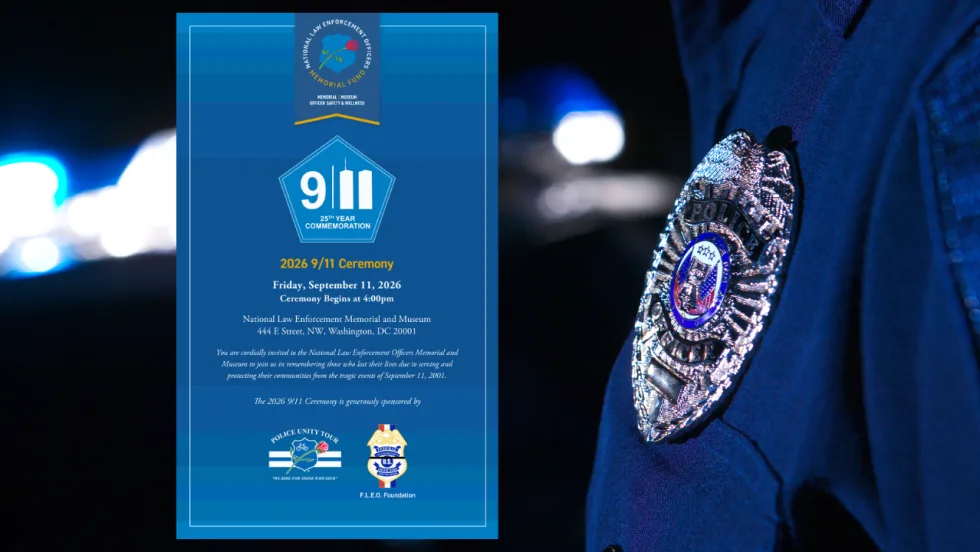
National Law Enforcement Memorial and Museum Hosting 9/11 25th-Year Commemoration Ceremony
The National Law Enforcement Memorial and Museum is hosting a 9/11 25th Year Commemoration Ceremony on Sept. 11 at 4 p.m.
Read More →
National Law Enforcement Officers Memorial Fund Announces June 2026 Officers of the Month
The National Law Enforcement Officers Memorial Fund (NLEOMF) named 15 officers of the Chico Police Department (California) as the Officers of the Month for June 2026 for their roles in responding to an active-shooter incident at a public library.
Read More →
Team Wendy App Creates New Digital Hub for Helmet Owners
The Team Wendy Community App provides one location for warranty registration, size-fit tools, product updates, and community connection. For helmet owners, the new app creates a simpler path to the information and tools that matter most.
Read More →