



NC Department Focuses on Women in Policing, Recruiting
“The policing profession is historically male dominated. We have to acknowledge that, and we have to do everything in our power so that women feel welcomed from all walks of life and all cultures. Those are intentional conversations we had when we launched 30x30,” says Capt. Gene Lim, part of the CMPD recruiting division.

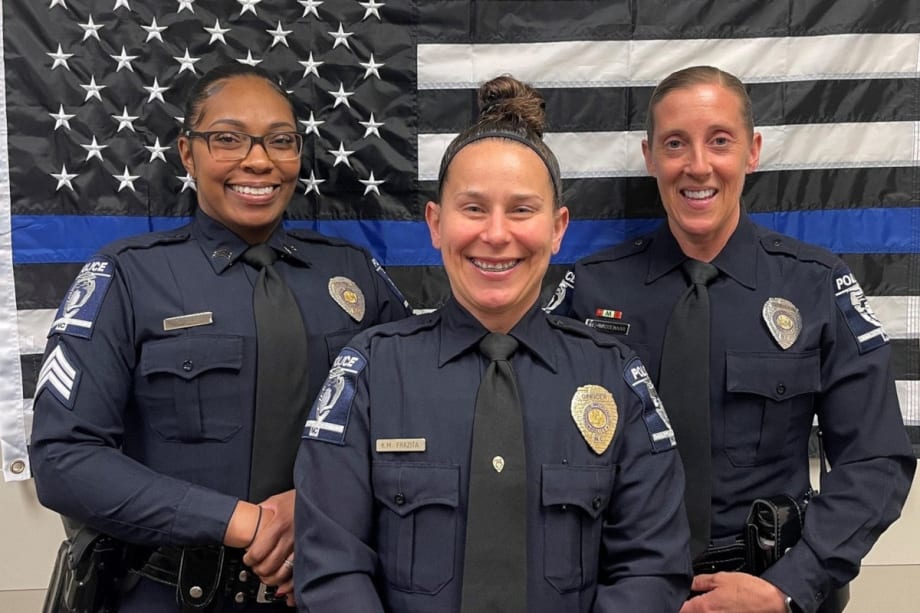
Charlotte-Mecklenburg Police Sgt. Candace Miles, Officer Kristina Frazita, and Officer Jean Wassenaar shared their individual stories about their careers in a post for Women’s History Month on the department’s website.
Photo: CMPD
There is a growing effort within law enforcement to not only recruit more women into the profession but to also make sure departments improve the experiences and opportunities for women in what traditionally has been a male-dominated workplace.
Nationwide, less than 13% of sworn law enforcement officers are women.
The Charlotte-Mecklenburg Police Department is among many departments that have signed the 30x30 Initiative pledge to have recruiting classes comprised of 30% women by 2030. The 30×30 pledge is a series of no-cost or low-cost actions policing agencies can take to improve the representation and experiences of women in sworn positions in all ranks. The initiative was co-launched more than a year ago by the National Association of Women Law Enforcement Executives (NAWLEE) and the New York University School of Law Policing Project.
The department formalized its focus on women in policing by signing the pledge this past October. But CMPD is already ahead of many other departments since currently 15% of its officers are women. The department, at this point, is comprised of more than 1,900 sworn officers, 500 civilian employees, and 600 volunteers. Women can be found throughout the ranks.
“The policing profession is historically male dominated. We have to acknowledge that, and we have to do everything in our power so that women feel welcomed from all walks of life and all cultures. Those are intentional conversations we had when we launched 30x30,” says Capt. Gene Lim, part of the CMPD recruiting division.
Even before the commitment to 30x30, women have excelled at the Charlotte-Mecklenburg Police Department.
“Up and down the organization the long and the short of it is there are females in every role – detective, officer, community officer – I can’t think of a single place that we don’t have female representation within our organization,” says Lim.
For Lim, he fully understands what it is like to have women rise to the higher ranks within a police department. In many instances during his more than two decades with the department, his supervisors have been women.
“My particular experience and what I tell people, is I was blessed in my 23 years to have six direct female leaders. I’ll go one further, they were all African-American females,” he says. “You want to talk about some of the best people, some of the best leaders, that is what I see and that’s why I’m so passionate about these initiatives.”
Recruiting
“We’re really taking a look at being intentional in all of our processes right now and events that we do. One of the things I came up with, Sgt. Candace Miles, is having significant recruiting events when we have significant events in women’s history,” Lim explains.
The department this year is making sure to have a recruiting presence align with key women-specific observances. Just a few weeks ago on International Women’s Day, the department hosted an event solely focused on female recruiting. Later in the year, on Sept. 12, they will host a similar event for National Police Woman Day. For Women’s History Month, the department also posted a blog sharing the stories of three women on the force.
Miles points out that recruiting, not only of women but of men also, is tough nowadays. The workforce is different and across the country there has often been negative sentiment against police in social media, protests, and media. Police in Charlotte, like most everywhere else, are hoping that will change.
“I think the pendulum will swing back to where we will get a whole bunch of applicants, how it was years ago when everybody wanted to be the police. I really think that will come back within a few years,” says Miles.
Lim says nobody can control social climate and generational changes, and recruiting efforts just have to adapt with changes. He brings a good understanding of recruiting a few years ago versus now. Lim previously worked in recruiting, took a four-to-five-year break, and then returned to recruiting in his current role.
“It’s a different world even from the mid-2010’s because the generation is changing. The workforce and what this generation looks for nowadays could be different. When I came in, I wanted a pension, a retirement, and a long-term career over decades. I’m not so sure this generation thinks like I do in that regard,” Lim says. “Opportunities come quicker, and I think they are more willing to shift where I may have been more willing to hold what I had and work toward a long-term goal.”
While it is true that across the country there is much talk about recruiting and how to land the next batch of officers, attrition is basically the flipside of recruiting and must be addressed at the same time. Lim and Miles also have to consider retention of current officers and the future ones they hire.
“What we are up against, as well as other agencies, is just retention,” Miles says.
Staffing relates to two elements, recruiting and retention, and Miles and Lim say they are confident in the Charlotte-Mecklenburg Police Department’s ability to take on the varied challenges on both fronts.
“I think we just need to focus on what we can do every day and it has to be very, very intentional. No idea is a bad one when you’re trying to put something together. You just continue to look at all the angles and what you can do in your locus of control to make that positive change,” Lim explains.
Roadmap to 30
The Charlotte-Mecklenburg PD already had women throughout its ranks, however, it was a man who spearheaded the department’s pursuing 30x30. Wiley Ross, a relatively new human resources representative in the department and a former police officer from Cincinnati turned civilian, led the charge.
“He played a huge role in finding the initiative, following up, and bringing it to our attention that it was a national initiative for what we were trying to do anyway,” says Lim.
When a department signs the 30x30 Initiative pledge, a framework is there to guide them through very deliberate steps. Phase 1, which is intended to take place in the first six months after the signing of the pledge, entails what the 30x30 Initiative deems as “Immediate Action Items.” Phase 2 focuses on diagnostic data and demographics and outlines many steps that a department should take to advance women in the field and increase the percent of women in recruit classes.
Another large part of the process after taking the pledge is planning. Departments are expected to craft a strategic plan to advance women in policing. Work on that task begins six months after signing the pledge with the expectation it will be completed and due within 24 months of the pledge signing.
“It started out with some very intentional monthly meetings all the way up to the deputy chief level. Two of our four deputy chiefs within the organization are female and we brought them into the fold obviously along with a lot of female leadership and officers to meet and talk about what it would take to better ourselves. We’re doing great, but we need to get better,” Lim says.
He points out the upcoming climate culture survey will internally note the pulse of the department regarding women officers, what are the feelings, and what are the areas of opportunity that need focus at all ranks, officers to deputy chief level. Miles says that survey establishes baseline data and looks at the number of female sworn officers within the agency, the demographics, and where women are in different ranks.
“The survey, it is pretty much saying how have you been treated, not only as a female within this department but also being a minority. Has it been fair, what are some things that you would like to change if there are any or how can we improve to continue to retain more women and then do a better job at recruiting more women?” she says. “The survey is very in depth. It gets, I don’t want to say personal, but being a female in the position that I am in now it is personal to me because of the simple fact that it affects me because I am a woman, and I’m a woman of color at that.”
“So, I would like to see a lot more representation of women within this agency and since I am onboard with it along with other women within rank within this agency, we always look at the ways how we can strategically plan to advance women in policing,” Miles says.
Once that data is compiled, Miles says they will look at it collectively to see how the department can improve, what has been working, and how to better the things that are already working. She says the survey will be pushed out within the agency this upcoming quarter.
“When you look at the 30x30 Initiative and goals, I would put our organization up against it and it is a relief to know we are doing a lot of those things already,” Lim says. “I think more departments need to take a keen look at what this is and take the pledge.”
Recalling The Past
Lim’s experience with the department bridges decades, and with that experience he understands how women are being incorporated more within the department now versus when he began. CMPD now has a multitude of women officers in varying roles such as police training officers (PTOs), four K-9 officers, one SWAT female officer, one SWAT female sergeant, and women working in vice, narcotics, and the gun crime suppression team. He tried to think of even just one unit at the department that does not have a female officer but could not.
Women shaped Lim growing up as he was raised by his grandmother and mother. He also now has to understand the female viewpoint better since he is raising a daughter, which he calls being “a girl dad.” He says he knows there are barriers and things he doesn’t even understand, but that was even more the case earlier in his career.
“It is one of those things that you kind of don’t know what you don’t know, especially in your youth,” he said. “As I look back with perspective now, I understand there were invisible walls for females coming into this profession just based on the sheer nature of the volume of males. It was an extremely male dominated profession in those days.”
However, now he shares a picture of a department that is taking steps for and creating opportunities for women to thrive in a law enforcement career more than in the past.
“When you talk about creating opportunities, I think an organization that is trying to do what CMPD is doing, increasing females in the ranks and obviously improving the culture, you have to have allies on the other side as well. That is what I consider myself to be. I consider myself to be an ally to that cause because I have seen and worked with some amazing females throughout my career,” he said.
A Woman’s Perspective
Miles, now a sworn officer with CMPD for 11 years, never intended to be a cop. When she was a youngster years ago, police officers were not even liked in her neighborhood.
“Initially, I never wanted to be a police officer, ever,” she says.
Her family move to Charlotte when she was 4 and Miles grew up on the westside of town, which she described as a rough area at the time.
“Seeing police in my neighborhood, it was kind of like ‘don’t talk to them’ type thing,” she recalls. “But there was always something in the back of my mind where I wanted to serve.”
Both of her parents were in the military, but they persuaded her not to follow that career path. Even at that point, she was not considering law enforcement as a career. She was in college, amassing student loans, and just felt like she was not on the right path. But she had close friends who worked at the police department.
“They kind of showed it to me. They said, ‘Candace it’s not about you’,” she says. “In the moment I was like ‘It’s my career, it’s my life, it is about me’.”
Miles said she took time to think about what her friends had told her.
“It wasn’t about me. It was bigger than me. I had the ability to touch other people who grew up like me or had the same mind frame as me of ‘I don’t want to talk to the police’,” she explains of the revelation she uncovered. “I realized cops aren’t that bad. They’re cool, they’re human beings just like I am.”
That desire to serve others, and her community, was the motivation that fueled Miles through the police academy and still drives her efforts today as she recruits others to follow in her footsteps and choose a law enforcement career.
She, as a female officer, now explains to other women what it will be like if they follow the same career choice.
She knows other women will face challenges when they choose to become a police officer. She says they may have self-doubts when family or peers question the choice, concerns of how they will be perceived once they finish the academy and put the uniform on, and women may have to work twice as hard in the academy because they will be up against some other cadets that are more physically fit or stronger. Facing physical challenges at the academy can be daunting, but as Miles points out those challenges serve as motivation. If women recruits push past, they can find a rewarding career ahead.
“I explain to them that it is rewarding despite what you see or read within the news or social media. It is the complete opposite,” Miles says. “If it is something you want to do, not only do you have to have the drive for it but you have to have the willingness to overcome obstacles. It’s male driven agencies, but if you put your mind to it, you can do it and nothing should stand in your way.”
More Procedures & Policies
No Waiting: Detective Busts Missing Persons Myth
Detective David Lee Stephens wants the public and every law enforcement agency to know there is no truth nor logic to the widely held belief that one must wait 24 or 48 hours to report a missing person.
Read More →
Trump Issues Executive Order He Says Will Help Police Fight Crime
“My Administration is steadfastly committed to empowering State and local law enforcement to firmly police dangerous criminal behavior and protect innocent citizens,” Trump said.
Read More →NYPD Restricts Vehicle Pursuits to Suspects Wanted for Serious Crimes
The revamped policy, which takes effect Feb. 1, bars police from pursuing suspects for traffic infractions, violations or non-violent misdemeanors, police Commissioner Jessica Tisch said.
Read More →NYPD Going “Old School” with Uniform, Facial Hair Policy
“It’s absolutely ludicrous that you have an officer with pink hair and nails longer than their fingers,” one Manhattan officer said. “We’re a police department not a hip hop department. Let’s go back to being police officers.”
Read More →AZ POST Considers Revision to Marijuana Rules for Recruits
“My recommendation for your consideration is we go for a six-month window,” said Matt Giordano, executive director. “We would go to six months of the last use.
Read More →
Time to Change Our Pursuit Policies
Complicated guidelines that require officers to make decisions during the heat of the moment are not working.
Read More →Baltimore Police Complying with Key Consent Decree Requirements, DOJ Says
If the court grants the motion, BPD must maintain compliance with the provisions for one year before the court can terminate these sections of the consent decree.
Read More →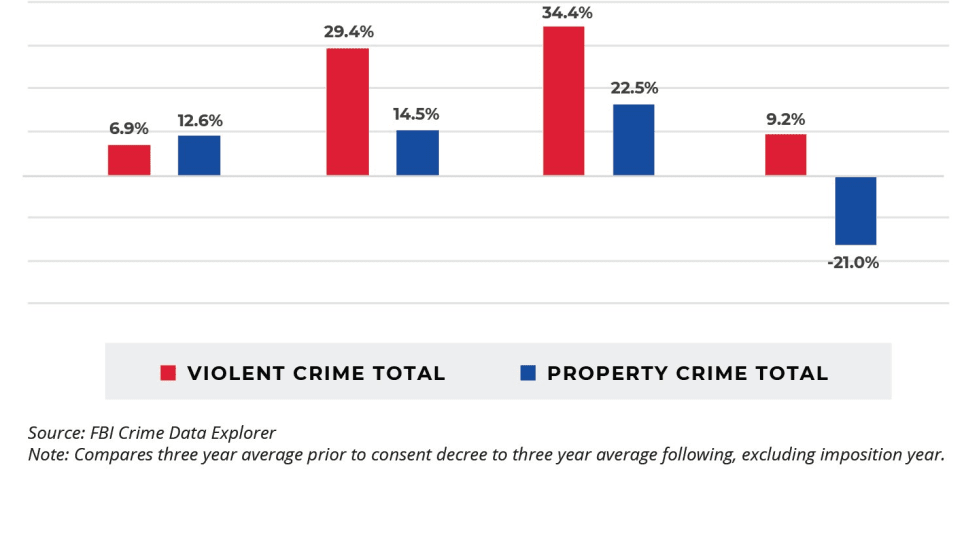
Study Finds Consent Decrees Onerous, Ineffective, and Often Harmful
The report concludes: “When a consent decree is truly warranted, it must focus on the most urgent concerns. The violations should be clearly identified and fully supported by rigorous evidence."
Read More →DOJ and Consent Decree Monitor Praise Albuquerque PD for Reforms
Monitors tracking civilian oversight, one of the largest remaining roadblocks in reaching full compliance, called it “a mess” that was being cleaned up, and advocates applauded the work done by the department to come so far, so fast.
Read More →
Portland Loosens Restrictions on Vehicle Pursuits
“We have seen a significant propensity for criminal suspects to elude traffic stops, often driving extremely dangerously despite no officers chasing them,” the Bureau said in a statement.
Read More →