



High-Tech System Streamlines Reports
It's not that I begrudge writing reports, although I certainly appreciate anything that makes the job easier. But I am always looking for other ways police departments help officers handle reports quicker, such as Coplogic.

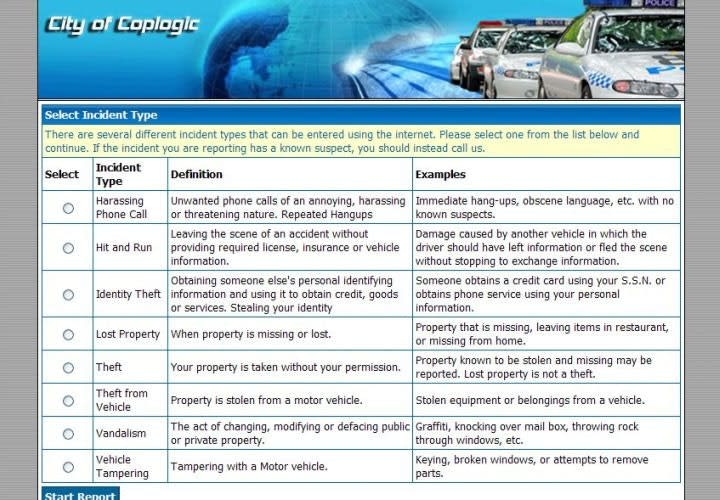
Screen shot of Coplogic's DeskOfficer Online Reporting System (DORS).
One thing that's bugged me for the better part of three decades is the amount of redundant and wholly unnecessary paperwork. OK, maybe not wholly unnecessary. But paperwork that could certainly be streamlined.
It's not that I begrudge writing reports, although I certainly appreciate anything that makes the job easier. For instance, I like Dragonspeak software, and will happily prostitute myself more aggressively on its behalf the day I fall in love with it (like when its recognition accuracy approaches 99 percent).
But I am always looking for other ways police departments help officers handle reports quicker.
Some allow their officers to dictate reports that are then transcribed by highly appreciative secretaries.
Others re-formulate their forms so as to have as many check-off boxes as possible (I'm sure somewhere out there is a homicide check-off report form).
If you were a deputy working Temple City in the mid-'80s, you had a pretty good chance of getting a citizen holding a misdemeanor suspect arrest right out the gate. Often, this was at the K-Mart right next door to the station.
Security at the time told me that a million dollars worth of unpaid merchandise walked out the front doors every year. This was why every time some dude got busted for stealing some hair restoration product he was too embarrassed to buy, they flagged him for me or whoever happened to be on that day.
Besides a collective waste of time relative to the dollar amount loss and the likelihood of the case getting filed, it was a son-of-a-bitch filling out the dull, boring attendant report forms. But we did it. And I always wondered why the hell we had to since the security guards inevitably had already written their own statement of facts incident to their arrest of said perp.
But ours was not to ask, but to do, so like every other lemming I went along with the program.
Well, one nice thing about trade shows is you get to see things you don't get to see if you work for the Pauper Police. And such was the case last week when I checked out a relatively new report generating system.
The Coplogic Online report filing system allows law enforcement agencies to make their report forms available via cyberspace. Visitors to an agency's Website can then download the forms and fill out the paperwork themselves ("I, John Citizen, being of questionable sanity and dull-normal IQ, left my Rolex watch and wallet in plain view atop the dashboard of my personal vehicle which was parked outside a biker rally...").
Aside from getting reports processed that much quicker, citizen use of such forms frees up cops so that they can get back into the field sooner. San Francisco launched the system and within the first month of going live was able to receive 10 percent of its reports online. Fremont (Calif.) PD consistently receives 20 to 30 percent of its reports online every month through the application.
It really alleviates the amount of time officers spend out in the field taking calls that really don't require a police presence, while allowing the citizens to not be inconvenienced by not waiting for a response time and being able to make sure that the information that they want to be in a report is inside that report. They also receive a PDF copy of that report via e-mail. So even the front desk personnel of the agency benefit by not having a long line of citizens requesting copies of reports. Being able to handle minor incident reports online allows victims of major crimes to be cared for more quickly. Reports can be filed online or at a lobby kiosk, freeing up the desk officer's time.
Fremont (Calif.) PD recovered 3,500 manhours over a six-month period. Stockton (Calif.) PD recovered 1,300 hours in just one month.
Methods of getting the word out vary, with some police agencies advertising their report forms through Website or dispatch referral; others issue press releases. Many will incorporate multiple approaches.
According to Andrew Cartwright, executive director of Coplogic, one of the cool things about the system is that almost all installation, support, maintenance, and training is done remotely. It becomes a matter of convenience right out the gate. The system is very intuitive, and many agencies can begin to use the system based on the demo that is available.
Once completed, reports are reviewed by an officer at the agency. At some agencies it is sworn personnel, others it is civilian personnel who might otherwise be responsible for taking reports over the phone anyway.
Upon review, the report can be accepted or dismissed. The citizen is informed of the reason for rejection - which is more than some cops can hope for - or the citizen can provide the agency with additional information via the online system.
Price depends on agency size and RMS (records management system) used by the agency, as well as citizen population size. Smaller agencies can expect to pay $15,000 to $20,000, including first year support and maintenance. Larger agencies with a citizen population in the multi-millions can expect to pay $100,000 to $125,000.
More than 130 agencies are already using the system across the United States and Canada. But it's a drop in the bucket compared to how many could be (I'm sure that some agencies are probably using similarly commercially available reporting systems: More power to them).
Ancillary benefits are many. Some Massachusetts officers were able to recover property because of the information contained in the report simply because the descriptions that are coming in from the citizens are far more detailed than the ones taken out in the field. When a citizen has one major report to write that day, it's his or her own report and you're going to get every possible detail involved.
Police agencies' IT personnel like it because it is easy to install. Coplogic has been around for five years, and its staff, save for IT experts, is comprised of current or former law enforcement. They built the system with a huge insider perspective. Since then, it has been customer driven.
"Stockton PD suggested a secure site filing so security guards could file reports online," says Cartwright. "Fresno came up with an idea for us to track all of the modifications that went into a report before it is filed into their records management system, just in case one of these reports does end up going to court. Fremont came up with the idea to provide supplemental information so that officers can still respond to commercial and residential burglaries, but not have to do any data entry regarding the property. The officer is able to deal with the citizen, take the initial report, and the citizen can enter the complete data online. It doesn't require follow-up a week or two later. Citizens avoid getting upset by having to itemize everything that's missing while the officer is on scene.'
I'm not a shill for Coplogic, just someone who recognizes a good thing when he sees it. And absent any forthcoming horror stories about the product - and if you have 'em, let's hear 'em - I sincerely hope that police agencies look into Coplogic, or at least look at other ways to streamline their operations.
For more information, consider throwing this link on your chief's desk. You might be glad you did.
More Blog Posts

Preventing Heat Injury in Police K-9s
In the relentless heat of summer and even early fall in some parts of the country, officers face the important task of protecting their K-9 partners while working in sweltering temperatures. Recognizing changes in a dog’s behavior is the key.
Read More →
Why Your Agency Needs to Attend the ILEETA Conference
ILEETA is a complete resource for trainers to address trainers' needs. Its mission is to enhance the skills and safety of criminal justice practitioners while fostering stronger and safer communities.
Read More →
IACP 2023: New Training Products
Technologies for improving law enforcement training and training management were some of the highlights at this year's show.
Read More →
Initial Results Released from MSP 2024 Police Vehicle Testing
The 2024 pursuit-rated vehicles--all pickup trucks or SUVs, including two battery electric models the Chevrolet Blazer EV AWD and Ford Mustang Mach-E--were put through their paces.
Read More →
Officer Safety Considerations Related to Alternative-Fuel Vehicles
As more alternative-fuel and hybrid vehicles hit the road, police and other first responders need to understand that they are no more dangerous than conventional vehicles. However, there are certain safety considerations every cop should know.
Read More →
Garmont Working to Grow LE Market Presence
Garmont Tactical has found wide acceptance by military boot buyers, but now the company is trying to better respond to the needs of police officers. Many cops now are not fans of 8-inch boots, so Garmont is adapting.
Read More →
Publisher’s Note: Our Commitment to You
Through our magazine and website and our Police Technology eXchange event, we promise to provide you with information and access to resources to help you do your job safer and better.
Read More →
10 Tips for Responding to Mental Health Crisis Calls
The Harris County Sheriff's Office is a model for other agencies that want to learn about crisis intervention and mental health crisis response. Sgt. Jose Gomez shares the story of their programs and provides 10 tips for mental health crisis call response
Read More →
5 Things to Know When Buying Concealed-Carry or Off-Duty Holsters
Mike Barham, of Galco Holsters, shares five important considerations to keep in mind when you buy off-duty concealed or plain-clothes carry holsters.
Read More →
10 Tips for Reviewing Use-of-Force Reports
While the burden of accurately reporting use-of-force situations is on an individual deputy or officer, the person reviewing those reports shares in the responsibility of making sure the reporting is done properly, with clear details included.
Read More →