



Testing Body Cameras for Image Fidelity
The traditional gelatin-silver image reproduction film process was a very stable imaging platform with reliable, repeatable characteristics; lighting was also more consistent. In digital photography, we have to contend with many more variables and different elements involved in producing the final image.


Frames from videos of Humanoid Harry skating around taken by four different cameras, all illuminated by the same light source.
It is important to differentiate truth from hype when purchasing body-worn and security cameras. A Royal Canadian Mounted Police study found major discrepancies between the advertising claims of video system manufacturers and reality. This article’s aim is to provide information that will help the readers identify the most suitable camera for their law enforcement operations.
In my career as an architect, I have designed more than 50 police stations. My father was a police officer, so I have become close to the law enforcement community and its issues.
Also through architecture, I became interested in photography, both the artistic and technical aspects. Some years ago, while designing a plan for their community's police station, I met David Corley, who, with his wife Sue, built DSC Labs. The products of DSC Labs are used worldwide where accurate image reproduction is required. The company's main clients are in motion pictures, television, and space exploration.
The Corleys and I get together fairly regularly, and I was interested to learn from them that DSC was expanding into law enforcement. I was also surprised to hear David’s comments on the image quality in policing. In his words, "It's ridiculous that the entertainment industry, whose main goal is making good-looking pictures, is more interested in image quality than policing and medicine, where image accuracy can make the difference between a person's life and death."
This concerned me and I discovered that while there are imaging experts in law enforcement there is substantial room for improvement.
This article will discuss:
1.
Why image control is more difficult today than in the past
2.
The technology that created the problem
3.
A practical solution
Photography has changed dramatically over the last 30 years and is technically very different to the relatively simple film process of the previous 100 years. The traditional gelatin-silver image reproduction film process was a very stable imaging platform with reliable, repeatable characteristics; lighting was also more consistent. In digital photography, we have to contend with many more variables and different elements involved in producing the final image. These include:
Image display. Monitors and displays use a number of different technologies to produce an image; this results in differences between displays.
Illumination. Until the mid-20th century, light was generated by heat. The Sun, oil and gas lamps, candles, incandescent light bulbs all produce heat; even movie projectors used a burning carbon arc to illuminate the film. Today, illumination is provided by fluorescent, HID, induction, and LED systems. Each of these have different characteristics.
Printing. While the pigments change, this technology has remained relatively stable.
Producing images that accurately represent the original scene requires sophisticated systems and designs that control every aspect of the imaging process—the key variable is the light.
Light. Light consists of waves of radiant energy, but the band of wavelengths visible to humans covers a very small section of the whole spectrum.
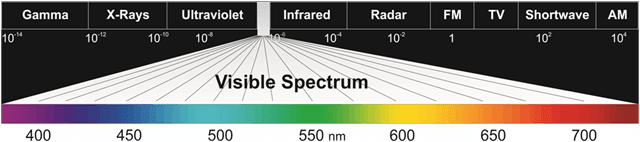
Light consists of waves of radiant energy, but the band of wavelengths visible to humans, the visible spectrum, covers a very small section of the whole spectrum.
In reality we cannot see light beams any more than we can see x-rays, unless we are either looking directly at the light source itself or when the rays strike something and are reflected.
Color and Light. These are complex concepts that are not as easily understood as they appear to be. The color of an object is a combination of the wavelengths of light shining on it and the reflective properties of the object.
Let's look at some examples.

Here we have black, white, and red cards in front of a gray panel, illuminated by white light.

Now turn off the light and everything is black. Replace the gray panel with black. The black card is still there, but we can't see it or the back panel because they are absorbing and not reflecting the light.


How do we explain these two images? We know that the middle card is white. The logical explanation is that the second scene is being illuminated with a red light source.
Now let's look at the energy levels of light. Depicted in this image.
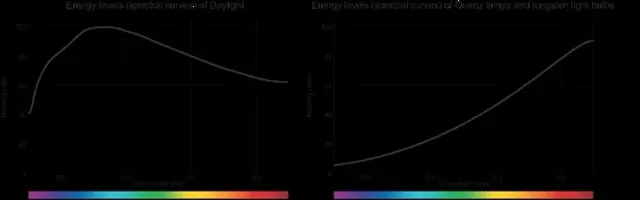
On the left, daylight produces approximately equal energy across the visible spectrum. Quartz and tungsten lamps on the right, have lower energy at the blue end of the spectrum, but more in the infrared, which is why tungsten lamps get hot. While there are significant differences in color, both daylight and tungsten are smoothly distributed across the visible spectrum, no peaks and valleys. Now compare that daylight and tungsten spectra to other modern light sources.
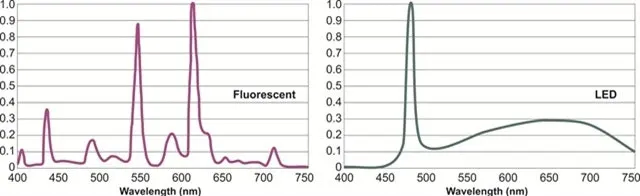
There is little similarity between fluorescent (left) and an LED (right). The vicious blue spike on many LEDs has raised serious medical concern as to potential damage to human eyesight. Little wonder that cameras have trouble reproducing certain colors under different light sources.
Now, let's look at color reproduction accuracy in photography.
Reproducing color accurately in scenes illuminated by different types of lighting and photographed by cameras having different sensitivity characteristics is a challenge; these graphs illustrate the problem.
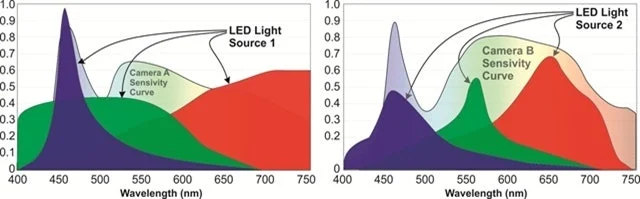
Let's look at two images of the same car. The first image shows the car as green. In the second, the car is blue.
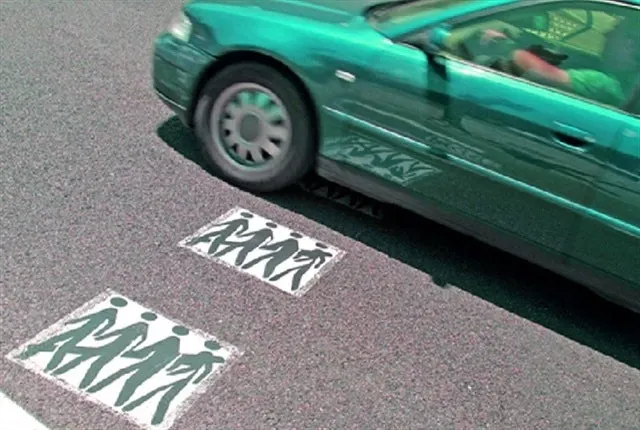
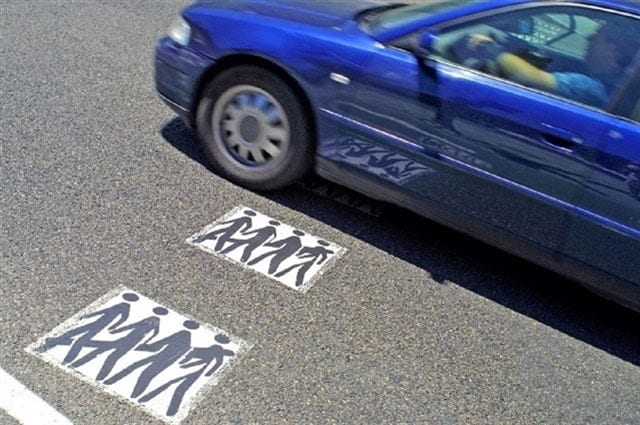
DSC Labs has technology that can color-correct an image even after an event and could have told us that the car was, in reality, blue.
Unlike motion picture and TV production, a police officer has no control of lighting when his or her body camera captures an incident. This is one of the reasons why it is imperative to select cameras that provide the most accurate image reproduction under a wide variety of conditions.
The question is: How can police departments select the best cameras for their missions?
They need to first decide which of the dozens of body-worn cameras have the desired basic features such as mounting position, camera controls, and evidence management software. Once that is determined, they should obtain samples of the most likely candidates and test them identically, under real world environments.
The tests should compare the following image quality concerns:
* Color reproduction accuracy.
* Camera sensitivity. It is critical that BWCs produce usable images under a wide variety of lighting conditions. Sometimes an officer is in bright sunlight, other times in a dark alleyway.
* Field of view. Generally speaking, the wider the field of view the greater the distortion and lower the resolution. This is one of the biggest misconceptions in selecting a BWC. Given the same pixel count, because the pixels are spread more thinly, a 140-degree camera will have half the resolution of a 70-degree camera.
* Image distortion. Suspects and details have to be easily discernible in a video. Without high-resolution images and fine detail, video can be useless as evidence. And police officers are not camera tripods; they move, particularly when chasing a suspect. Consequently, we need image stabilization to contend with two sets of movement, the suspect and the officer.


The second image in this set shows the benefits of image stabilization for evidentiary video.
How do you test all these different parameters identically in different cameras?
DSC invited me out to see how it’s done. The company has 50 years of experience making precision image control systems for international corporations such as the British Broadcasting Corporation, Canon, the Canadian Broadcasting Corporation, the CTV Television Network, NASA, the National Oceanographic and Atmospheric Administration, Panasonic, Sony, and others. And the company showed me its patented $325,000 camera test facility in its home office. The facility called TACT (Totally Automated Camera Testing) helps users select the best camera for any application.
TACT uses a combination of stationary and moving test patterns along with an animated figure called "Humanoid Harry" to provide what I believe is the most comprehensive camera workout ever devised. Each camera receives identical tests under four different types of lighting: daylight, tungsten, LED, and fluorescent.
TACT lets police departments and others interested in accurate image reproduction find out before it’s too late that the system they plan to use would not be adequate for their operations.
TACT is simple, effective, and totally confidential. Law enforcement agencies send DSC samples of the camera makes and models they would like evaluated. Within a few days of testing the cameras, DSC provides comprehensive reports that evaluate 12 important image quality parameters. Note: A number of camera makers keep samples of their current models at the TACT facility ready for testing.
TACT reports include graphs and images from videos of Humanoid Harry, photographed under daylight, tungsten, LED, and fluorescent light. Each set of graphs compares four cameras under the same light source. With four light sources in total, this produces 16 graphs for each function tested.
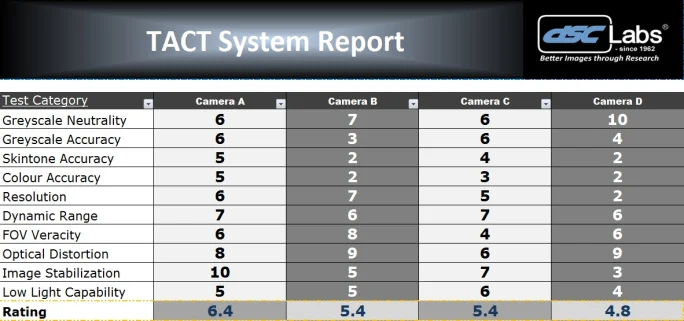
Clients of DSC Labs receive a simple numerical report documenting the results of the TACT analysis.
For the scientifically minded, DSC also provides numerous data graphs from which the numbers above were generated; here are a few sample images and graphs.
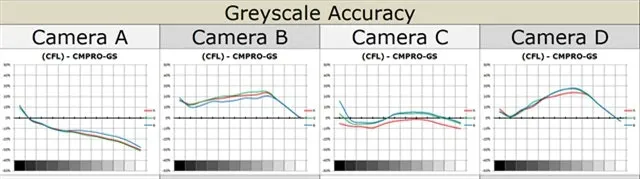
These graphs are easy to read. Above the line is too bright and below is too dark; a trace from a theoretically perfect camera would fall on the line.
These reports let you select the camera with the features you value most. In the example above, camera A is basically too dark particularly in the lighter tones; Camera D is excellent at white and black levels, but too light in the mid tones.
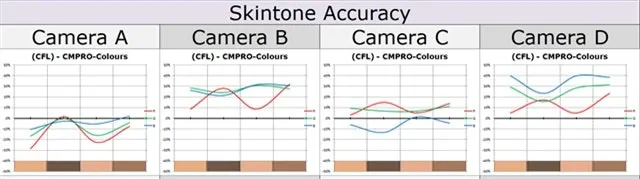
Of the skin tones Camera A is reproducing the dark African skin tone best (2nd segment) and Camera C reproduces light Asian best (3rd segment). Camera D’s reproduction of light Asian is very bad (4th segment, too light and too green/blue).
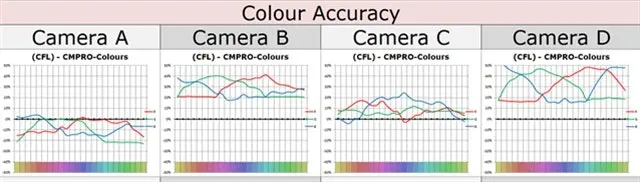
DSC insists on confidentiality and uses non-disclosure agreements to protect everyone’s interests, from police departments to camera manufacturers.
TACT Side Benefit—Spending millions of dollars of taxpayer money is a big responsibility for any agency. By providing unbiased data, TACT gives clients confidence they are making the right decision.
High Quality BWC images need backup. Image control does not end at the camera. It is important that we select and align monitors, projectors, and printers to establish the scientific veracity of the images we present in a court of law. DSC has a complete set of tools called “Scene2Screen” that can be used for this purpose.
More Blog Posts
Preventing Heat Injury in Police K-9s
In the relentless heat of summer and even early fall in some parts of the country, officers face the important task of protecting their K-9 partners while working in sweltering temperatures. Recognizing changes in a dog’s behavior is the key.
Read More →
Why Your Agency Needs to Attend the ILEETA Conference
ILEETA is a complete resource for trainers to address trainers' needs. Its mission is to enhance the skills and safety of criminal justice practitioners while fostering stronger and safer communities.
Read More →
IACP 2023: New Training Products
Technologies for improving law enforcement training and training management were some of the highlights at this year's show.
Read More →
Initial Results Released from MSP 2024 Police Vehicle Testing
The 2024 pursuit-rated vehicles--all pickup trucks or SUVs, including two battery electric models the Chevrolet Blazer EV AWD and Ford Mustang Mach-E--were put through their paces.
Read More →
Officer Safety Considerations Related to Alternative-Fuel Vehicles
As more alternative-fuel and hybrid vehicles hit the road, police and other first responders need to understand that they are no more dangerous than conventional vehicles. However, there are certain safety considerations every cop should know.
Read More →
Garmont Working to Grow LE Market Presence
Garmont Tactical has found wide acceptance by military boot buyers, but now the company is trying to better respond to the needs of police officers. Many cops now are not fans of 8-inch boots, so Garmont is adapting.
Read More →
Publisher’s Note: Our Commitment to You
Through our magazine and website and our Police Technology eXchange event, we promise to provide you with information and access to resources to help you do your job safer and better.
Read More →
10 Tips for Responding to Mental Health Crisis Calls
The Harris County Sheriff's Office is a model for other agencies that want to learn about crisis intervention and mental health crisis response. Sgt. Jose Gomez shares the story of their programs and provides 10 tips for mental health crisis call response
Read More →
5 Things to Know When Buying Concealed-Carry or Off-Duty Holsters
Mike Barham, of Galco Holsters, shares five important considerations to keep in mind when you buy off-duty concealed or plain-clothes carry holsters.
Read More →
10 Tips for Reviewing Use-of-Force Reports
While the burden of accurately reporting use-of-force situations is on an individual deputy or officer, the person reviewing those reports shares in the responsibility of making sure the reporting is done properly, with clear details included.
Read More →