



10 Tips for Crisis Communications
“I've handled a lot of big incidents in my time and in the 12 years before I came to Boulder, there was nothing like the King Soopers shooting. Everything is permanently etched in my mind,” says Dionne Waugh, Boulder Police Department public information officer.

Public information officers balance answering requests from media while also informing the community following critical incidents.
PHOTO: Dionne Waugh/POLICE Illustration
Wrangling the media and informing the community following a critical incident can pose challenges for police. Dionne Waugh, public information officer for the Boulder Police Department (CO) knows that well. She had managed communications for other critical incidents previously in her career, but none that rose to the level of the March 2021 mass shooting at King Soopers, a local grocery store in the Table Mesa community of Boulder.
Waugh says she drew on lessons she had learned through other PIOs, trainings, and conferences, to get her through managing the crisis communications process following the mass shooting that included a duty death. Among the 10 victims lost that day was Officer Eric Talley, one of her friends and one of the first people she met when she took on the PIO role in Boulder.
The City of Boulder has a large communications team, but Waugh is imbedded at the police department as PIO. She assumed the role in November 2020 and previously had worked for the Jefferson County Sheriff’s Office (CO) and the Richmond Police Department (VA). Prior to those public safety communications roles Waugh worked as a reporter covering varied topics, including crime and public safety.
“I've handled a lot of big incidents in my time and in the 12 years before I came to Boulder there was nothing like the King Soopers shooting. Everything is permanently etched in my mind,” Waugh says.
It had snowed a little that morning and Waugh had decided to work from home. A tone came through on her phone indicating a major incident had occurred.
“I just basically flew to the scene,” she says. “One of the best things was the city communications team, that I'm a part of, and the region has a PIO group that I've been a part of since I moved to Colorado eight years ago. Basically because of those two things, from a communications perspective, I was able to rely on those networks to help me manage the crush of inquiries that were coming in and the amount of workload that was required instantly and for many, many days and weeks after that.”
An example of how that broader city team helped is how someone at parks and recreation managed the police department Instagram content in the days following the mass shooting. Boulder at that time had about 26 full-time, part-time, and contract communications employees. The city has recently hired a crisis communications manager that will serve as both as a manager and a backup PIO for Waugh.
Even though she had others from the city’s communications team that could assist, Waugh says she also needed other law enforcement PIOs to help with law enforcement specific things. She says they knew what to anticipate and they knew how to help her with law enforcement inquiries.
She explains that is where the regional PIO group came into play. One PIO from another agency, who is a friend and colleague of Waugh, even beat her to the scene the day of the shooting because she was closer.
“She was there by my chief’s side until I got there. Then she was by my side nonstop for the first 12 days,” Waugh explains.
“I got to the scene probably within 30 to 45 minutes after the first tones went out. I left around midnight that night, and then just came back probably around between 4 and 5 a.m. because I went home, I laid in bed for two hours, couldn't sleep, took a shower, got dressed and came right back in because there was so much to do and there was going to be no sleep,” she adds.
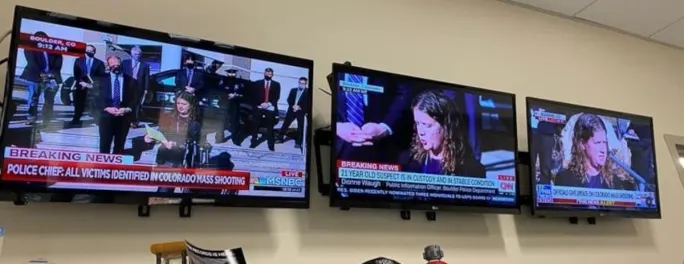
Dionne Waugh, Boulder Police Department PIO, is shown on multiple channels during media coverage following the 2021 mass shooting.
PHOTO: Dionne Waugh
As the story developed and reporters looked for daily reports, east coast media would start calling around 2 a.m. Boulder time, then progressively throughout the day more would call and request information. Basically, she says they were receiving media requests from nearly every time zone around the world. Some media interactions went well, some did not.
“I had, without a doubt, the worst experiences of my career with some reporters both nationally and locally during the incident, but I had others that have renewed my faith in the profession. Our goals aren't always the same with incidents like this, and I recognize that they have their priorities as journalists. I have my priorities, representing the police department and trying to get information to the community,” Waugh says.
As far as social media, Boulder mostly relied on Twitter following the mass shooting. Waugh says her department primarily uses Twitter, Instagram, Next Door, and Facebook, but is considering Reddit because Boulder has a very young community and a very large college community. The City of Boulder also has a YouTube channel.
“Twitter was the fastest way to get information out. It was a way to reach both the community and also the media we needed to reach. So, we focused on Twitter and then we made sure we live streamed everything because I wanted everybody to come to the City of Boulder for information and not have to rely on different media outlets for their facts,” says Waugh. “The first day we live streamed through Twitter and then by the second day we got it through the city's YouTube.”
On that tragic day of the King Scoopers shooting, Waugh drew on what she had learned along the way from others in similar roles. Now, she shares what she learned with other PIOs to help them be better prepared for similar critical incidents with a convergence of media attention, both local and national, and balancing the need to communicate with the community.
Her 10 tips for managing crisis communications are:
1. Don’t Answer Your Phone
It may sound contrary to all things communications, but in the height of a crisis, everyone and their sister station will be calling you for information. Only answer the phone if you know who’s calling and it will help you get the most important information out ASAP.
2. Know Your Priorities
Depending on the incident there will be multiple things that need to happen, and they almost always need to happen quickly. As the lead communicator you need to prioritize those tasks and juggle everything else until you can address each one. That means knowing what can hold and what can’t and for how long.
3. Build Relationships Before Something Happens
A crisis is no time to try and figure out who’s in charge of something at another department and what their phone number is (see Number 1). It’s also one of the worst possible times to get to know someone when they don’t have time to really talk to you or get to know you and see how you can work together. Make the time for that coffee or lunch to get to know your counterparts at other agencies or throughout your jurisdiction. It’s much easier to know who you can count on in a crisis when you know who you’re talking to.
4. Have A Plan/Strategy/Tabletop
One of the best ways to build those relationships is to tabletop. Yes, everyone is busy, but making the time to come together to walk through possible scenarios helps build those relationships and helps everyone see the types of questions that come up during an incident and identify who best can address them. It often also leads to strategies being created for crisis to help guide everyone.
5. Words Matter
It might sound obvious but using specific language when explaining situations affects everyone differently. Many of us have stopped using the word “accident” for example, rather than crash when describing vehicle collisions because the word means different things to different people.
6. Tone Matters Too
Even if you say it with the “right words,” if your tone doesn’t come across as sincere, it won’t matter. The famous saying goes that people might not remember exactly what you said, but they’ll never forget how you made them feel. Striking the right tone, especially in the right moment of heightened emotion, will do that.
7. A Second Set of Eyes/Non-Police Eyes
Always, always, always, have at least one other person read something before you put it out publicly. Whether it’s going out on social media, a news release or talking points, having a second set of eyes that hasn’t been staring at the screen trying to get it just right, is always helpful. If you have the time, it’s also helpful to have another perspective from outside of your agency or policing to see how it’s interpreted.
8. It’s Always Better to Be Accurate Rather Than First
In a crisis, everyone wants the information, and many want to be the first to share it. Police departments are not immune from this. But if you’re the lead agency and you put it out first and you are wrong, it’s a hard road to walk it back and maintain credibility. As hard as it is, take the time to make sure you have it right before you share it publicly.
9. Find Time to Take Care of Yourself
When I first started as a PIO 14 years ago, little was said about taking care of yourself during a crisis. Whether you were on the scene, reading the graphic reports, or interacting directly with victims, everyone at an agency is affected by a crisis in some form, and everyone—civilian and commissioned—needs to take care of themselves by processing their experience.
10. Reflect Afterward
After-action reports are a great way to debrief what worked and what didn’t and how you can do better next time. This is the time to delve into the details after the crisis has cooled and you have the time. It makes everyone better at their job and helps prepare others who weren’t a part of the crisis by giving them such perspectives.
More Blog Posts
Preventing Heat Injury in Police K-9s
In the relentless heat of summer and even early fall in some parts of the country, officers face the important task of protecting their K-9 partners while working in sweltering temperatures. Recognizing changes in a dog’s behavior is the key.
Read More →
Why Your Agency Needs to Attend the ILEETA Conference
ILEETA is a complete resource for trainers to address trainers' needs. Its mission is to enhance the skills and safety of criminal justice practitioners while fostering stronger and safer communities.
Read More →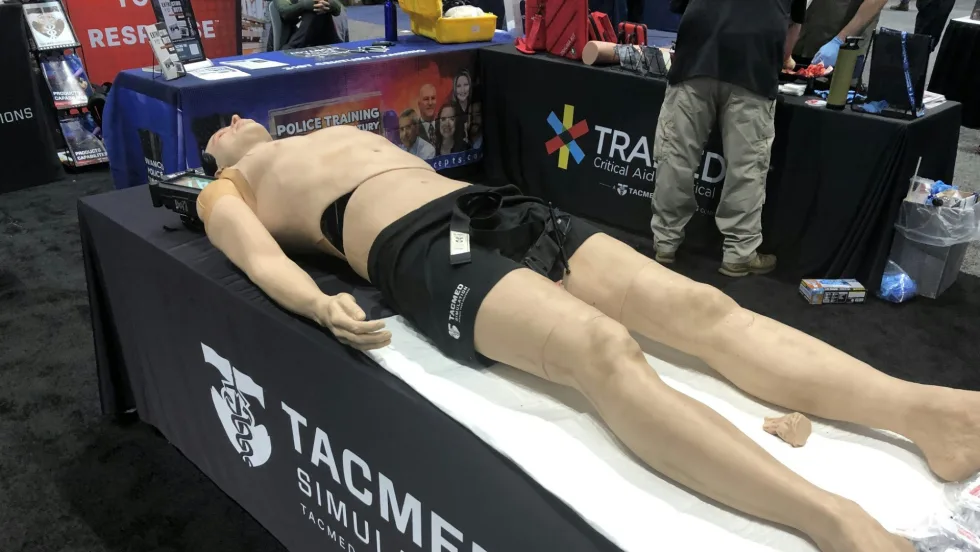
IACP 2023: New Training Products
Technologies for improving law enforcement training and training management were some of the highlights at this year's show.
Read More →
Initial Results Released from MSP 2024 Police Vehicle Testing
The 2024 pursuit-rated vehicles--all pickup trucks or SUVs, including two battery electric models the Chevrolet Blazer EV AWD and Ford Mustang Mach-E--were put through their paces.
Read More →
Officer Safety Considerations Related to Alternative-Fuel Vehicles
As more alternative-fuel and hybrid vehicles hit the road, police and other first responders need to understand that they are no more dangerous than conventional vehicles. However, there are certain safety considerations every cop should know.
Read More →
Garmont Working to Grow LE Market Presence
Garmont Tactical has found wide acceptance by military boot buyers, but now the company is trying to better respond to the needs of police officers. Many cops now are not fans of 8-inch boots, so Garmont is adapting.
Read More →
Publisher’s Note: Our Commitment to You
Through our magazine and website and our Police Technology eXchange event, we promise to provide you with information and access to resources to help you do your job safer and better.
Read More →
10 Tips for Responding to Mental Health Crisis Calls
The Harris County Sheriff's Office is a model for other agencies that want to learn about crisis intervention and mental health crisis response. Sgt. Jose Gomez shares the story of their programs and provides 10 tips for mental health crisis call response
Read More →
5 Things to Know When Buying Concealed-Carry or Off-Duty Holsters
Mike Barham, of Galco Holsters, shares five important considerations to keep in mind when you buy off-duty concealed or plain-clothes carry holsters.
Read More →
10 Tips for Reviewing Use-of-Force Reports
While the burden of accurately reporting use-of-force situations is on an individual deputy or officer, the person reviewing those reports shares in the responsibility of making sure the reporting is done properly, with clear details included.
Read More →