



Why You Should Double Check for Accuracy
Although law enforcement officers are given considerable leeway for reasonable mistakes, you don't get much slack for unreasonable mistakes that result from hasty reactions to bad information that comes from your own official sources.

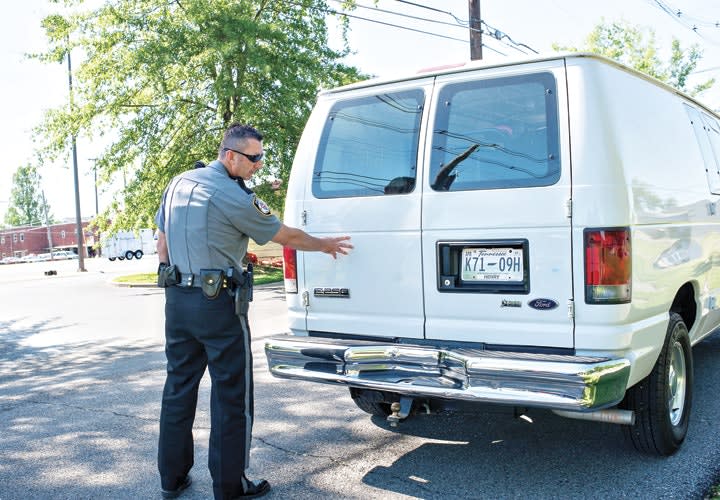
Photo: Mark W. Clark
People make mistakes. Computers make mistakes. Although law enforcement officers are given considerable leeway for reasonable mistakes, you don't get much slack for unreasonable mistakes that result from hasty reactions to bad information that comes from your own official sources. Two recent civil liability decisions illustrate the kind of trouble you can create for yourself when you fail to double check the accuracy of reports, especially when there's reason to question whether you've got the facts straight.
Tolan V. Cotton
A patrol officerwatched two men get out of an SUV that had just parked in front of a residence. The officer ran the plate, but instead of the correct number 696BGK, he keyed in the incorrect number 695BGK. This number came back to a stolen vehicle of a similar description, so the officer ordered the two men to the ground at gunpoint, accusing them of having stolen the SUV. They both complied and lay down, but one of the men, Robert Tolan, protested that the vehicle was not stolen, and that he lived at the house.
Hearing the commotion, Tolan's parents came out in pajamas and assured officers that the SUV was the family vehicle and was not stolen. A sergeant ordered Mrs. Tolan to stand against the garage door, and when she expressed surprise, he escorted her to the door, injuring her slightly. Seeing this, Tolan rose to his knees and yelled at officers to leave his mother alone, whereupon the sergeant fired three rounds at Tolan, collapsing his right lung and piercing his liver.
Tolan and his parents and companion filed a federal civil rights lawsuit against the sergeant for excessive force. The lower courts granted the sergeant summary judgment, dismissing the civil case against him, and the plaintiffs appealed to the U.S. Supreme Court.
The Supreme Court unanimously reversed the summary judgment ruling and reinstated the lawsuit. Considering the facts alleged by the plaintiffs in their complaint, the court concluded that the lower courts had erred in granting summary judgment, and the case was remanded for further proceedings.
It isn't difficult to imagine how a plaintiff's attorney would characterize this case to a jury: "Ladies and gentlemen, this entire incident could have been avoided if the officer had not entered the wrong plate number into his computer. Everything that happened here happened because of police carelessness and over-reaction.
"When my client was confronted with the officer's order to lie down, he immediately complied. He told the officer the SUV was not stolen. But did the officer bother to double check that he had the right license plate number? He did not. When the parents came out and told the officers they had made a mistake, did the officers then double check the accuracy of their information? They did not. They just ordered an unarmed housewife up against the garage door, and when she didn't move fast enough to suit them, they manhandled her.
"If you're an innocent young man falsely accused of auto theft and you see a policeman manhandling your mother, would you rise up and yell in your mother's defense? Which of us wouldn't? And did that shout from a caring son justify the police sergeant in pointing his gun and firing three times at an unarmed young man on his knees in the dirt, sending bullets through his lung and his liver? When no force is even necessary, any force is excessive force. And using deadly force when there's no immediate threat to officers' safety or public safety is always excessive force.
"These officers compounded their own license plate error by making more errors in judgment. None of this need have happened, if the officers had just taken one minute to double check the plate number once they were told the SUV wasn't stolen. They could have done it very easily and very quickly. But they didn't bother. I guess it's easier just to pull out a gun and shoot somebody."
Of course, there are two sides to any story, and a jury may find after listening to the officers' testimony that the use of force was fully justified. The problem is that they have to overcome the fact that the starting point for this unfortunate series of events was a police error that went unchecked, even after an issue was raised about the accuracy of officers' suspicions. When you're being sued in federal court, you don't want to start out in a hole dug by your own carelessness.
Green V. San Francisco
Exactly one weekafter the Supreme Court's decision in Tolan v. Cotton, the U.S. Court of Appeals for the Ninth Circuit handed down a similar ruling in a similar case. Denise Green was driving alone in her Lexus when an automated license plate reader mistakenly alerted officers that her car was stolen. In fact, the ALPR had misread the plate number; the vehicle to which the other plate belonged was a GMC truck. Because the ALPR occasionally gives false "hits," officers are trained to double check before making a stop.
Unfortunately, it didn't appear that any of the officers involved in Green's felony stop took the step of visually verifying the plate number and running it for a match, even though one officer followed directly behind her in traffic and was briefly stopped behind her at a red light. Green was stopped and ordered out at gunpoint. Though she was an unresisting 47-year-old woman, she was ordered to the ground and cuffed while several officers pointed guns at her. She was detained for up to 20 minutes before being released.
Green sued the city and the officers for illegal detention, false arrest, and excessive force. The district court granted summary judgment to the city and the officers, and Green appealed. The Ninth Circuit reversed and remanded the case for jury trial.
The court said that "A rational jury could conclude that it was unreasonable for the officer to fail to double check the plate number," in which case the stop would be unjustifiable. The use of guns and cuffs on a person who did not appear to be armed or resisting, made no attempt to flee, promptly complied with officers' directives, and was not suspected of a crime of violence, could constitute excessive force and create a de facto arrest which, absent probable cause, would also be unlawful.
Control, Then Verify
Situation permitting, it's a good idea to double check "stolen" and "wanted" reports before acting upon them. And even though crooks often lie and proclaim their innocence, if nothing in the suspect's appearance or demeanor heightens your suspicions, it's also a good idea to double check whenever a cooperative suspect gives a plausible denial upon detention.
Something as "routine" as a traffic stop can unexpectedly turn deadly for police officers, who must never take their safety for granted. But once control is established and no immediate threats appear, taking a minute to double check the accuracy of the information that provoked your actions can be good insurance for you, especially when the circumstances raise a question about whether a mistake may have been made.
Devallis Rutledge is a former police officer and veteran prosecutor who currently serves as special counsel to the Los Angeles County district attorney. He is the author of 12 books, including "Investigative Constitutional Law."
More Patrol

Streamlight Portable Scene Light III Wins 2026 OH&S New Product of the Year Award
Streamlight’s Portable Scene Light III has won the 2026 Occupational Health & Safety (OH&S) New Product of the Year Award in the Lighting category.
Read More →
Adept Armor Introduces Two New Rifle Plates
Adept Armor has launched two new Level IV ballistic plates, the Emperor and the Archon Mark 2, which brings Adept Armor’s new Quatroid ceramic to the high-threat, performance-value center of the range at 5.2 pounds.
Read More →
POLICE Product Test: Benchmade Bailout
The Benchmade Bailout is a slim, lightweight carry knife with a deep-ride pocket clip and comes in a variety of blade steels and scales. Here is a detailed review of the Taiga Green Bailout, released earlier this year.
Read More →
NLEOMF Announces July 2026 Officer of the Month
NLEOMF honored a Michigan deputy sheriff as the July 2026 Officer of the Month for rescuing a trapped driver from a burning vehicle following a Fourth of July crash.
Read More →
Streamlight to Showcase Newest Lighting Products at National Safety Council’s Safety Congress & Expo 2026
Streamlight will showcase its latest lights, including the Portable Scene Light III and the LiteBox 1Million, at the 2026 National Safety Council (NSC) Safety Congress & Expo.
Read More →
The 2027 World Police & Fire Games Set for Perth, Australia
The 2027 World Police & Fire Games (WPFG) will take place in Perth, Western Australia, from Friday, March 12 through Sunday, March 21, 2027.
Read More →
5.11 Partners with National Fallen Firefighters Foundation to Support #ForThe343
5.11 has joined the nationwide movement honoring the 343 New York City Fire Department firefighters lost on Sept. 11, 2001.
Read More →
Team Wendy Announces Title Sponsorship of the Jorge Pastore Foundation
Team Wendy’s 3-year partnership with the Jorge Pastore Foundation expands access to programs that strengthen those who serve.
Read More →
National Law Enforcement Memorial and Museum Hosting 9/11 25th-Year Commemoration Ceremony
The National Law Enforcement Memorial and Museum is hosting a 9/11 25th Year Commemoration Ceremony on Sept. 11 at 4 p.m.
Read More →
National Law Enforcement Officers Memorial Fund Announces June 2026 Officers of the Month
The National Law Enforcement Officers Memorial Fund (NLEOMF) named 15 officers of the Chico Police Department (California) as the Officers of the Month for June 2026 for their roles in responding to an active-shooter incident at a public library.
Read More →